
'%20id='ico-down'%20stroke='%23000000'%20stroke-width='1.5'%3e%3cg%20transform='translate(1092.250000,%20254.750000)'%3e%3cpolyline%20id='Path-2-Copy-4'%20transform='translate(5.500000,%202.750000)%20scale(1,%20-1)%20rotate(-180.000000)%20translate(-5.500000,%20-2.750000)%20'%20points='0%200%205.5%205.5%2011%200'%3e%3c/polyline%3e%3c/g%3e%3c/g%3e%3c/g%3e%3c/svg%3e)


Moving
Visas & Immigration
How to immigrate to Luxembourg: visas in 2026
Discover all you need to know about Luxembourg immigration, including the types of visas on offer, the application process, costs, and more.


Luxembourg is a multilingual country that allows many nationalities to visit visa-free for short stays. However, not all countries are exempt, and if you stay for longer than 90 days or want to live, study, or work in Luxembourg, you’ll need a visa too.
Discover everything you need to know about the immigration process in Luxembourg by looking at the following topics:
lingoking
Do you need help translating documents? Make sure all your legal proceedings go smoothly by using lingoking for all your translation needs. Whichever papers you need translated, lingoking's network of professional translators can help. Order online 24/7 and take some of the stress out of your legal procedure.

Immigration in Luxembourg
Luxembourg is a great place to live for several reasons. It has excellent public transport, beautiful castles and sightseeing opportunities, and a multicultural community, to name a few. It’s no wonder that there are so many internationals in the country. Expats made up 47.4% of the country’s population in 2023.

Luxembourg is also well-known as a multilingual country with three official languages: Luxembourgish, French, and German. A 2018 Ministry of National Education study showed that 80% can speak English, 98% French, 78% German, and 77% Luxembourgish. So, it’s safe to say that Luxembourg is easy to navigate when it comes to communication.
As well as being a multilingual and diverse nation, Luxembourg is relatively easy to visit, especially if you are from the European Union (EU). The country forms part of the Schengen Area guaranteeing free movement to all EU citizens.
For non-EU citizens, ease of access into the country varies by nationality or citizenship. Luxembourg allows people from some countries to visit without a visa, providing they have valid IDs and passports, such as Austria, Belgium, Italy, the United Kingdom (UK), and Japan. However, some countries (e.g., Qatar, Saudi Arabia, and South Africa) will require a visa.
Wise
Are you an expat or thinking of moving to Luxembourg? Managing your money across borders shouldn’t be complicated. With a Wise account, you can hold over 40 currencies and pay with a Wise debit card in more than 150 countries. Whether you’re using spending abroad, receiving or sending money home, Wise can help make international money management simpler.
Who needs a Luxembourg visa?
EU/EFTA nationals
For a stay of 90 days or less, EU or EFTA citizens (i.e., Iceland, Liechtenstein, Norway, and Switzerland) do not need a visa to enter the country, only a passport or national identity card. This goes for work and leisure travel. EFTA stands for European Free Trade Association.
If you want to extend your stay beyond the 90 days, you must make a declaration of arrival at you local commune, within eight days of your arrival and complete a registration certificate within three months. However, your family members would not need to complete the authorization to stay.
As part of the registration, you need to provide the following documentation:
- Proof of employment or business permit, or registration with an educational institution
- Proof of sufficient funds to avoid dependency on the social welfare system
- Proof of health insurance depending on your type of application
You may also need to supply proof of health insurance, depending on your type of application.
Non-EU/EFTA nationals
If you are visiting for less than 90 days and are not a citizen of the EU or EFTA countries (i.e., a third-country national) you may require a visa depending on your citizenship. The Luxembourg government lists all the countries exempt from visas and the ones needing permits.

Regardless of visa requirements, within eight days of entering the country, you must make a declaration of arrival at the commune of your new temporary residence or fill out an accommodation form where you stay. You must also have a passport – valid for more than three months from the start date of your travels – and valid health insurance. If you wish to work during that time, you need to apply for a work visa at the Immigration Directorate (Department for Foreigners).
Because of Brexit, as a British citizen, you will be treated as an non-EU entrant. However, if your visit is 90 days or less, you do not need an entry visa because Luxembourg is a Schengen Member State.
Long-stay visas for non-EU nationals
As a third-country national, immigration to Luxembourg requires you to apply for temporary authorization to stay, followed by request for a visa if your citizenship requires one. Applying for the authorization to stay will fall under one of the following activities, which will affect the procedures involved:
- Salaried worker (employee)
- Self-employed worker (independent)
- Highly qualified worker
- Researcher
- Athlete
- Student
- Pupil
- Private reasons
- Au pair
- Salaried worker posted by a company established outside the EU
- Trainee
Once in Luxembourg, a declaration of arrival and a medical check is required. You must then apply for a residence permit. These documents must be in English, German, or French or officially translated by a sworn translator, like lingoking.
What types of visas are available in Luxembourg?
There are two main types of Schengen area visas for Luxembourg:
- Short-stay visas (type C): valid for up to 90 days within any 180 days
- Long-stay visas (type D): for stays lasting longer than 90 days
There is also a transit visa (type A), which allows the holder to only pass through the international zone in airports and does not permit entry into the country.
Short-stay immigration visas for Luxembourg
Short-stay visas for Luxembourg are available for the following activities:
- Tourist or family visits
- Business trips (e.g., visiting professional partners, negotiating, and concluding contracts)
- Participating in conferences (conference speakers and university lecturers), exhibitions, fairs, or shows
- Participating in the board of directors’ meetings and general meetings
- Providing services within the same business group
- Cultural and sports activities

There are no short-term visas for working in Luxembourg. If you require a permit to enter Luxembourg and wish to work in the country, you will need to apply for a long-term visa.
How to apply for a short-stay visa for Luxembourg
To apply for a short-stay visa, you will need to make the application at least 15 days prior to your visit, but no longer than six months before the intended travel dates. You can do this at a Luxembourg diplomatic or consular mission, honorary consulate, or embassy.
When making your application, you will need to have the following documents prepared:
- Identity photos
- A passport valid for at least three months longer than the expiry date of the visa
- Supporting documents (which vary by the purpose of visit)
- Proof of sufficient funds (e.g., a bank account statement)
- Proof of residence in your current country
- Health insurance valid for your entire stay in Luxembourg
The supporting documents for Luxembourg immigration will vary based on the purpose of your visit. This could include the following:
- An invitation for business meetings or networking event
- A return ticket
- A hotel reservation
In some cases, proof of sufficient funds can be replaced by a financial statement of support from a referee or guarantor in Luxembourg. This requires official procedures to be carried out by the guarantor, and the document provided is only valid for six months.
You will receive the result of your application within 15 calendar days of submission. However, it may be extended to 30 or 45 calendar days in exceptional circumstances or when additional documentation is required.
The short-stay visa can only be extended in cases where the visa holder cannot leave Luxembourg due to force majeure (unforeseeable circumstances) or for humanitarian reasons.
Those applying for a Type A (transit) visa will have to provide much of the same documentation.
Long-stay visas for Luxembourg
Long-stay visas for Luxembourg are available for the following purposes, and the application procedures vary by intended visit.

These purposes can include the following categories.
Work-related:
- Salaried worker (employee)
- Self-employed worker (independent)
- Highly qualified worker
- Researcher
- Athlete
- Au pair
- Salaried worker posted by a company established outside the EU
- Trainee
Education-related:
- Student
- Pupil in the primary or secondary education system
Family and other:
- Family of EU/EFTA nationals
- Family of third-country citizens
- Personal reasons
This type of long-stay visa is valid for 90 days or more, with a maximum of one year.
Long-stay visa requirements for Luxembourg
Although procedures will vary by category when applying for a long-stay visa for immigration to Luxembourg, all applicants must obtain temporary authorization to stay. You can apply at the Immigration Directorate. Only family members of EU citizens are exempt.
Within 90 days of receiving the authorization, you must apply for your visa at a Luxembourg diplomatic or consular mission, or honorary consulate.
When making your application, you will need to have the following documents prepared:
- Identity photos
- A passport valid for at least three months longer than the expiry date of the visa
- Document stating temporary authorization to stay
- Other documents as per visa category requirements
Work visas for Luxembourg
When moving to Luxembourg for long-term work, as mentioned above, you will need to first apply for temporary authorization to stay.
To do so, you have to provide the following documents:
- Passport copy (in its entirety)
- Criminal record or an affidavit
- A curriculum vitae (CV)
- A copy of your diploma or professional qualifications
- A copy of the employment contract, dated and signed by both the applicant and future Luxembourg employer
- Original copy of the certificate from the National Employment Agency (L’Agence pour le développement de l’emploi – ADEM) granting the employer the right to hire a third-country national
Application and requirements for work visas in Luxembourg
Temporary authorization to stay is required for anyone who wishes to work in Luxembourg regardless of visa requirements and can take a maximum of four months to receive. It is valid for 90 days. During that time, you need to apply for your visa (if required), or enter Luxembourg and declare your arrival.
Once in Luxembourg, you must make a declaration of arrival within three days of arriving, presenting your travel documents and proof of address.
If you are a third-country national, you must visit a doctor for a medical check at your own expense.
Finally, you need to apply for a residence permit through the Immigration Directorate within three months of arriving in Luxembourg. To do so, you will complete a form and supply the following documents:
- Passport copy (in its entirety)
- Copy of the temporary authorization to stay
- Copy of the declaration of arrival
- Proof of address
- Proof of payment of the application fee
You can renew your residence permit if you can prove that you have worked for the duration of the initial visa.
Note that the above information is specific to salaried workers.
There are slight variations in the documentation required depending on the type of work you are doing. You can check the specific requirements for other visa work categories for third-country nationals on Luxembourg’s official immigration website.
It is also possible for a highly qualified worker to get an EU blue card, a special residence permit with particular requirements.
Student visas for Luxembourg
If you are enrolled in a higher education establishment in Luxembourg with the aim of receiving a degree or diploma from that institution, you can apply for a student visa.
Application and requirements for Luxembourg student visa
A student visa involves the same processes as applying for a work visa in Luxembourg, including receiving authorization to stay, making a declaration of arrival, having a medical check, and an applying for a residence permit.
The main differences between the two, however, are the documents required for the application process, such as:
- Passport copy (in its entirety)
- Criminal record or an affidavit
- Copy of residence permit issued in another EU Member State if you already reside in the Schengen area
- Proof of enrollment in a higher education establishment in Luxembourg
- Proof of sufficient funds for living expenses and travel costs amounting to at least 80% of the current social inclusion income (e.g., certificate of scholarship or student loan, or bank statement for the past six months)
- Parental consent if the student is under 18
- Proof of health or travel insurance
For younger school pupils, there are different requirements.
Luxembourg family visas
If you are immigrating to Luxembourg to join a family member, you have to proof your relation to the EU citizen already living in Luxembourg:
- Spouse
- Registered partner
- Direct descendant (children under 21) of the EU citizen or their spouse
- Direct ascendant (parents) if they are under the care of the EU citizen or their partner
- Other dependent family members
- Proven non-registered partner (via cohabitation or common-law union)

For this process, you would receive a short-stay visa of 90 days but would then apply for a residence permit on arrival that would grant you longer-term residency.
You only need a passport and visa (if required for the Schengen area) to enter Luxembourg for family reasons. You do not need authorization to stay.
Luxembourg family visa: requirements and how to apply
Depending on your relationship with the EU citizen, the required documents and processes differ to obtain a visa for immigration to Luxembourg. Still, in all cases, a valid passport and proof of the relationship are required to apply. For example, for a couple, this could be a certificate of marriage or proof of cohabitation and for a descendent a birth certificate. The Luxembourg government lists a few examples of what constitutes evidence of relationships.
Once in Luxembourg, you would apply for a family member residence permit within three months of arrival. If you do not hold a Type D visa for family reunification purposes, you will be required to submit your proof of relationship to obtain the residence permit.
The residence permit can take up to six months to process, but you will receive a copy of your permit application with the same legal status as a residence permit for a maximum of six months.
Once you have received your residence permit, you have the right to partake in paid or unpaid professional activities without prior authorization.
There are also other visa categories with different procedures, such as for personal reasons.
Cost of visa applications in Luxembourg
If you require a visa, there are fees associated with the application process.
The standard fees are:
- Airport transit visa (Type A) – €90
- Short stay visa (Type C) – €90
- Long stay visa (Type D) – €50
However, if you fall into one of the following categories, you do not need to pay the visa fee:
- Children under six years of age
- Pupils, students, and teachers on educational trips
- Third-country researchers visiting for scientific studies
- Those under 25 participating in seminars or events as a representative of a non-profit organization
- Family members of an EU national
- Specific categories of nationals of Moldova, Ukraine, Serbia, Montenegro, Bosnia-Herzegovina, Albania, Georgia, the Republic of North Macedonia, Armenia, Azerbaijan, and Cape Verde
There is also a reduced fee for nationals from the same countries mentioned above, and for children between the ages of six and twelve.
Luxembourg residence and citizenship
EU and EFTA nationals
As mentioned before, EU and EFTA nationals do not need a residence permit for immigration to Luxembourg for more than 90 days. However, there is still a due process.

To live in Luxembourg for longer than the short-stay period of 90 days, one of the following must apply to you:
- Be working as a salaried employee or are self-employed
- Have sufficient resources or funds to ensure you and your family members are not dependent on the social welfare system and hold medical insurance
- Registered with an approved public or private education institution in Luxembourg with the intent to complete an educational or training course. In this case, you must also prove sufficient funds and hold medical insurance.
You must then declare your arrival within eight days of landing in Luxembourg and fill in a registration certificate within three months of arrival.
After five years of uninterrupted residency in Luxembourg (i.e., fewer than six months of absence per year unless there are exceptional circumstances), you can apply for permanent residency (certificat de résidence permanente) from the Immigration Directorate.
Non-EU nationals
For long-term or permanent immigration to Luxembourg, non-EU nationals must follow the procedures for a long-stay visa and temporary authorization to stay, as covered in the sections above. After five years of uninterrupted residency, you can apply for long-term residence status through the Immigration Directorate.
This residency is not permanent but lasts five years and should be renewed within two months of its expiry date. Third-country nationals who are family members of an EU national can apply for a permanent residence permit that lasts 10 years.
After five years of permanent residency in Luxembourg, regardless of your nationality, you can apply for Luxembourg citizenship through naturalization. This process is available to adults (over 18) who fit the following criteria:
- Have legally resided in Luxembourg for at least five years
- Have knowledge of the Luxembourgish language, which requires proof in the form of a language test (Sproochentest)
- Have taken the Vivre ensemble au Grand-Duché de Luxembourg (Living together in the Grand Duchy of Luxembourg) course or passed the test that covers the same topics
The applicant must also be of ‘good repute,’ and have a clean criminal record.
The naturalization procedure does not cost anything, but there may be associated expenses costs with the documents and processes required for the application. Various documents are required when applying, such as a passport, birth certificate, and criminal record. The Nationality Office of the Ministry of Justice (Service de la nationalité luxembourgeoise) reviews all applications and can take up to eight months to reach a verdict.
Asylum seekers and refugees in Luxembourg
As part of the 1951 Geneva Convention, Luxembourg follows the Dublin Regulation for handling international protection claims for refugees.
In 2023, there were 2,615 applications for asylum. By April 2022, Luxembourg had taken in around 5,000 refugees from Ukraine.
Asylum applications can be made with one of the following institutions:
- The Ministry of Foreign and European Affairs (Direction de l’Immigration, Service des réfugiés – MAEE)
- The control service (Service de contrôle) at the airport
- The Grand-Ducal Police
- The detention center where the refugee temporary resides
- The state prison where the refugee has been placed
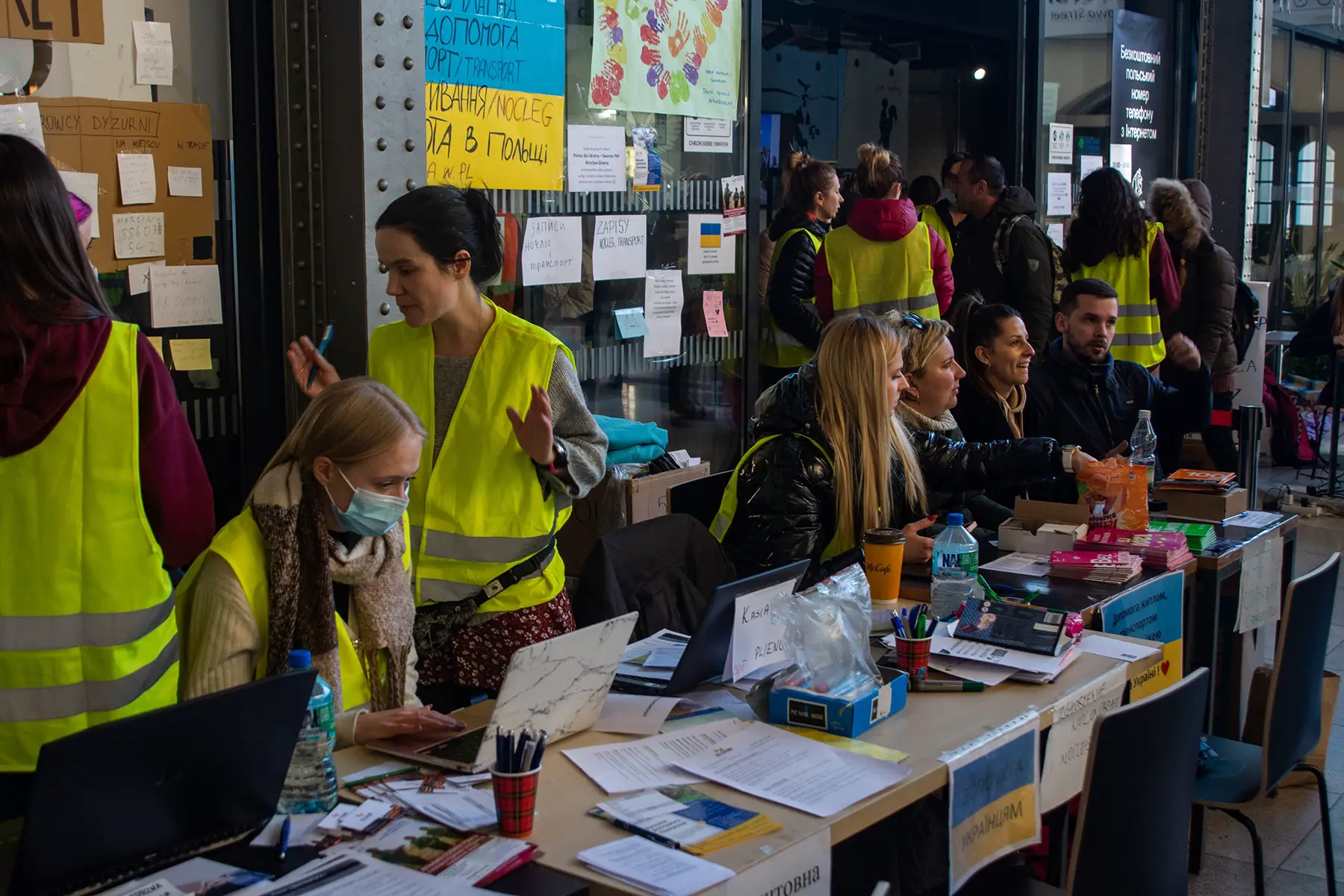
When entering Luxembourg, the applicant will need to make a declaration of arrival within eight days of landing and undergo a medical check. Identity documents and forms are required, and immigration authorities may interview the applicant. In that case, an interpreter and lawyer can be present.
It can take up to six months to reach a verdict. During that time, the applicant receives a pink document or papier rose, which allows residence in Luxembourg. The document is valid only for one month, and must be renewed monthly.
If granted international protection status, you will receive a residence permit valid for five years. In some cases, such as with Ukrainian refugees, the Luxembourg government or European Union may choose to implement temporary protection status for a large influx of people.
Useful resources
- Guichet.lu – a public information portal about procedures and services
- Ministry of Foreign and European Affairs (MAEE) – official immigration information, including a list of Luxembourg embassies
- Schengen Calculator – a tool for calculating remaining travel days under a Schengen short-stay visa
- Your Europe – information and directory for procedures and rights for EU citizens



Did you find this guide helpful?