
'%20id='ico-down'%20stroke='%23000000'%20stroke-width='1.5'%3e%3cg%20transform='translate(1092.250000,%20254.750000)'%3e%3cpolyline%20id='Path-2-Copy-4'%20transform='translate(5.500000,%202.750000)%20scale(1,%20-1)%20rotate(-180.000000)%20translate(-5.500000,%20-2.750000)%20'%20points='0%200%205.5%205.5%2011%200'%3e%3c/polyline%3e%3c/g%3e%3c/g%3e%3c/g%3e%3c/svg%3e)


Finance
Taxes
Taxes in Spain for expats: residency, rates, and filing
Moving to another country and trying to make sense of the tax system can be a challenge. Spain is no different in this regard, so it’s important to understand your obligations as quickly as possible.

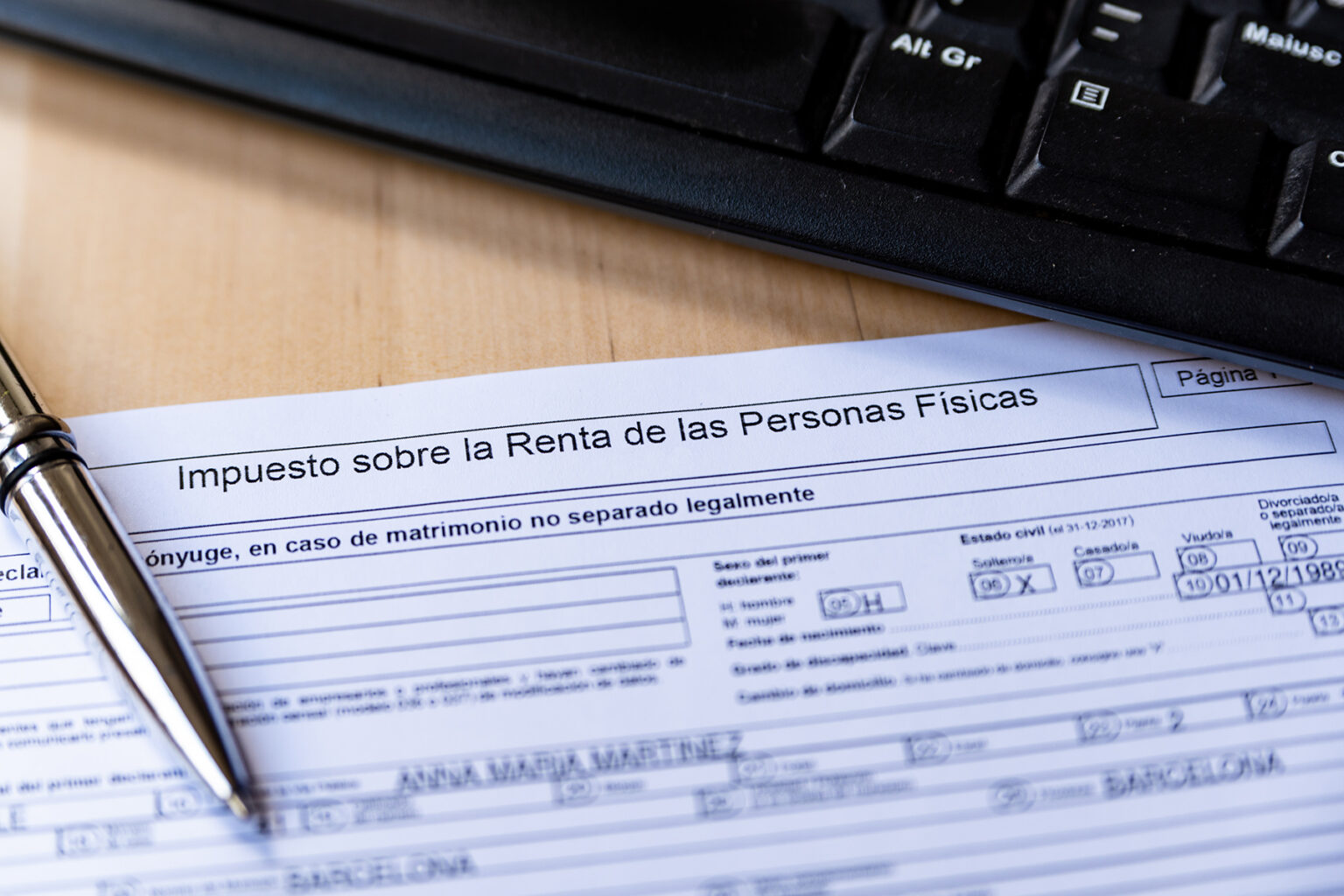
You need to establish if you’re a Spanish tax resident first. If you are, then Spain will generally look at your worldwide income under its personal income-tax rules. If you aren’t, you may still have Spanish tax obligations on income or property connected to Spain. Your days in the country, where your economic interests are based, your family situation, and whether you have income or assets abroad can all affect what you need to declare.
Key takeaways
- Tax residency comes first: You may become a Spanish tax resident if you spend more than 183 days in Spain, keep your main economic interests there, or have close family who habitually live there.
- Residents and non-residents are taxed differently: Residents are generally taxed on worldwide income, while non-residents are usually taxed only on Spanish-source income.
- Filing season is usually spring: The main resident filing season usually runs from April to June, but dates can change each year.
- Forms matter: Modelo 100, Modelo 210, and Modelo 720 are three of the main forms expats should check.
- The biggest trap is oversimplifying: Residency, foreign income, regional taxes, and reporting duties can overlap.
Who counts as a tax resident in Spain?
For most readers, Spanish tax residency starts with the 183-day rule. If you’re in Spain for more than 183 days in a calendar year, including sporadic absences unless you prove residence elsewhere, Spain may treat you as resident for the full year.
Spain can also look at your center of economic interests. In practice, that means the main base of your work, business, or income-producing activity sits in Spain.
There’s also a family presumption. If your spouse who isn’t legally separated and your dependent minor children habitually live in Spain, the tax office may presume you’re resident unless you show otherwise.
| Status | Tax base | Next check |
| Resident | Worldwide income | IRPF, Modelo 100, foreign income or asset duties |
| Non-resident | Spanish-source income | IRNR, Modelo 210, source rules |
Example: a remote worker who spends seven months in Valencia and works there for an overseas employer would generally meet the 183-day test.
Insider Tip: You should keep a travel log with tickets, rental contracts, and padrón records. This is important because Schengen travel may not leave clear passport stamps.
Which taxes in Spain do expats most often need to check?
You don’t need to know about every single Spanish tax. Most expats only need to identify the taxes tied to their residency, income type, property, and larger asset positions.
| Tax or duty | Who it affects | Common trigger | Timing | What to check |
| IRPF | Residents | Salary, freelance, pension, savings, rental income | Annual | Residency, allowances, regional rates |
| IRNR | Non-residents | Spanish-source income or property | Varies | Source rules, form, deadline |
| IBI and property taxes | Owners | Owning Spanish property | Local or transaction-based | Municipality, valor catastral, local rules |
| Wealth tax | Higher net worth readers | Net wealth above the relevant threshold | Annual | Regional rules and allowances |
| Inheritance and gift tax | Heirs and recipients | Receiving property or money | When triggered | Region and relationship |
Employment, self-employed, pension, and savings income
For residents, most personal taxation sits inside IRPF, Impuesto sobre la Renta de las Personas Físicas, Spain’s personal income tax. Salary, freelance profits, pensions, and investment returns can all appear on the same return, but they’re not all taxed in the same bucket.
General income and savings income use different rate structures. Non-residents usually fall under IRNR, Impuesto sobre la Renta de no Residentes, which follows different rules and usually offers fewer deductions.
A salaried employee may mostly review withholding. A freelancer may need advance payments and expense records, while a retiree may need to check how a foreign pension is treated. Expatica’s salary tax calculator, freelancer tax guide, and social security pages help when income isn’t just salary.
Property, wealth, and inheritance taxes
Homeowners often first meet IBI, Impuesto sobre Bienes Inmuebles, a local property tax based on the valor catastral, or cadastral value, not market price. Selling property can also trigger capital gains tax and local land value tax.
Wealth tax and inheritance or gift tax in Spain can change sharply by comunidad autónoma, or autonomous community. Madrid, Catalonia, and Andalusia may not land on the same result, so higher net worth readers and inheritors should check local rules and Expatica’s guide to inheritance tax in Spain.
How do expats file a tax return in Spain?
Filing is easiest as a sequence. First confirm whether you’re a resident or non-resident, then gather records and login details, and finally submit and pay through the right route.
Key forms, deadlines, and documents to check
For most residents, the main annual filing season falls between April and June, but the Agencia Tributaria, Spain’s tax agency, or AEAT, confirms the exact calendar each year. The standard resident return is usually Modelo 100.
Some non-residents use Modelo 210 for Spanish-source income or property. Modelo 720 Spain is different because it’s an information return that some residents may need if qualifying foreign assets exceed the threshold in one or more categories.
Many readers file through Renta Web, AEAT’s online service, using Cl@ve, Spain’s digital identity system, a certificate, or another approved login. Make sure your NIE numbers in Spain are in order, and use Expatica’s guide on filing income tax in Spain in 2026 if you want the step-by-step process.
To prepare, you should collect:
- Your NIE and tax address
- Employment, pension, freelance, and savings statements
- Foreign income records and evidence of tax paid abroad
- Proof of deductible expenses or contributions
- Bank account details for payment or refund

Author
Jason Loewenthal
Insider Tip
You shouldn’t assume the borrador contains every item you need to report. Make sure you review it against your own records, particularly for foreign income, investments and other information that may not be complete or may require additional reporting.
How to pay, and when to get help
When tax is due, payment is commonly made online through AEAT or through approved bank-based methods. Direct debit cut-offs can fall earlier than the final filing deadline, so you shouldn’t assume the last day to file is also the last day to set payment up.
A simple return with one salary may be manageable alone. Once you have foreign income, self-employment, major capital gains, or treaty questions, a tax adviser or gestor who regularly handles Spanish tax filings usually makes more sense.
Managing money from abroad
If you need to move money in from abroad to cover a Spanish tax bill, a Wise account can help you hold euros alongside other currencies and see the conversion costs before you convert them.
Wise account
Are you an expat or thinking of moving to Spain? Managing your money across borders shouldn’t be complicated. With a Wise account, you can hold over 40 currencies and pay with a Wise debit card in more than 150 countries. Whether you need to spend abroad, receive or send money home, Wise can help make international money management simpler.

How do double taxation and special expat rules affect you?
A tax treaty doesn’t usually mean you have nothing to file in Spain. Double taxation relief can change the final tax bill without removing filing or reporting duties.
Tax treaties and foreign income
Spain has double taxation treaties with many countries, but the result depends on the income type, your residency status, and the treaty article involved. Salary, pensions, dividends, rental income, and capital gains can all work differently.
Before assuming foreign income is covered, check where it’s sourced and whether Spain still wants it declared. Then look at whether a credit, exemption, or extra reporting duty applies.
Example only: a retiree with a foreign private pension may face a different outcome from a landlord with overseas rental income. If your case mixes several countries or income types, broad summaries are rarely enough.
Beckham Law and foreign asset reporting
Beckham Law, officially Spain’s special impatriates regime, can let some eligible inbound workers use taxation closer to non-resident rules for a limited period. Some teleworkers and certain professionals may also qualify, but deadlines and trade-offs matter, which is why Expatica’s guide to Beckham Law in Spain is worth checking before you choose a route.
Modelo 720 Spain is different. It’s not a tax bill by itself, but an information return that can apply to some Spanish tax residents with qualifying foreign accounts, securities, insurance, or real estate above the reporting threshold by category.
FAQ
Frequently asked questions about taxes in Spain for expats
Do expats pay tax on foreign income in Spain? 
Spanish tax residents are generally taxed on worldwide income, so income earned abroad may still need to be declared in Spain. Non-residents are usually taxed only on Spanish-source income, although treaties and reporting rules can still affect what must be declared.
Do I need to file Modelo 720 in Spain?
Some Spanish tax residents with qualifying foreign assets above the reporting threshold may need to file Modelo 720 in Spain. Check the categories separately, because foreign accounts, securities or insurance, and real estate aren’t tested as one big combined total.
What happens if I miss the Spanish tax deadline?
If you miss the Spanish tax deadline, surcharges and interest may apply, and your position can worsen if the tax office contacts you first. Deal with it quickly rather than waiting, because voluntary correction is usually better than silence.
Useful resources
- Agencia Tributaria home Official site for filing, deadlines, and online services.
- AEAT Personal Income Tax (IRPF) Resident income tax information and Renta Web access.
- AEAT non-residents section Non-resident obligations and procedures.
- AEAT taxpayer calendar Current filing periods and deadlines.
- AEAT list of double taxation treaties signed by Spain Treaty list by country.
- AEAT guidance on the special impatriates regime Official Beckham Law style guidance.
- Spanish National Police NIE related procedures and context.
- Ministry of the Interior of Spain Official identity and administrative references.
Related Articles


Editor's picks
 Top 10 Spanish foods – with recipesWhat better way to explore Spain than with your tastebuds? From tasty tapas to delicious dishes, here are the best Spanish foods.
 International schools in SpainWant to send your child(ren) to an international school in Spain? Find out everything you need to know about fees, exams, and more.
 Guide to getting health insurance in Spain in 2026Find out whether you need private health insurance in Spain in 2026, with insider info on costs, coverage, and medical professionals.
Did you find this guide helpful?