
'%20id='ico-down'%20stroke='%23000000'%20stroke-width='1.5'%3e%3cg%20transform='translate(1092.250000,%20254.750000)'%3e%3cpolyline%20id='Path-2-Copy-4'%20transform='translate(5.500000,%202.750000)%20scale(1,%20-1)%20rotate(-180.000000)%20translate(-5.500000,%20-2.750000)%20'%20points='0%200%205.5%205.5%2011%200'%3e%3c/polyline%3e%3c/g%3e%3c/g%3e%3c/g%3e%3c/svg%3e)


Education
Language Learning
Introduction to Dutch: the Netherlands’ official language
With its many dialects, unexpected sounds, and tricky grammar rules, the Dutch language has more to it than meets the eye (or ear).


You’ll be forgiven for thinking that people in Holland – formally known as the Netherlands – speak Hollandish or Netherlandish. After all, it makes sense to name the language after the country. England speaks English, China speaks Chinese, Germany speaks German.
So, why is the Netherlands’ official language called Dutch?
Learn more about the language, its origins, dialects, and its place within the world of communication. We’ll also explore basic grammar rules, pronunciation, and the difficulty setting when you are an expat.
Let’s dive in:
Talencoach
Albert Both is also known as Mr. Dutch Brainwash, from his (in)famous Dutch-language teaching method. Talencoach offers different language course packages, from the seven-day immersive Brainwash class to the higher level Dutch Mastery – as well as individual sessions.

What languages are spoken in the Netherlands?
Not many people know that the Kingdom of the Netherlands actually consists of four countries (yes, like the UK) – the Netherlands, Aruba, Curaçao, and Sint Maarten. In all four countries, Dutch is the official language, along with:
- English on Curaçao, Sint Maarten, and the special municipalities of Saba and Sint Eustatius
- Frisian (Fries) in the province of Friesland
- Papiamento or Papiamentu (Papiaments) 0n Aruba and Curaçao
The Dutch government also recognizes several minority languages, including Dutch Sign Language, Yiddisch, Limburgish, Low Saxon, and Romani. These have protected status, meaning the government cannot restrict and, in some cases, must even promote the use of these languages.

Depending upon where you choose to live in the Netherlands, you may only ever hear one of the official languages on the street or in your local supermarket. You may also hear all of them (or more).
According to the Dutch Language Association, around 17 million people in the country speak Dutch. There are also roughly 440,000 people who speak Frisian and 400,000 who speak Papiamento or Papiamentu. Meanwhile, about 90–95% of the population in the Netherlands is able to have a conversation in English.

Dutch Sign Language in the Netherlands
The Netherlands is home to an estimated 1.5 million people who are deaf or hard of hearing. Of those, roughly 10,000 people have Dutch Sign Language (Nederlandse Gebarentaal – NGT) as their mother tongue. Another 50,000 people speak it as a second language, including interpreters, teachers, and researchers.
Interestingly, NGT has at least five different regional variants, based on the school it’s taught in. Accents include Gronings, Amsterdams, Voorburgs, Rotterdams, and Sint Michielsgestels.
The Netherlands officially recognized NGT as a minority language on 1 July 2021. This obliges the government to encourage the use of the language in society, for example, by providing NGT translations on public broadcasts.
What other countries speak Dutch?
Dutch is spoken by around 24 million people worldwide (although the Netherlands accounts for most of these speakers). It’s also an official language in Belgium, along with French and German.

Thanks to the Netherlands’ seafaring history (i.e., colonialism), Dutch is also spoken in the Dutch Caribbean – Aruba, Bonaire, Curaçao, Saba, Sint Maarten, and Sint Eustatius – and Suriname.
Although Indonesia no longer officially recognizes it (and few Indonesians actually speak it), many legal government documents still exist in the Dutch East Indies language. Meanwhile, parts of Namibia and South Africa speak Afrikaans, a daughter language based on 17th-century Dutch.
If you’re living abroad and want to learn Dutch, there are several schools and universities you could go to. For example, bachelor degree courses are offered in France, Germany, Hungary, Indonesia, New Zealand, South Africa, and the United States.
Origins and history of the Dutch language
Dutch vs Holland vs the Netherlands
So, why is the language called Dutch and not Hollandish or Netherlandish?
The word “Dutch” goes back to the Proto-Germanic word *þiudisk (meaning “popular” or “of the people”). This was used to refer to the language spoken by the common folk (as opposed to French, which was spoken by the aristocrats, or Latin, which was used by the clergy). *Þiudisk gradually became *thuusk, duutsc, and dietch. From there, Dutch – and Deutsch! – wasn’t a giant leap.
However, this doesn’t explain why the Netherlands isn’t called Dutchland or something. Well, although the language was called Dutch, the region wasn’t its own country. Instead, it was just a province of the Carolingian Empire.
The Dutch called the forested area near the coast (now North and South Holland) holt lant – which later became Holland. The area that is now the Netherlands was referred to as ‘low lands’ or ‘low lying country’, so literally nether lands.
How did Dutch evolve as a language?
Dutch is a Germanic, Indo-European language. It’s related to Old English and German, and has influences of (modern) English, French, Latin, and Yiddish.
The spoken language emerged around 850, or possibly even earlier. Of course, there wasn’t a single uniform language yet: the regional dialects were so different that their speakers could hardly understand each other (if at all). There also wasn’t a general written language – everyone who could write, wrote in Latin.

The oldest written record of Dutch dates back to the 11th century, when a monk wrote down the now immortal words: “Hebban olla vogala nestas hagunnan hinase hic enda thu wat unbidan we nu.” This roughly translates to: “All birds have begun nests, except me and you. What are we waiting for now?”
As the country began to form (ca. 1300s to 1500s), the dialects became more linked to each other. The proper standardization of Dutch – and the start of the language as we know it today – came about with the Protestant reformation and the invention of the printing press. This allowed the first Dutch State Bible to appear in 1637.
Modern Dutch in the Netherlands
In the centuries that followed, the country had an influx of immigrants and trade and, of course, foreign languages. Dutch was influenced by French, German, Indonesian, and Yiddish. Students of history will know that Napoleon Bonaparte and his brother Lodewijk Napoleon also made an appearance, throwing more French in the mix. Last names were also invented, but that’s a story for another time.
In the 20th century, Dutch grammar rapidly simplified. For example, the difference between masculine and feminine nouns disappeared (though this did make it more difficult to know when to use de or het). The language also gained new words from English, Moroccan, and Turkish.
Nowadays, young people of Moroccan descent are the greatest source of language innovation with their contribution to the Dutch rap scene.
What’s Dutch pronunciation and phonology like?
Dutch language pronunciation has a mix of familiar and unique sounds, making it both approachable and tricky for new learners. While it shares some similarities with English and German, Dutch also has distinctive sounds, including vowel combinations, guttural consonants, and syllabic stress.
Dutch is known for its hard G (/ɣ/), a sound often described as a throaty growl. It also has diphthongs like ui (/œy/), ij (/ɛi/), and eu (/øː/), which don’t have direct English equivalents. Stress is generally placed on the first syllable of a word, though exceptions exist, especially in loanwords.

Another notable feature of the language is the way in which speech flows. Dutch-speakers tend to link their words, creating fluid, connected phrases that can be tricky to decipher at first. For example, “ik weet het niet” (I don’t know) becomes “kweenie” and “in principe” (basically or in essence) becomes “inpsiepe.”

Mr. Dutch Brainwash
Albert Both from Talencoach
Insider tip
Dutch, in itself, isn’t a difficult language. It’s very close to English and more similar than, for example, German… And much easier as well! You could call Dutch German light.
Do Dutch people have different dialects?
While Dutch is mostly pronounced the same in standardized speech (Algemeen Beschaafd Nederlands – ABN), this doesn’t apply to dialects and regional accents. Because yes, even in a country as small as the Netherlands, there are hundreds (if not thousands) of different dialects.
For example, depending where you are, the word schaap (one sheep) may be pronounced schaap, schaep, schoap, schoop, schiep, scheep, or scheup. Zeven (seven) is another contentious word – pronounced san, sivve, seuven, zeven, zeuve(n), zeum, and zeu’m.
Then, things can have its own regional name, of course. A butterfly is a vlinder, but also a barbulet, flikketeer, kapel, kapelka, pannevogel, snuffel, uil, and zomervogel.

Broadly speaking, the Netherlands has the following dialect groups:
| Dialect group | Spoken in the province(s) or regions |
| Brabantian-Franconian (Brabants-Frankisch) | Brabant and parts of Gelderland and Limburg |
| Hollandic-Franconian (Hollands-Frankisch) | North-Holland, South-Holland, Utrecht, and parts of Friesland |
| Limburgish (Limburgs) | Limburg |
| Low Saxon (Nedersaksisch) | Groningen, Drenthe, and parts of Friesland and Gelderland |
| Non-continental Dutch | Suriname and the Dutch Caribbean |
| West Flemish and Zeelandic (West-Vlaams en Zeeuws) | Zeeland |
This means that, if you live in Groningen or Leeuwarden, you’ll hear completely different sounds and pronunciations than if you live in Amsterdam or Maastricht. And if someone has a very thick accent, you may have to ask them multiple times to repeat what they’re saying.
You can hear examples of some Dutch accents and dialects in this video.
What are the most important grammar rules?
Dutch grammar follows a pretty logical structure but has some unique language rules that can be difficult for new learners. Here are some of the most important ones to know:
Basic grammar rules
Definite articles: de and het
Dutch has two definite articles (de) and (het), both meaning ‘the’. Which article applies to which noun depends on its linguistic gender. For example, languages are female, so it’s “het Nederlands” (the Dutch language). Types of fruit, on the other hand, are male, so it’s “de appel” (the apple).
This is where it gets tricky: there’s no easy rule to predict which gender the noun has, so they must be memorized. That said:
- diminutive words (nouns ending in je, sje, tje, pje, etc) are always het
- plural nouns (e.g., apples, chairs) are always de

Adjective endings depend on the article
When a noun has an adjective, the ending will depend on the article. De has an -e ending and het does not:
- de grote hond (the big dog)
- het grote huis (the big house)
- een groot huis (a big house) → (no -e after een with het-words)
Adjectives always precede the noun, so it’s “de gele bakstenen weg” (the yellow brick road).
Word order
Speaking of word order, basic sentences start with a subject and a verb:
- ik loop (I walk)
- hij reist (he travels)
From there, you can add other stuff to the sentence. For example, direct objects follow verbs and indirect objects follow direct objects:
- zij plant de bloemen (she plants the flowers)
- zij plant bloemen met een schep (she plants flowers with a schovel)
If you’re also using an adverb, it follows the verb it modifies:
- ik schrijf veel (I write a lot)
- hij koopt altijd brood bij de bakker (he always buys bread from the bakery)
Verbs and tenses
Dutch verbs are either regular (regelmatige werkwoorden) or irregular (onregelmatige werkwoorden). For the present simple, this doesn’t really matter because that tense uses basic language rules:
- ik fiets (I cycle)
- hij/zij fietst (he/she cycles)
- wij/zij/jullie fietsen (we/they/you cycle)

It gets more difficult when you’re using the past tense. For example (past simple):
- Regular verbs end in -de(n)/-te(n) → hij werkte (he worked), zij werkten (they worked)
- Irregular verbs change their vowel → ik zong (I sang), wij zongen (we sang)
Unfortunately for non-native speakers, the language has a lot of irregular verbs. However, there’s no need to learn all of these by heart; the average Dutch speaker won’t mind if you say, for example, “hij zwemde” instead of “hij zwom” (I swam).
Interesting facts about the Dutch language
- Many English words have Dutch origins, including boss (baas), cookie (koekje), coleslaw (koolsla), dike (dijk), gherkin (augurk), iceberg (ijsberg), and landscape (landschap).
- Dutch words often have more than one meaning, for example: alsjeblieft (“here you are” and “please”) and onhandig (“clumsy”, “unhandy”, and “inconvenient”). Lekker (“nice”, “tasty”, “comfy”, “attractive”, etc) can also be used as an adjective or adverb to almost everything.
- Dutch words can be delightfully literal, describing things exactly as they are. For example:
- handschoen (hand shoe), meaning glove
- zeehond (sea dog), meaning seal
- schildpad (shield toad), meaning turtle
- People in the Netherlands use a lot of filler words (gap words) when they speak, like dus, echt, eigenlijk, gewoon, hoor, nou, and tja. A perfectly normal answer is “ja, nou ja, gewoon” (yea, well, just like usual).
- Many Dutch swear words refer to diseases, such as pleuris (pleurisy), pokken (pocks), zenuwen (anxiety), tering (tuberculosis), and tyfus (typhus). Never, under no circumstances – whatever your Dutch friends and acquaintances say – say kanker (cancer); people will have a visceral reaction and you may get attacked physically.
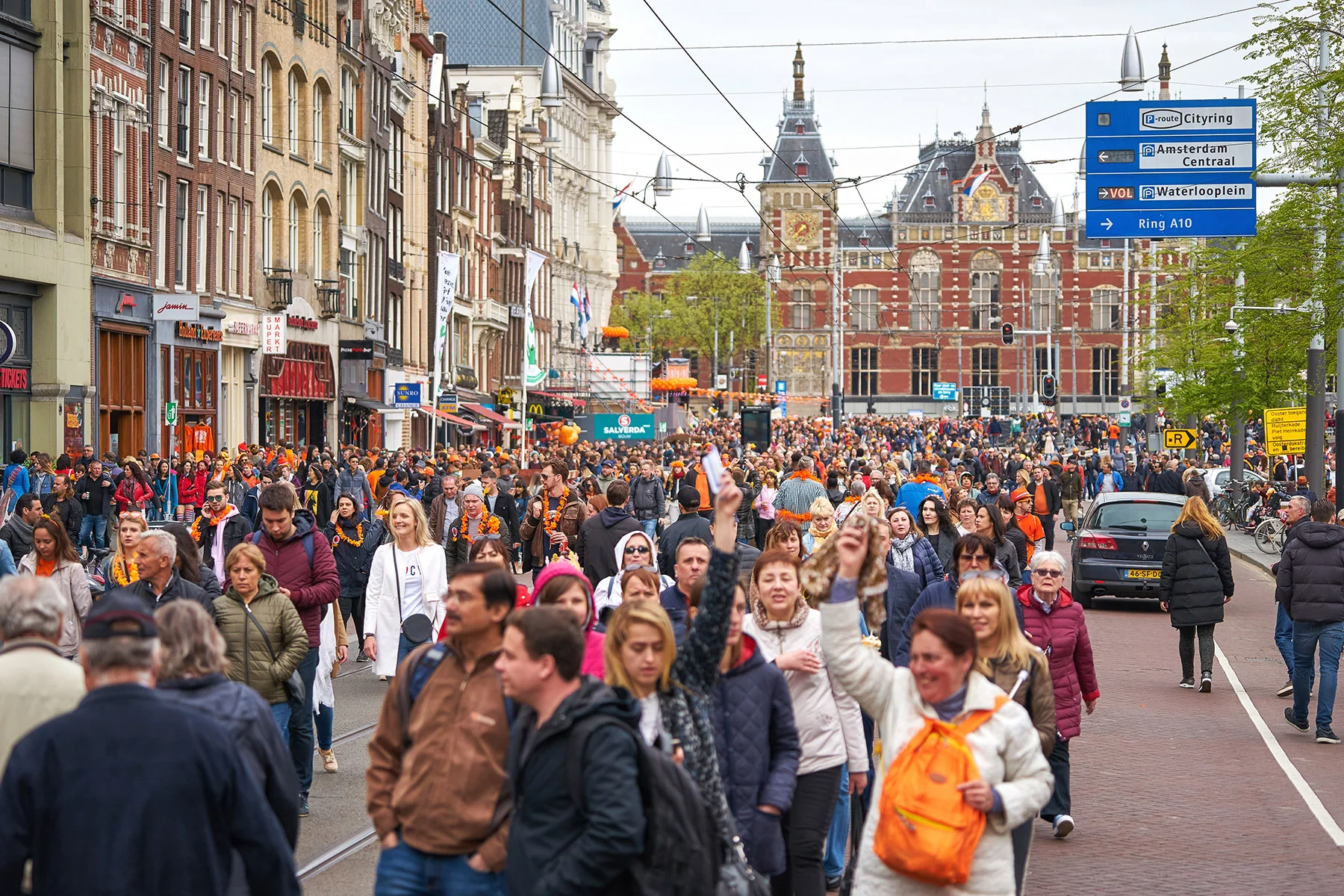
Learning Dutch in the Netherlands
Even though most Dutch people speak English fluently, they love it when you try to speak their language. They’ll often encourage you, even if you make mistakes. And it’s much more gezellig if you do.
One of the simplest ways to learn the Dutch language is to attend a community, university, or language course in your city. Alternatively, consider asking a friend or colleague to be your language partner for daily practice.
The Dutch will try to be courteous and switch to English when they hear you struggle. You can always say “Ik ben aan het oefenen!” (I’m practicing) and they’ll try to help you out.
It’s worth noting, however, that most Dutch people do not know the official grammar rules. They can (and will) tell you when something is (in)correct, but often can’t explain why.

Is Dutch a hard language to learn?
Of course, whether Dutch is hard to learn is subjective to your own language and experiences.
Asian (like Chinese, Japanese, and Korean) and African languages (like Xhosa and isiZulu) are further removed from Dutch, so people from those countries consider the language more foreign than English or German speakers. On the other hand, Asian and African languages can be more complex with their sounds and vocabulary (especially seen from a European/Northern American perspective), so maybe they will find it a breeze.
It’s all relative to what you’re used to.
Mr. Dutch Brainwash
Albert Both from Talencoach
Insider tip
It takes a lot of energy to learn a new language, especially at the beginning. You just have to get out of your comfort zone and learn to relax. The rest will follow.
Useful resources
- Dutchpod 101 – website with information on Dutch language grammar
- Onze Taal – website with information on the Dutch language; grammar, spelling, and more
- MijnWoordenboek – dictionary website where you can look up the different dialects in the Netherlands
- Why You Hate Learning Dutch – free e-book by Talencoach with tips on learning Dutch
Related Articles



Editor's picks
 Secondary schools in the NetherlandsWe explain the complex secondary school system in the Netherlands, including the three public streams and various international options.
 Higher education in the Netherlands: a guide to Dutch universitiesThe Netherlands is home to some of the world's top universities. Learn all about the different subjects available at Dutch institutions.
 Human and civil rights in the NetherlandsFrom the right to protest to protection from discrimination, here's what you need to know about human rights in the Netherlands.
Did you find this guide helpful?