
'%20id='ico-down'%20stroke='%23000000'%20stroke-width='1.5'%3e%3cg%20transform='translate(1092.250000,%20254.750000)'%3e%3cpolyline%20id='Path-2-Copy-4'%20transform='translate(5.500000,%202.750000)%20scale(1,%20-1)%20rotate(-180.000000)%20translate(-5.500000,%20-2.750000)%20'%20points='0%200%205.5%205.5%2011%200'%3e%3c/polyline%3e%3c/g%3e%3c/g%3e%3c/g%3e%3c/svg%3e)


Moving
About Luxembourg
Where to get the news in Luxembourg
Discover the most trusted news sources to stay up to date with breaking news and current events in Luxembourg and around the world.

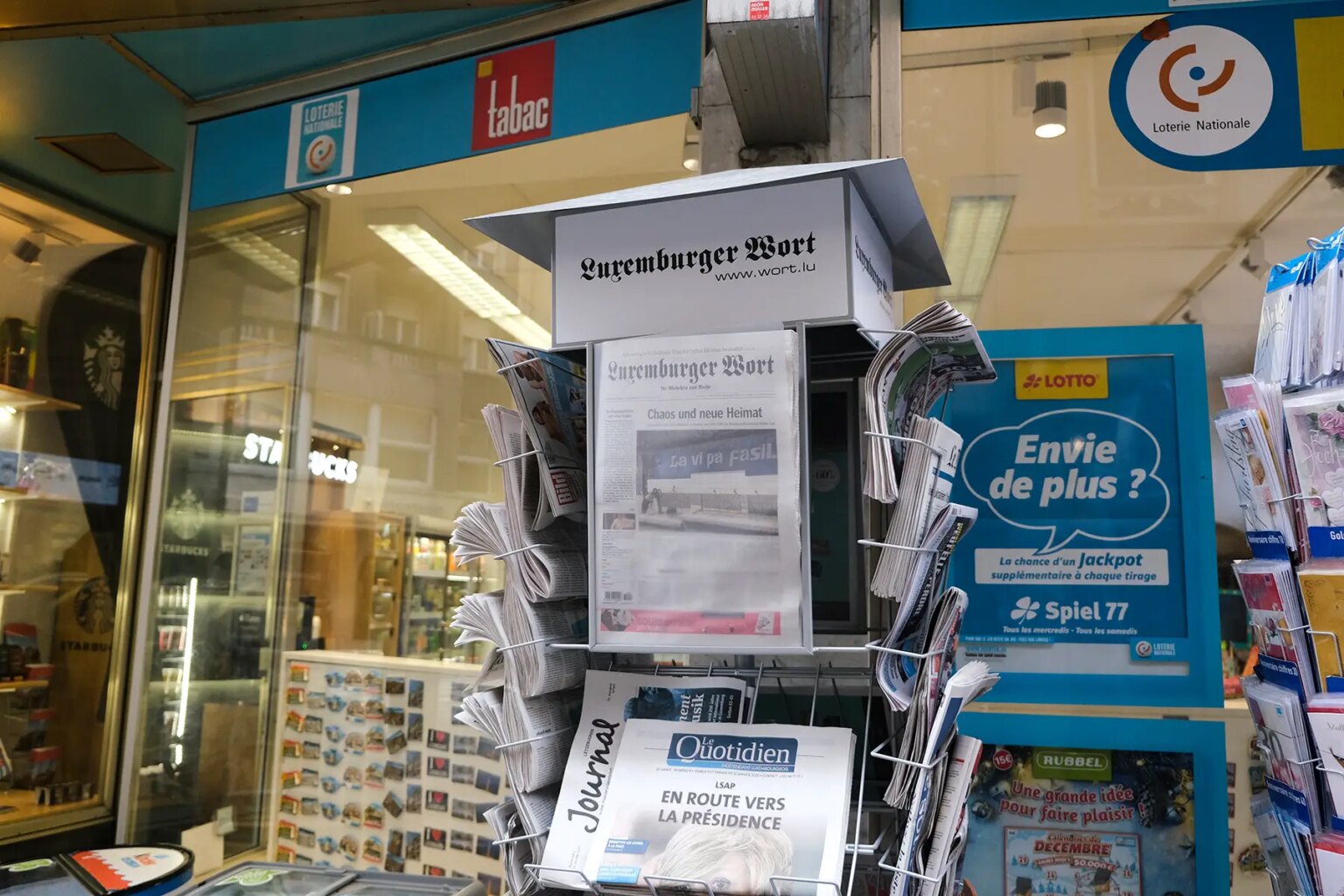
In Luxembourg, keeping up with local and global news (French: actualités, German: nachrichten, Luxembourgish: Noriichten) requires little effort. The multilingual country has plenty of reliable media sources where you can easily access reporting in English, French, German, Luxembourgish, and Portuguese.
Not sure where to start, which news outlets to trust, and which channels to steer clear of? Here’s what you need to know about Luxembourg’s news media across the different media formats. Sections include:
Ground News
Get every side of the story with Ground News, the biggest source for breaking news around the world. This news aggregator lets you compare reporting on the same stories. Use data-driven media bias ratings to uncover political leanings and get the full picture. Stay informed on stories that matter with Ground News.

The news media in Luxembourg
Luxembourg has a more extensive news media landscape than you might expect for such a small country.
Although there are a few different privately owned broadcasters, TV news is largely dominated by public broadcasting (French: audiovisuel public, German: Öffentlich-rechtlicher Rundfunk, Luxembourgish: ëffentlech audiovisuell). The government funds both private and public journalism; in 2021, a law was passed to grant €200,000 per media outlet on the condition of hiring five journalists on permanent contracts.

Unlike elsewhere in the world, the readership of print media is very high in Luxembourg. According to government data, more than two-thirds of the population read one or more newspapers.
Interestingly – and somewhat surprisingly – people have started consuming less online news over the years. In 2019, around 74.5% of the population accessed the news online; this number declined to 66.6% in 2023.
Other data on the weekly audience of news media is unavailable; frustratingly, the Digital News Report by the Reuters Institute does not analyze the press in Luxembourg.
Political bias of the Luxembourg media
Luxembourg’s news media are generally trustworthy and factually accurate. Journalists must follow the Code of Ethics (French: Code de déontologie, German: Ethikkodex, Luxembourgish: Code vun Ethik) from the Press Council (CdP – French: Conseil de Presse, German: Presserats, Luxembourgish: Presserot).
That said, it’s recommended you always double-check your preferred news source for any potential bias. For example, the newspaper and TV and radio broadcaster Privat is the only non-member of the Press Council. The tabloid is known for publishing sensationalist stories and is boycotted by other media outlets in Luxembourg.
Freedom of the press in Luxembourg
Luxembourg has a high level of press freedom. The country ranks 11th out of 180 nations worldwide on the 2024 World Press Freedom Ranking, scoring 83.8/100.
The freedom of speech and the press is guaranteed by Article 24 of the Luxembourg constitution. It also states that “censorship may never be established.” According to Reporters Without Borders (RSF), “the press enjoys true freedom of operation. [However], the proximity of journalists’ interests to political and economic power limits their freedom of expression.”

While the government respects these freedoms, it also recognizes the need for regulation. To broadcast an audiovisual or audio service in Luxembourg, you must first apply for a license:
- The Department of Media, Connectivity and Digital Policy (French: Service des Médias, de la Connectivité et de la politique numérique – SMC) processes applications for services broadcast over the air, by cable, and via satellite
- The Independent Luxembourg Broadcasting Authority (French: Autorité Luxembourgeoise Indépendante de l’Audiovisuel – ALIA) processes applications for local radio stations and radio transmission networks
Commercial media must also have a business permit.
Journalism safety in Luxembourg
The press faces less danger in Luxembourg than elsewhere in the world. RSF reports only a few threats and intimidation tactics in connection with the COVID-19 pandemic. According to the Safety of Journalists Platform, there have been zero active alerts since 2022.
The 2023-2028 coalition agreement of the Luxembourg government explicitly mentions the importance of the protection of journalists, stating it “is committed to strengthening the protection of journalists against acts of physical violence and attempts at intimidation.”
The government also provides financial support to the Press Council and the Luxembourg Association of Professional Journalists (ALJP), which can help cover any expenses relating to the legal protection of their members.
Do people in Luxembourg trust the press?
Despite the seemingly healthy journalism landscape, most of the population in Luxembourg feels that the press is unreliable. According to the Summer 2022 Eurobarometer, only 41% of people tend to trust the press (page 53). Around 54% tend not to trust the media, and 5% of respondents don’t know.
While incredibly low, this percentage is comparable to the world’s average. In 2024, only 40% of people view the news as reliable. The country with the highest level of overall trust in the press is Finland (69%), while Greece and Hungary (23%) record the lowest levels of trust (Reuters Institute, 2024).
Where to get the news in English in Luxembourg?
English-language newspapers and magazines
You can buy foreign-language international newspapers, such as The Guardian, The Financial Times, and The New York Times, from many newsagents and kiosks in Luxembourg. Some places sell them the day following the issue. Alternatively, you can take out a newspaper subscription and have it delivered to your home.

Expats looking for an English-language magazine with a focus on Luxembourg could give CITY a try. This magazine covers life in the capital, Luxembourg City, and features interviews and in-depth articles on culture, current events, politics, and more.
English-language news websites and social media
In a country where almost half of the population is foreign (47.2% in 2024), there are many news outlets that are multilingual, publishing articles in French, German, Luxembourgish, Portuguese, and English. It is even common to find articles in several languages on the same page, although German continues to predominate.
Major media outlets that are solely in English and cover Luxembourg news include:
- Chronicle.lu – an online-only newspaper that focuses on news and culture for English-speaking expats in Luxembourg
- Delano – a reputable website that covers news, politics, business, and lifestyle for the expat community
- Luxembourg Times – the English-language website of the popular German-language newspaper Luxemburger Wort. Articles have a slightly Catholic leaning.
- Lux Today – a news portal that also publishes blogs, citizens guides, and business articles
- RTL Today – the online English-language site of the public TV broadcaster RTL Group
English-language TV, radio, and podcasts
A standard cable TV package doesn’t have much in the way of English-language programming. However, you can access international news stations with satellite TV. Available channels include Al Jazeera English, BBC News, CNBC, CNN, and Euronews.

If you’re looking for English-language audio, you can tune in to ARA City Radio, which is part of Luxembourg’s only independent community radio station, ARA Radio. Similarly, the RTL Group has round-the-clock English-language programming on RTL Today Radio.

You can also catch up with foreign radio broadcasts by streaming them online. Many international news outlets have podcasts that you can get for free, including:
- Global News Podcast – a BBC news podcast focusing on global news
- Informationen am Abend – a German podcast from Deutschlandfunk
- Le journal de 19h – a French podcast from Radio France
- Morning – an Italian podcast from Il Post
- The Daily – an American podcast from the New York Times
- Today Explained – an American podcast from Vox Media
Where to get non-English news in Luxembourg?
Luxembourg’s official languages are German, French, and Luxembourgish. Beyond these three official languages are many minority languages. The country is in the very paradoxical situation where the sum of its linguistic minority groups will soon become the majority.
As said before, many news outlets in Luxembourg are multilingual. It is common to find articles in French, German, Luxembourgish, Portuguese, and English on the same page. Other media platforms focus on one language only.
National and local print news media
Luxembourg has a few national daily and weekly newspapers that publish in German, French, Luxembourgish, and Portuguese. The most popular papers include:
| Newspaper | Language | |
| Contacto | Portuguese | The sister edition of Luxemburger Wort; published weekly |
| d’Lëtzebuerger Land | German, French, Luxembourghish | An independent weekly newspaper that offers a liberal-left take on current events |
| L’Essential | French | A free daily newspaper with the second-highest readership in Luxembourg |
| Le Quotidien | French | The sister edition of Tageblatt |
| Luxemburger Wort | German | The most widely-read print newspaper in Luxembourg, published six days a week (Mon-Sat), with a separate Sunday edition, LW Weekend. The paper is moderately conservative in its political stance. |
| Tageblatt | German | The sister edition of Luxemburger Wort, published weekly |
| Woxx | German, French, Luxembourgish | A weekly newspaper that has close relations with The Greens (center-left) |
| Zeitung vum Lëtzebuerger Vollek | German | A newspaper published by the Communist Party of Luxembourg (KPL). It comes out five days a week (Tues-Sat). |
Periodicals and specialist magazines
There are many periodicals and specialist magazines in Luxembourg that can help keep you in the loop. These can be anything from weekly to quarterly. Available titles include:
- Business and finance: e.g., Agefi Luxembourg, Decisão, Merkur, Paperjam
- Current events: e.g., Lëtzebuerger Gemengen, Revue
- Tech and innovation: e.g., Silicon Luxembourg
You can find a list of specialist publications on the website of the National Library of Luxembourg.
Online news in Luxembourg
A lot of people get the bulk of their news online, whether that’s through social media, websites, or news apps. Almost all traditional media outlets have an online presence. Many are free to access, though some have hidden their content behind a paywall for subscribers only.
Some newspapers and magazines also made the switch to fully digital.

Popular news websites in Luxembourg include:
- L’Essential – website of the free French daily newspaper
- Lëtzebuerger Journal – formerly a daily newspaper, now an online-only magazine
- Luxemburger Wort – website of the popular German daily newspaper
- Reporter.lu – an online-only magazine that promotes critical thinking
- virgule.lu – the French-language website of the Luxemburger Wort
In 2021, the country had 400.000 social media users, which is about 62% of the population. Many of these use social media platforms to keep up with breaking news stories, while journalists will follow up on leads and frequently use social posts to collate public opinion.
According to STATEC, Luxembourg’s statistics office, the social media platforms with the largest presence are:
- TikTok
- X (formerly Twitter)
Because social media posts are not editorially filtered for factual accuracy, users risk being subjected to fake news. The rise of artificial intelligence (AI) is especially making it easier to trick people online into believing dis– and misinformation.
Fortunately, people in Luxembourg are highly skeptical of social media sources. A whopping 93% viewed them as untrustworthy, a 2021 study found.
According to EU DisinfoLab, the awareness of disinformation is still recent in Luxembourg. The government is currently developing regulations, and the community is building capacity.

TV, radio, and podcasts
The RTL Group is the main media company in Luxembourg. It operates a number of TV channels in German, French, and Luxembourgish, including RTL Télé Lëtzebuerg and RTL Zwee. People in the north of Luxembourg can also follow the news on Nordliicht TV, a private channel that specifically covers that region of the country.

The RTL Group also runs RTL Radio Lëtzebuerg, which provides news, entertainment, and current affairs programming in German and Luxembourgish.
Other popular radio news outlets in Luxembourg include:
- EldoRadio – music and news in all three official languages
- L’Essential Radio – French-language broadcaster
- Radio ARA – a community-based radio station
- Radio Latina – a station broadcasting in Portuguese
- Radio 100,7 – covering cultural news and information in Luxembourgish
A lot of newspapers and broadcasters in Luxembourg have their own news podcasts as well. Some top-ranking podcasts include:
- LuxUnplugged podcast
- REPORTER On the Record
- Newsflash RTL Infos
- RTL – Journal
- Background am Gespréich (RTL)
- Invité:e vum Dag (radio 100,7)
- Panorama (radio 100,7)
Alternative news sources and satire
As a small, wealthy, and relatively politically moderate nation, Luxembourg doesn’t have too much of a culture of alternative or grassroots media. Many of its inhabitants are fairly switched on when it comes to political engagement, and levels of press freedom are high. While the national journalistic culture lacks a real cutting edge, there are no sanctions against critical content.

Alternatively, you can fall back on satire to digest current events. A well-known example of Luxembourg satire – and maybe one of the most important works of Luxembourgish literature – is the 19th-century Renert oder de Fuuss am Frack an a Maansgréisst (Renert or the fox in a tailcoat and in human shape) by Michel Rodange.
Other more modern works include:
- Luxembourg Wurst
- Zikelalarm and Zikelalarm II by Roland Meyer
News sources to avoid in Luxembourg
There are no news media outlets in Luxembourg that you should avoid.
That said, you should be careful using social media as your main news source. Information can easily be user-generated, and people can be easily tricked into believing dis– and misinformation.
Tips on getting reliable news
There are some resources out there specifically designed to help you assess news articles and sources for accuracy, bias, and reliability. Some of the services operating in Luxembourg include:
The key to stopping the spread of misinformation is learning how to spot it. Here are some top tips from the experts:
- Develop a critical mindset when following in news coverage. Instead of relying on just one source, cross-check different news platforms across the political divide.
- Consider what might be missing from the news report; fake news often leaves out information
- Double-check whether quotes attributed to a particular person or group have been represented accurately
- Look for fake images. If the story is false, the images may include stock photos, fake pictures, or images that are not relevant to the news story. If the image is found online, you can check it with Google Reverse.
- Always check the website’s URL. Scammers often create copycat websites to misinform, promote dodgy products, or phish for your information.
Useful resources
- Press Council – official website of the regulator for Luxembourg’s printed press
- European Digital Media Observatory – website of the EU’s largest network to counter fake news and misinformation



Did you find this guide helpful?