
'%20id='ico-down'%20stroke='%23000000'%20stroke-width='1.5'%3e%3cg%20transform='translate(1092.250000,%20254.750000)'%3e%3cpolyline%20id='Path-2-Copy-4'%20transform='translate(5.500000,%202.750000)%20scale(1,%20-1)%20rotate(-180.000000)%20translate(-5.500000,%20-2.750000)%20'%20points='0%200%205.5%205.5%2011%200'%3e%3c/polyline%3e%3c/g%3e%3c/g%3e%3c/g%3e%3c/svg%3e)


Working
Finding a Job
International companies in Belgium: industries, employers and expat tips
Discover the top international companies in Belgium, major industries, and essential tips for expats looking to advance their careers.

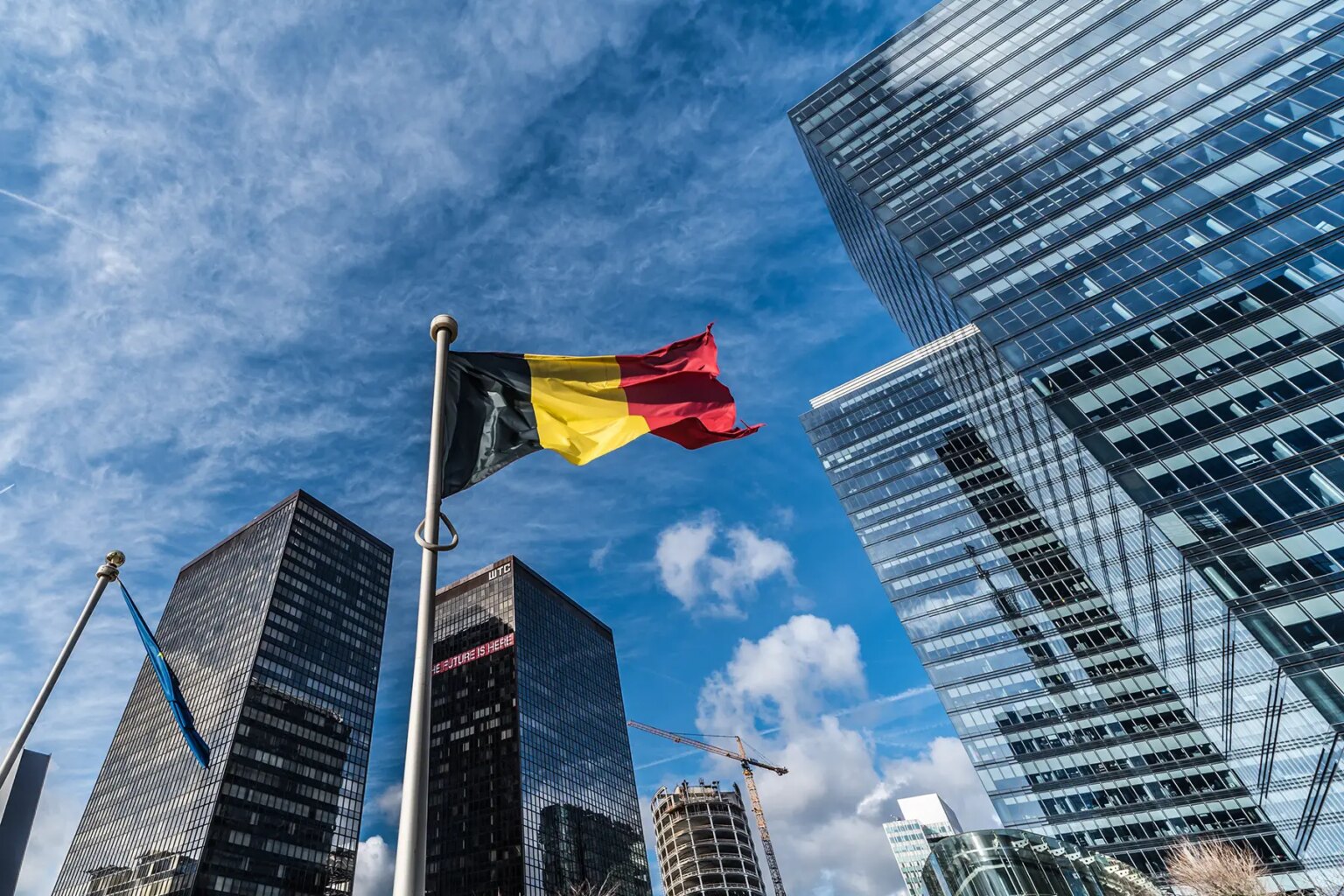
Belgium is home to some of the world’s most significant international companies, spanning pharmaceuticals, chemicals, finance, consumer goods, and technology. As the de facto capital of the European Union and host to major global institutions, it is also one of the most strategically important business locations in Europe.
This guide covers which major employers are based in Belgium, why the country attracts them, and what you need to know practically as an expat looking to work for one of them.
Key takeaways
- Belgium hosts global headquarters and major operations across pharmaceuticals, chemicals, finance, consumer goods, and technology.
- Brussels is the seat of the European Union and NATO, creating a unique cluster of international organisations alongside private sector multinationals.
- Key business cities are Brussels, Antwerp, Ghent, Leuven, and Liège, each with distinct industry strengths.
- Belgium has three official languages (Dutch, French, and German), and English is widely used at most large multinationals.
- As an EU member state, EU and EEA nationals can work in Belgium freely. Non-EU nationals require a work permit.
- Many expats working in Belgium earn in euros (EUR) while maintaining financial ties in another currency, making cross-border transfers a common practical need.
Why does Belgium attract so many international companies?
Several factors make Belgium one of the most attractive locations in Europe for international companies.
Belgium sits at the geographic heart of Western Europe, sharing borders with France, Germany, the Netherlands, and Luxembourg. Its central position, combined with world-class logistics infrastructure, makes it an ideal base for companies serving the European market. The Port of Antwerp-Bruges is one of the largest ports in the world and a critical gateway for European trade.
Brussels is home to the European Commission, the European Parliament, and the Council of the EU, as well as NATO headquarters. Hosting these powerful institutions has fostered a dense ecosystem of lobbying, consulting, legal, and policy-facing organisations, drawing a large and highly international workforce. Belgium is also an EU member state, which means companies based here have full access to the EU single market.
Belgium has a highly educated, trilingual workforce. Dutch is spoken in Flanders, French in Wallonia, and German in a small eastern region. English is widely used in international business environments, particularly in Brussels and Antwerp. The country also offers a competitive corporate tax environment, including an innovation income deduction for research and development activities, which is particularly attractive to pharmaceutical and technology companies.
Major international companies in Belgium
Below is a practical overview of well-known international companies in Belgium, organised by sector. This is not an exhaustive list, but it covers the most prominent employers across the key industries. Headquarters locations vary by region.
Finance, banking and professional services
Brussels is Belgium’s main financial centre and the home of several major international banks and financial institutions. English is widely used at senior and cross-border levels. Typical roles for expats include finance, compliance, risk, audit, and advisory.
- KBC Bank (Brussels) – One of Belgium’s largest financial institutions, offering banking and insurance services across Belgium and Central Europe.
- BNP Paribas Fortis (Brussels) – The Belgian arm of BNP Paribas, one of Europe’s largest banks, with major operations in corporate banking, retail, and asset management.
- ING Belgium (Brussels) – The Belgian subsidiary of the Dutch financial group, offering retail, commercial, and investment banking services.
- Euroclear (Brussels) – A Brussels-based financial services company that provides post-trade settlement and clearing services in more than 90 countries.
- Mastercard (Brussels) – Mastercard’s European headquarters is in Brussels, with teams across technology, compliance, and policy.
- EY, KPMG, Deloitte (Brussels and Antwerp) – All three major professional services firms have significant Belgian operations, with roles across audit, tax, consulting, and advisory.
Pharmaceuticals and life sciences
Belgium is one of Europe’s leading life sciences hubs. The country is the second largest EU exporter of chemicals and pharmaceuticals, accounting for around 12% of the EU’s total share. Life sciences companies are concentrated around Brussels, Antwerp, Ghent, and the Walloon-Brabant area. English is the standard language for research and global functions. These companies actively recruit internationally for research, clinical, regulatory, and commercial roles.
- UCB (Brussels) – A Belgian biopharmaceutical company specialising in neurology and immunology, with products used in multiple countries.
- Janssen Pharmaceutica / Johnson and Johnson Innovative Medicine (Beerse) – One of the largest pharmaceutical employers in Belgium, with major manufacturing and research facilities in Beerse and Geel.
- GSK (Rixensart, Wavre, and Gembloux ) – The British pharmaceutical company has a long-established presence in Belgium, with major vaccine research and manufacturing at its Rixensart, Wavre, and Gembloux sites.
- Pfizer (Puurs) – Pfizer’s Puurs facility is one of the largest pharmaceutical manufacturing sites in the world.
- Sanofi (Geel) – The French pharmaceutical company has a significant production site in Geel, in the Antwerp province.
- Galapagos (Mechelen) – A Belgian-Dutch biotechnology company focused on drug discovery and development, headquartered in Mechelen.
Chemicals and materials technology
Antwerp hosts the largest integrated chemical cluster in Europe and one of the largest in the world. The port’s central location in the Western European pipeline network makes it the backbone of continental chemical supply chains. Generating close to 100,000 direct jobs across Belgium, this vital sector accounts for around 33% of total Belgian exports.
- Solvay (Brussels) – A Belgian multinational chemical company producing advanced materials, specialty polymers, and industrial chemicals used across aerospace, automotive, and healthcare industries.
- Umicore (Brussels) – A global materials technology company specialising in battery materials, precious metals recycling, and emission control catalysts, with a major presence in Antwerp.
- BASF Belgium (Antwerp) – The German chemical group has a large production site at the Port of Antwerp, one of its most important European facilities.
- Air Liquide Belgium (Brussels and Antwerp) – The French industrial gas company provides oxygen, nitrogen, and hydrogen to industrial, healthcare, and food and beverage customers across Belgium.
- TotalEnergies (Brussels and Antwerp) – The French energy company has major refining and chemicals operations at Antwerp.
Consumer goods and food
Belgium is home to some globally recognisable consumer brands, particularly in beverages and chocolate. These companies offer roles across marketing, supply chain, research and development, and sustainability.
- AB InBev (Leuven) – The world’s largest brewer, headquartered in Leuven, producing brands including Budweiser, Stella Artois, and Corona. The company employs over 150,000 people globally.
- Barry Callebaut (Brussels and Ghent) – A global leader in chocolate and cocoa products, supplying the food and beverage industry worldwide from its Belgian operations.
- Procter and Gamble (Brussels) – P&G’s Brussels offices cover European brand management, research, and operations for its broad portfolio of household and personal care products.
- Delhaize Group (Brussels) – One of Belgium’s largest food retailers, with international operations across the US and Southeast Asia.
Logistics and supply chain
Belgium’s unmatched logistics infrastructure, centred on the Port of Antwerp-Bruges and Brussels Airport, has made it a key operational hub for global supply chain companies.
- DHL (Brussels area) – DHL has major logistics and distribution operations in Belgium, serving as a European hub for international parcels and freight.
- UPS (Brussels) – UPS has a significant Belgian operation serving the broader European market.
- Kuehne and Nagel (Antwerp) – One of the world’s largest freight forwarders has a major presence in Antwerp, handling sea, air, and overland freight.
Technology and consulting
Brussels and Leuven are Belgium’s main technology and consulting hubs. Tech companies operating in Belgium often use English as their primary language and tend to be open to international hires. Brussels also attracts technology companies that want proximity to EU policy-making and regulatory bodies.
- IBM Belgium (Brussels area) – IBM has a long-established Belgian operation covering consulting, cloud, and technology services.
- Microsoft Belgium (Brussels area) – Microsoft’s Belgian hub covers sales, cloud, and enterprise technology services.
- Tata Consultancy Services (Brussels) – One of the world’s largest IT services companies has a major Belgian operation serving European clients.
- Thermo Fisher Scientific (Brussels and Ghent) – The US scientific research company has significant Belgian operations, including in laboratory equipment, reagents, and life sciences services.
- Accenture, Capgemini (Brussels) – Both global consulting and IT services groups have major Belgian offices with roles across technology, strategy, and digital transformation.
What do international companies in Belgium look for?
International companies in Belgium hire across a wide range of levels, from graduate and early-career roles to specialist and senior management positions. The bar is generally high, particularly at multinational headquarters.
Language skills are important. While English is used broadly at international firms, the majority of roles in Belgium require at least one Belgian national language (Dutch or French), depending on the region and company. Brussels roles often ask for bilingual French and English proficiency. Roles in Flemish-based companies frequently require Dutch.

Editor
Tarah Ren
Insider Tip
While English is the standard in many multinationals, learning Dutch or French is a game-changer. Being bilingual in both gives you a massive competitive edge in the Belgian job market.
As an EU member state, Belgium applies the EU freedom of movement principles. EU and EEA nationals can work in Belgium without a work permit. Non-EU nationals require a professional card or work permit, depending on their situation. For salaried employees, the employer typically applies for the permit on behalf of the candidate. Large international companies with established HR functions are best placed to support this process. You can verify current rules on the official Belgian immigration and work permit page from the Immigration Office.
Here’s a practical checklist before you apply:
- Relevant degree or professional qualification in your field
- Several years of experience at the appropriate level
- Fluent English (essential for most multinational roles)
- At least one Belgian national language (an advantage for most; required for many)
- Valid right to work in Belgium, or EU/EEA nationality
Working at an international company in Belgium: what to expect
Belgian salaries are competitive by European standards, though lower on average than Switzerland or the UK at the top end. Roles in pharmaceuticals, finance, and technology tend to attract the strongest compensation packages. You can use our guide to the minimum wage and average salary in Belgium to benchmark pay in your sector. The cost of living in Belgium is moderate by Western European standards, with Brussels being the most expensive city, though still affordable compared to cities like London or Zurich.
Working hours are typically 38 to 40 hours per week, Monday to Friday. Belgian employment law provides strong employee protections, including a minimum of 20 days paid annual leave per year (with many employers offering more), parental leave rights, and statutory notice periods. Employment contracts in Belgium are generally well-structured and transparent.
Social security contributions in Belgium are compulsory for both employees and employers. These fund healthcare, unemployment insurance, pensions, and family allowances. Health insurance is organised through a mutual insurance fund (mutualité or ziekenfonds), which applies from the moment you stay in Belgium for more than three months. Many large international employers offer complementary group insurance and pension schemes.
One common financial consideration for expats is managing money across borders. If you receive your salary in euros but have financial commitments in another currency, such as a mortgage, family support, or savings in the UK, US, or elsewhere, understanding the cost of converting and sending money abroad is worth doing early.
Manage your international finances in Belgium with Wise
Earning in euros while maintaining financial ties in another currency is one of the most common challenges for expats working at international companies in Belgium. Many expats keep a bank account in their home country and need to send a regular portion of their salary abroad. When you do this through a bank, the exchange rate applied often includes a mark-up compared to the mid-market rate, the neutral rate you would see on a currency search, which means you receive less than the headline figures suggest.

Wise is a money transfer service that converts and sends money using the real, mid-market exchange rate, with a small, transparent fee shown clearly before you confirm. It supports EUR alongside 40+ other currencies, which makes it a practical option for expats moving earnings between Belgium and the UK, the US, Australia, or other countries.
You can open a Wise account and check the exact fees for your specific currency route on the Wise website before you send.

Frequently asked questions about international companies in Belgium
Which city in Belgium has the most international companies?
Brussels has one of the highest concentrations of international companies, particularly in finance, professional services, technology, and EU-facing organisations. It is also home to the European Commission, European Parliament, and NATO, creating a unique ecosystem for internationally mobile professionals. Antwerp is the second major hub, especially for chemicals, logistics, and the port sector. Leuven is home to AB InBev and a strong biotech and academic cluster, while Ghent is a growing centre for life sciences and food technology.
Do international companies in Belgium work in English?
Most large international companies in Belgium use English as their primary working language for internal communications, management, and cross-border roles. However, language requirements in Belgium are more complex than in many other countries, because the country is divided into distinct linguistic regions. Companies based in Flanders may expect Dutch alongside English. Brussels-based roles often require French, and sometimes both French and Dutch. If you are looking for companies in Belgium that use English as the main day-to-day language, Brussels-based multinationals and EU institutions are your strongest starting point.
What is the biggest company headquartered in Belgium?
By revenue and global brand recognition, AB InBev, headquartered in Leuven, is Belgium’s most internationally recognisable company. It is the world’s largest brewer, with more than 150,000 employees worldwide, and is the only Belgian company currently ranked on the Fortune Global 500. In chemicals, Solvay is one of Belgium’s largest and most global companies. In pharmaceuticals, UCB has a strong international profile, particularly in neurology and immunology.
Can expats work in Belgium without an EU/EEA passport?
Yes, but the process requires employer support. EU and EEA nationals can work freely in Belgium under the EU freedom of movement. Non-EU nationals, including British, American, and Australian citizens, need a work permit, typically obtained by their employer on their behalf. Large international companies with dedicated HR teams are generally the best-placed employers to manage this process. Always verify the latest requirements with the Belgian Immigration Office before applying.
How do I find jobs at international companies in Belgium?
Most major employers post roles on their corporate careers pages. The Expatica job board for Belgium lists roles at international and English-friendly companies.
Our guide to finding a job in Belgium covers job platforms, CV tips, and how Belgian hiring culture works. It’s also a useful starting point for Brussels-specific searches.
Editor
Tarah Ren
Insider Tip
Don’t underestimate the power of networking in Belgium! Recruiters heavily rely on LinkedIn, especially for roles in Brussels and Antwerp, so keep your profile updated.
Useful resources
The links below can help you research employers, check work permit rules, or find jobs:
- Expatica job board Belgium – Job listings at international and English-friendly companies in Belgium
- Belgian Immigration Office (DOFI) – Official source for work permits, professional cards, and residency rules for non-EU nationals
- Jobs.be – Belgium’s leading general job platform, available in English, French, and Dutch
- LinkedIn Belgium – Widely used by recruiters at major Belgian multinationals
- EuroBrussels – Specialist job board for EU institutions, NGOs, and Brussels-based international organisations
- Glassdoor Belgium – Employee reviews and ratings for top Belgian employers



Did you find this guide helpful?