
'%20id='ico-down'%20stroke='%23000000'%20stroke-width='1.5'%3e%3cg%20transform='translate(1092.250000,%20254.750000)'%3e%3cpolyline%20id='Path-2-Copy-4'%20transform='translate(5.500000,%202.750000)%20scale(1,%20-1)%20rotate(-180.000000)%20translate(-5.500000,%20-2.750000)%20'%20points='0%200%205.5%205.5%2011%200'%3e%3c/polyline%3e%3c/g%3e%3c/g%3e%3c/g%3e%3c/svg%3e)


Education
Language Learning
Introduction to French: France’s official language
Learn more about the history, geography, and grammar of the French language, as well as how and why you should learn it.


According to the Observatoire de la langue Française, French is spoken by 97% of people in France, a country whose population is mostly monolingual. It’s also an official language in 28 other countries around the world, from Canada to Vanuatu. And its use and popularity are only growing, with over 300 million mother-tongue or second-language francophone speakers around the globe.
Learn more about the French language, from its history to its structure:
Babbel
Want to brush up on your French before making the move to France? Babbel is a language app that lets you learn at your own pace, around your busy lifestyle. Courses are designed by language teaching professionals, meaning you'll be able to access expert courses from the comfort of your own phone. Download Babbel today and start your French journey.

What languages are spoken in France?
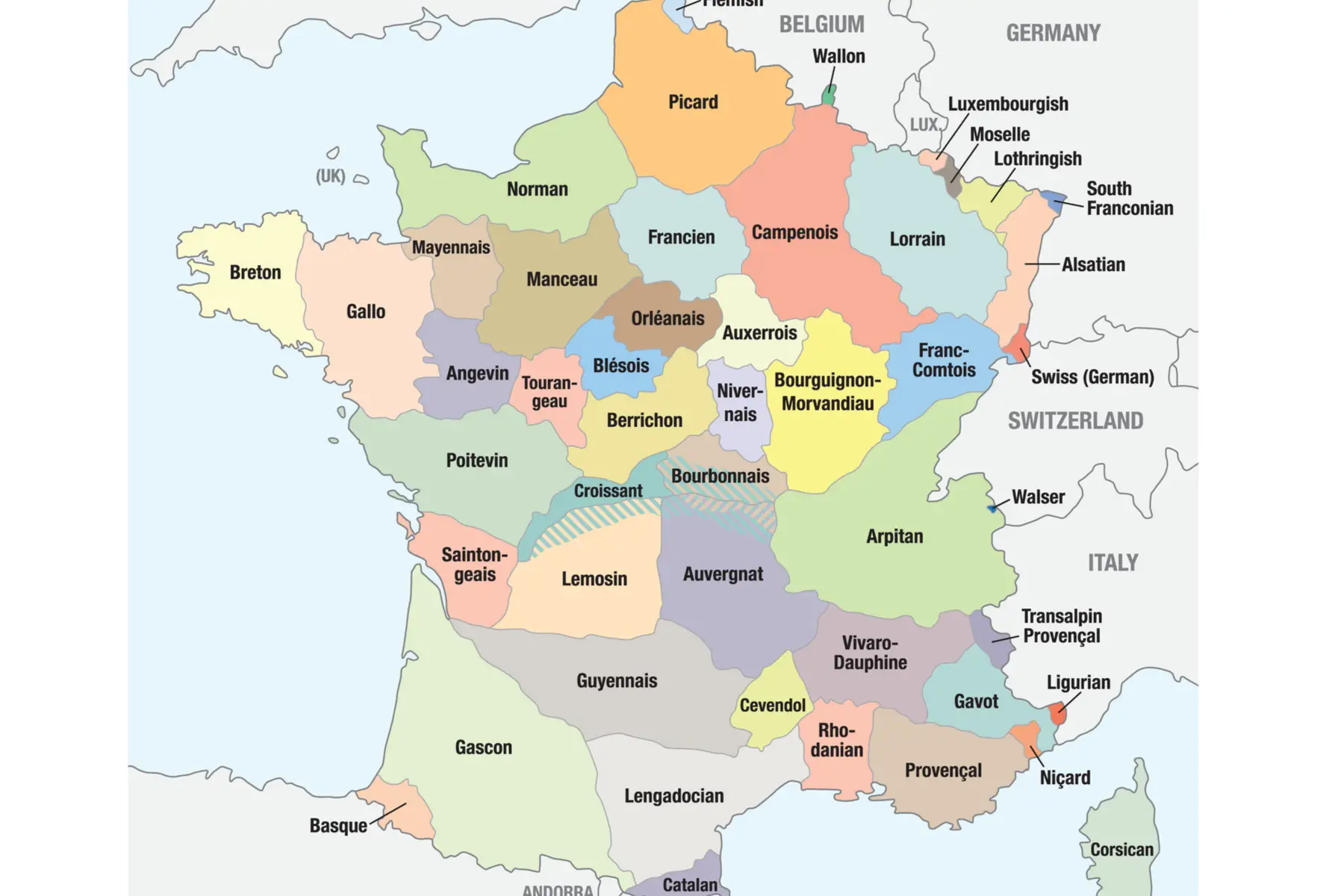
While the main and only official language of the French Republic is evidently French, dozens of other dialects and languages co-exist with it. These include (just to name a few):
- the Basque language to the south
- Breton to the west
- German dialects on the eastern border
- Corsican and Niçard to the south
Breton schools are making a comeback, and Basque has a strong local media presence. However, most other languages and dialects are only spoken in homes and local neighborhoods by speakers who are also fluent in French.

Local languages other than French with the most numbers of speakers include Occitan (526,000), Alsacien (548,000), and Breton (304 000). In addition to this, immigration has brought with it a wealth of linguistic diversity.
Arabic is the second most spoken language in France, with around four million speakers, followed by Creole, Berber, Armenian, and Romani languages. These minority languages have often been transmitted down a few generations of immigrant families. As such, they now differ to various degrees from the official languages or variants spoken in the countries from which they originally hail.
Where do they speak French worldwide
As said before, around 300 million people around the world speak French. For roughly 78 million people, it’s their mother tongue, while the rest speak it as a second or third language. Indeed, French is – perhaps surprisingly – the second most common foreign language (pdf) after English and is taught in schools around the world.

Of course, French is spoken not only in France, but by francophone communities in just about every corner of the globe. People in many regions and countries have it as their first or second language, including Sub-Saharan Africa, North Africa, the Middle East, the Indian Ocean, Haiti, North America, French Guiana, and other French overseas territories.
It’s worth bearing in mind that 60% of francophone speakers live in Africa and the Middle East, while only 28% live in France. All of this makes French the sixth most spoken language in the world after Mandarin, English, Hindi, Spanish, and Arabic.
Some countries with the largest percentage of French speakers outside of France include Mauritius (73%), Gabon (66%), Seychelles (53%), and the DRC (51%). French is also the third language of business around the world and the second in Europe.
Origins and history of the French language
French is part of the Italic branch of the Indo-European language family. It is a Romance language, deriving, like Italian, Spanish, Romanian, and Portuguese, from Vulgar Latin.
In the 5th century BC, people spoke three languages on the territory now covered by France: Greek, Ligurian, and Gaulish. In 50 BC, the Romans invaded France with their own language, Latin, also descended from an Indo-European language spoken some 8,000 years ago.

Around 500 years later, a group of Germanic peoples known as the Franks took power. For centuries after this, Latin was the official language of the State and Church, while the populace continued to speak Vulgar Latin and Frankish. Gradually, these languages merged and evolved into a new Romance language.
By the 10th century, this Romance language existed in hundreds of different forms. The variant spoken in Paris, known as Francian, or French, slowly became the more prestigious, widespread variety. Finally, in 1539, King François I decided that laws would be written in French, entrenching this variety as the official language of the State. After the Revolution, schools also switched from Latin to French.
French dialects
Although there are many dialects and languages spoken around France and in other francophone territories, not all of them are dialects of French. A language like Basque is linguistically unrelated to French, while many local dialects spoken in eastern France are much closer to German.
In metropolitan France, there are two main groupings of Romance dialects. First, the langues d’oïl, which cover the northern territory of France and include Frainc-Comtou, Walloon, Champenois, Picard, Norman, Gallo, Poitevin-saintongeais, Lorrain, and Burgundian.
Second, Occitan or langues d’oc, represented in the south of the country and including Auvergnat, Lemosin (Limousin), Provençal, Niçard, Lengadocian and Gascon. The French spoken in Belgium and Switzerland differs much less from standard French, but variations in vocabulary and pronunciation are nonetheless noticeable.
Beyond Europe, French colonization around the world has left a multitude of creoles and regional variations in its wake. In reality, from French Guiana to Martinique, Haiti to New Caledonia, the French language has evolved, shaped by the grammar, pronunciation, and expressions of local languages.
The French spoken in Quebec, for example, has lexical borrowings from English, the remnants of old French expressions no longer used in Europe, and a unique accent that some French speakers find very difficult to understand.
French pronunciation and phonology
The French language uses the Latin alphabet, but unlike English, it can have accents on certain letters (é, è, ê, ô, ç, ù, û). In fact, as an English speaker, you will find yourself learning ten new sounds. For foreign learners, the trickiest are undoubtedly the guttural ‘r’ and the four nasal vowels, with spellings that include ‘un’, ‘en’, ‘an’, ‘ain’, ‘em’, ‘ein’ and ‘on’. Portuguese and Breton are the only other European languages with such use of nasal vowels.
On the whole, the subtle difference between the French nasal vowels is difficult to distinguish if you haven’t grown up francophone, yet it often produces a difference in meaning. For example, the words main (hand), ment (lies), and mon (my) have quite different spelling, but they all sound quite similar: the sound ‘m’ followed by a different nasal vowel.
Similarly, while the French sound ‘ou’ is very much like a ‘u’ sound in Italian or Spanish (“oo”), the ‘u’ in French is more acute and pronounced more to the front of the mouth. It’s hard for foreign speakers to get this variation right, but many words have different meanings depending on which ‘u’ sound you use, for example, tu (you) and tout (everything), or vu (seen) and vous (plural you) – note that the final consonants are silent.

Here are a few pronunciation tips to recall when reading French, but do bear in mind that there is a lot of difference between spoken and written French, with many silent consonants.
- OU = “oo”
- OI = “wah”
- CH = “sh” (as in short)
- AU/EAU = “o”
- Ç = “s”
To go further, check out the Lingvist website for more tips on French pronunciation.
French grammar
Here is a brief introduction to some of the essential elements of the grammar of the French language.
Nouns
All French nouns have either a feminine or masculine gender. E.g. la table (the table – feminine), but le camion (the truck – masculine). Plurals have a silent ‘s’ at the end.
Articles
French always uses articles, and they agree with the gender and number of the noun.
| Masculine | Feminine | Plural | |
| Definite (“the”) | LE / L’ | LA / L’ | LES |
| Indefinite (“a”) | UN | UNE | DES |
| Partitive (“some”) | DU | DE LA | DES |
Adjectives
French adjectives must always agree in gender (+ ‘e’ for feminine nouns) and number (+ ‘s’ for plurals) with the noun. E.g. un grand escalier / une grande vitre / des grandes dents (a big staircase, a big window, big teeth).
Verbs
There are three groups of verbs in the French language, distinguished (mostly, because of course there are exceptions!) according to their ending in the infinite form.
- First group: ER verbs (e.g., chasser, payer, acheter)
- Second group: RE verbs (e.g., prendre, vendre, comprendre)
- Third group: IR verbs (e.g., finir, punir, fuir)

The conjugation of verbs in their past, present, future, conditional, and subjunctive forms will depend on which group they belong to. There are of course exceptions to every rule, and very common verbs like être (to be), avoir (to have), and aller (to go) have their own special conjugations. In the present, they are as follows:
| Être | Avoir | Aller |
| Je suis Tu es Il/elle est Nous sommes Vous êtes Ils/elles sont | J’ai Tu as Il/elle a Nous avons Vous avez Ils/elles ont | Je vais Tu vas Il/elle va Nous allons Vous allez Ils/elles vont |
If you want to find more irregular verbs, there’s a whole list of them on the Lingolia Français website.
You need to use the verbs être or avoir when constructing the past perfect tense (passé composé). For example, j’ai vu, tu as vu, il/elle a vu (I/you/he/she saw), but je suis allé(e), tu es allé(e), il est allé, elle est allée (I/you/he/she went).
Meanwhile, the verb aller can be used to construct the future tense in conjunction with the infinitive: je vais faire, tu vas faire, il/elle va faire, etc. This is literally ‘I/you/he/she am going to do’.
To delve more into the intricacies of French grammar, you can check out the Collins Easy Learning French Grammar.
Interesting facts about the French language
Did you know…?
- About a third of modern English words are of French origin. Following the Norman Conquest of 1066, French blossomed in the English court and the language became associated with the aristocracy. As a result, its influence lives on in the modern English across the world, in words that you might never suspect of being French, including ‘sport’, ‘modern’, ‘origin’, and even ‘denim’ (the material comes from the town of Nîmes, de Nîmes).
- The Académie Française was created in 1635 to regulate the French language and is still highly influential today. Its 40 members are known as les immortels (the immortals) and they rule on every modernization and neologism in French.

- French does not use the letter “w” apart from in a handful of borrowings, like wagon, le wi-fi, le web, and les WC.
- “E” is the most common letter in French. Despite this, the writer Georges Perec took on the unfathomable challenge of drafting a whole novel without once using this letter. It’s called “La Disparition” and has been translated into English as “A Void”.
- Some French vocabulary is entrenched around the world, especially in specific cultural fields including ballet and cooking. For example, in ballet, the terms rond de jambe, plié, and enjambé are used, and in cuisine (another french word for cooking) there’s blanching, julienne, bain-marie, bouquet garni, jus, and papillote to name a few.
- In the United States, French is the number four native language, and the most taught second language after Spanish.
Learning the French language in France
If you’re moving to France, there’s a whole variety of reasons why it may benefit you to learn French. These include, but are not limited to career prospects, socialization with locals, integration into the culture and local community, legal requirements (if you plan to seek residency or nationality), and personal development.

Of course, there are different ways to learn a language. For instance, you may want to go down the traditional classroom route and sign up to your local Institut français or other language schools. In that case, teaching can take place in small groups, in a classroom, or online, and potentially with integrated visits and activities to help practice the lessons.
Another option is to get a private tutor. Also, for free, you can join conversation evenings, watch online tutorials or download a language learning app.
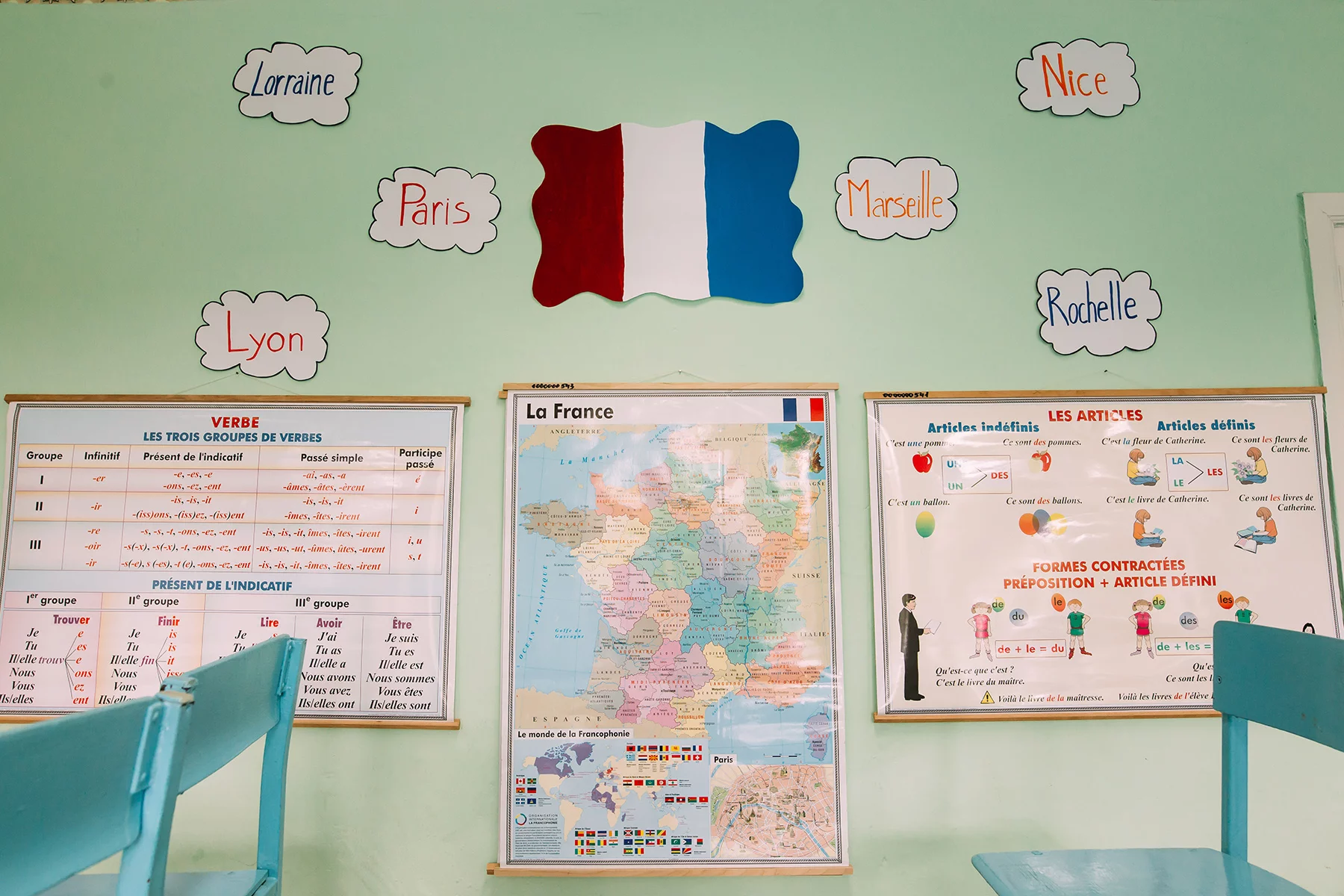
In essence, there is a way to learn to suit every personality and budget. Of course, if you’re in France, the best way to improve your French is to simply get out there and practice. To give you just a few ideas, start by reading your local newspaper, listen to French-language radio, and chat to your local shop owner or street sweeper.
You can even organize play dates for your kids, or start talking to other parents in the park. Just be open, let them know you want to practice, and insist on speaking French even if they want to switch to English!
Useful resources
- Collins Easy Learning French Grammar – a clear and easy-to-understand guide in English to the verbs and grammar of French with thousands of examples
- Institut français – a site where you can find all the places and events that promote French culture around the world
- Lingvist – an extensive guide to French pronunciation
- Ministère de la Culture – Langue française et langues de France – the French language platform of the French Ministry of Culture
- Observatoire de la langue française – an international francophone organization that collects and analyses data on the situation of French around the world



Did you find this guide helpful?