
'%20id='ico-down'%20stroke='%23000000'%20stroke-width='1.5'%3e%3cg%20transform='translate(1092.250000,%20254.750000)'%3e%3cpolyline%20id='Path-2-Copy-4'%20transform='translate(5.500000,%202.750000)%20scale(1,%20-1)%20rotate(-180.000000)%20translate(-5.500000,%20-2.750000)%20'%20points='0%200%205.5%205.5%2011%200'%3e%3c/polyline%3e%3c/g%3e%3c/g%3e%3c/g%3e%3c/svg%3e)


Finance
Taxes
Church tax in Germany: who pays and how to leave
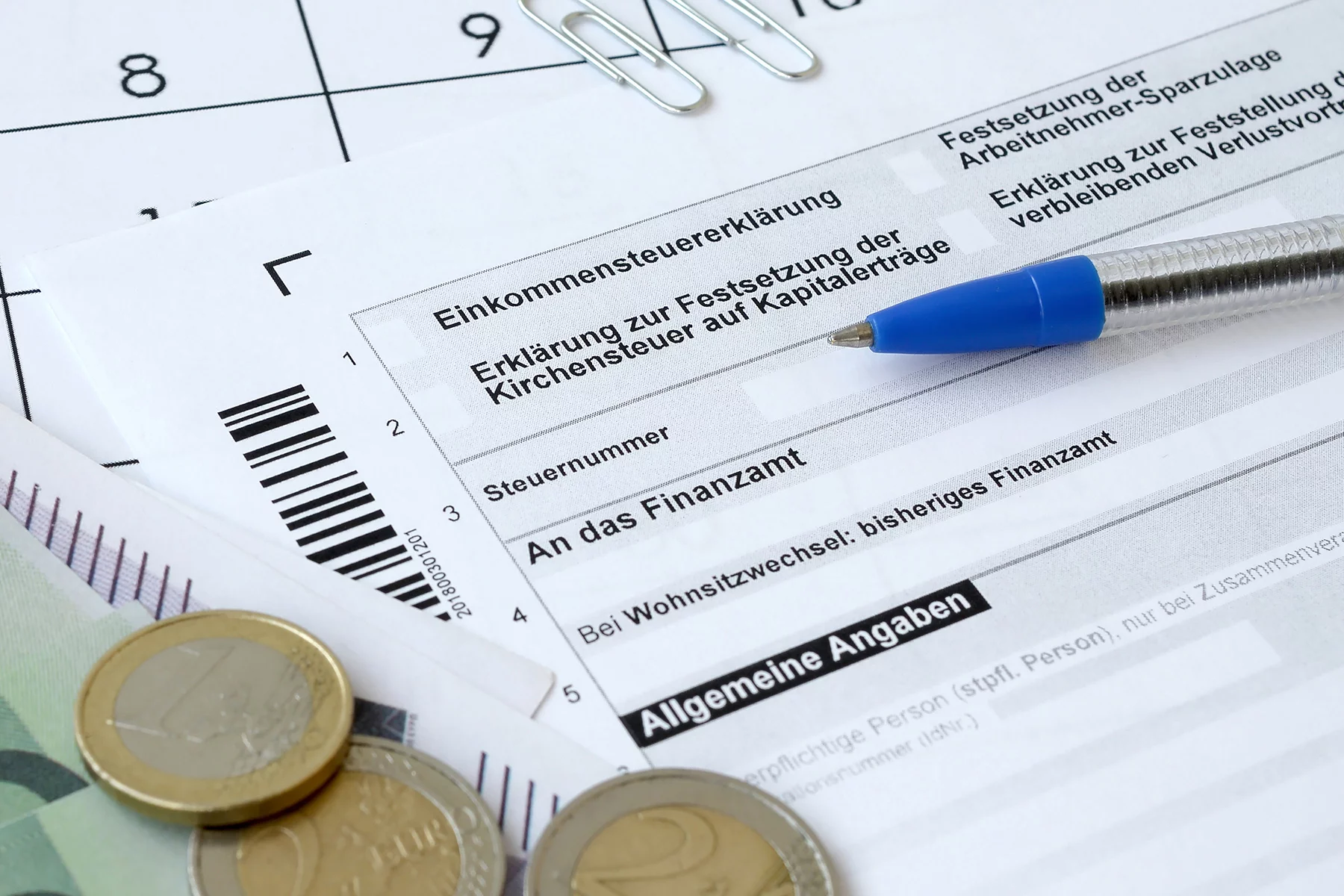
Many expats first meet church tax after Anmeldung or when a Kirchensteuer line appears on a first payslip. Germany treats membership in some religious communities as part of the wider German tax system as well as a matter of personal belief.


Kirchensteuer, or church tax, is a surcharge collected through the tax system from members of certain recognized religious communities. Registration data, foreign membership history, and church-leaving procedures can make the rules especially confusing for newcomers.
Key takeaways
- You may pay church tax if you belong to a recognized tax-collecting religious community and you have taxable income in Germany.
- The headline rate is usually 8% or 9% of your income tax liability, not 8% or 9% of your gross salary.
- Data from Anmeldung, or address registration, can feed into your tax record and payroll deductions.
- Kirchenaustritt, or an official church-leaving declaration, is handled by a public authority, but the correct office, fee, and process vary by federal state.
- The civil tax result of leaving is separate from any religious or sacramental consequence, which you must check with the relevant church or religious community.
Manage multi-currency relocation costs easily with Wise
Relocating to Germany often means handling cross-border expenses, from initial local deposits to ongoing foreign income transfers. A Wise account lets you hold multiple currencies, convert at the mid-market rate, and keep clear digital statements for your German tax reporting and administrative needs.

What is church tax in Germany?
Kirchensteuer (church tax) is a levy linked to membership in certain religious communities recognized under public law and allowed to collect tax through the state system. In practice, the tax can be collected alongside income tax and passed to the religious body.
The key point is that this is not a percentage of gross pay. It is usually a surcharge on income tax, wages tax, and sometimes capital income, so the amount depends on your tax position.
It is also different from voluntary donations or tithing. Whether you owe it depends on tax rules, membership status, and official data, not on weekly attendance.

Who pays church tax in Germany?
Broadly speaking, liability usually depends on recognized membership plus taxable income, not nationality. For expats, the harder question is often whether the authorities treat you as a member in the first place.
Which religions and memberships count?
Most expats asking about church tax mean membership in the Roman Catholic Church, Protestant regional churches, or some Jewish communities. The common factor is not the label “religion” on its own, but whether the religious community is legally recognized and entitled to levy church tax.
Not every Christian denomination falls under the same rules. Liability turns on membership in a tax-collecting community, so unusual cases should be checked with the relevant religious community and, if needed, your tax office.
What if you are a foreigner or were baptized abroad?
Foreigners are not automatically exempt from church tax in Germany. If you are treated as a member of a recognized religious community and you have taxable income in Germany, nationality by itself usually does not change the rule.
Many expats get confused after Anmeldung (address registration). Writing “no religion” on a form is not a safe shortcut if your prior baptism or membership record could still be relevant, because the civil tax question may not end with that first declaration.
If you were baptized Catholic in Italy and now register in Hamburg, check what your Meldebehörde (registration authority), tax office, and the relevant religious community say before your first full payroll month.

How church tax is calculated
Church tax is usually a percentage of income tax liability, not a direct slice of gross salary. Keep that in mind before you look at rates or payslip deductions.
Why the rate is 8% or 9% depending on your federal state
Bavaria and Baden-Württemberg generally use an 8% rate. The other federal states generally use 9%, and that percentage is applied to your income tax liability, not your total pay.
If your income tax liability is €10,000, church tax would usually be €800 in Bavaria or Baden-Württemberg and €900 in most other federal states. The real result can still vary with family setup and timing within the year.
How it appears on your payslip and tax return
Employees often first spot church tax as a separate payroll deduction on a payslip. It should be read alongside wage tax, not confused with social security in Germany, because social contributions and church tax follow different rules.
Church tax can also matter beyond salary. The Federal Central Tax Office says banks and insurers can withhold church tax on capital income when their data shows membership, so it is not only a payroll issue.
If the deduction looks wrong, do not ask payroll to make an unofficial change. Check your registration data, your tax record, and which authority is responsible. Church tax may be deductible in some cases, but capital-income treatment can differ.
If you manage money between Germany and another country, some expats also use a Wise account for euro receipts, multiple-currency balances, and downloadable statements. It can help with admin, but not with church-tax status or Kirchenaustritt.
How registration affects church tax
Address registration, tax records, and payroll data connect more closely than many newcomers expect. That is why one religion entry can have tax effects soon after you register.
What to check during address registration
Anmeldung is your official address registration, usually handled by a Meldebehörde (registration authority). The religion field matters because registration data can feed into tax systems used for payroll and other withholding.
Before you leave the office, confirm the religion entry, note which authority handled the registration, ask whether a copy is available, and check when the tax record should update.
Can you correct an incorrect religion entry?
There is often a correction path, but it is not identical nationwide. If you think a wrong religion entry or data error triggered church tax, identify the registration office and the Finanzamt (tax office) that holds your tax record.
Ask what documents they need, such as ID, proof of registration, or evidence from the relevant religious community. If the problem is a data error, the correction path is different from Kirchenaustritt.

How to leave the church in Germany
Kirchenaustritt (official church-leaving declaration) is the civil process used to end church-tax liability linked to membership. The office, fee, documents, and effective date rule can vary by federal state, so verify the local version before you act.
Find the correct local office for your home address.
Check the required documents and current fee on the official portal.
Make the declaration in the legally accepted format for your area.
Keep proof and check a later payslip or tax record for the update.
Which local office handles Kirchenaustritt?
Each federal state can assign this differently. The competent office may be an Amtsgericht (local or district court), a Standesamt (civil registry office), or another designated public office.
Berlin is a good example of why local checking matters. The official Berlin service portal routes residents to the local Amtsgericht, warns that an online declaration is not possible, and explains that responsibility depends on the court district for your address.
Documents, fees, and when the tax may stop
The details are local, but this checklist is a sensible starting point:
- valid photo ID, or a passport plus any locally required proof of residence
- marriage, partnership, or child records if your local office asks for them
- the current local fee and accepted payment method
- proof of the completed declaration for your records
- the official rule on when the change takes effect for tax purposes
Do not rely on paid middlemen that promise a nationwide online exit. Berlin’s official page says the declaration cannot be made online, uses a 30 euro fee, and says tax relief begins at the end of the month in which the declaration reaches the court. Your own federal state may use a different office, fee, or timing rule, so check locally.
How to verify your state-specific process
Start with your federal state or city service portal. Then confirm the details with the competent local office and, if needed, the tax office. Your employer does not decide the civil exit procedure.
Fraud warning: church-leaving declarations are not universally available online. If a website offers to complete the legal exit for you nationwide, treat that as a red flag unless your official portal says online completion is legally available where you live.
Civil effects vs religious effects after leaving
Keep the two tracks separate. The state handles tax records and public administration. The religious community handles faith, sacramental status, and related consequences.
| Civil effects after Kirchenaustritt | Religious effects after leaving |
|---|---|
| You make an official declaration to a public authority. | Any spiritual or sacramental consequence is decided by the relevant religious community. |
| The authority updates the civil record and communicates with other public bodies according to local rules. | Questions about baptism, marriage, burial, or godparent roles are not decided by the tax office. |
| Church-tax deductions should stop under the rule in your federal state once the update takes effect. | Different communities can treat the same civil exit differently, so you need confirmation from them. |

Common expat edge cases
The headline rule helps, but real life can still be messy. These are the cases where the right record and the right authority matter most.
Married couples, children, and joint filing
Family status can make church tax harder to read. If spouses have different religious affiliations, or only one spouse is a member, the result can depend on how income tax is attributed within a joint filing context.
Couples should also know that some church tax laws include special rules for mixed-affiliation couples or low-earning spouses. Child-related and denomination-specific questions should be checked against current official or church guidance, not forum advice.
Capital income, bonus payments, and other non-salary questions
Church tax is not only a salary line on a payslip. It can also connect to bank or insurance withholding on capital income, and one-off taxable items such as bonuses can change the tax base that the surcharge sits on.
If you are unsure, review your tax documents, bank statements, and any church-tax lines tied to investment income or withholding. If the amounts are material or your situation spans Germany and another country, a German tax advisor can help separate data issues, membership issues, and normal tax calculation.
If you regularly move money between Germany and home for tax bills or savings, a Wise account can help separate euro and home-currency funds and pull records later. It is an admin tool, not part of your tax status.
FAQ
Frequently asked questions about church tax in Germany
Do foreigners have to pay church tax in Germany? 
Foreigners are not automatically exempt. Liability usually depends on membership in a recognized tax-collecting religious community and taxable income in Germany, so check your registration data, prior membership status, and local authority guidance.
Is church tax 8% or 9% of salary in Germany?
No. The usual 8% or 9% figure is a percentage of income tax liability, not gross salary. If your income tax liability is €5,000, church tax would usually be €400 in Bavaria or Baden-Württemberg and €450 elsewhere.
Can I stop church tax by telling my employer I left the church?
No, not by itself. The formal civil process and official data update matter, so use the correct local office for Kirchenaustritt and then check a later payslip or tax record to make sure the change was processed.
Does church tax end immediately after Kirchenaustritt?
Not always. The effective date depends on your federal state and administrative processing, so ask the local office when the change takes effect and keep proof in case later payroll or tax records need checking.
Is church tax deductible in Germany?
It can be, but the answer needs care. Church tax paid on income tax is generally treated differently from church tax linked to capital-income withholding, so check current official guidance before you rely on a deduction.
Sources
Expatica’s experts are all about providing the most up to date and accurate information. All guides are fact checked, and whenever we use external sources (like government websites or research papers) we’ll make a note of them here so you can check them out too.
- National overview of church tax, rates, family-rule caveats, and deductibility, Federal Ministry of Finance, An ABC of Taxes
- Tax identification and religious-affiliation data, Federal Central Tax Office, The identification number
- Official search tool for the competent Finanzamt, Federal Central Tax Office, Suche nach zuständigem Finanzamt
- Official Berlin procedure, office, documents, fee, and timing example, Service Berlin, Kirchenaustritt erklären
- Court finder for identifying the competent Amtsgericht, Justiz-Online court finder
- Church tax withholding on capital income, Federal Central Tax Office, Kirchensteuer auf Kapitalertragssteuer
- Information about tax returns and local tax-office responsibility, Federal Central Tax Office, Tax return
- Wise account features referenced in the article, Wise Help Centre, What is a Wise Account?
- Downloading account statements referenced in the article, Wise Help Centre, How do I download a statement?



Did you find this guide helpful?