





Renouncing Canadian citizenship is a formal legal act, not just a way to stop using a Canadian passport. If you live abroad and need to renounce Canadian citizenship, the safest approach is to check the correct Immigration, Refugees and Citizenship Canada (IRCC) route, confirm your other nationality position, and understand what rights you will lose.
Below, you can check eligibility, the forms and fees, where to submit from outside Canada, how to track the case, and what changes after approval.
This guide is based on current IRCC guidance and is for general information only, not legal, immigration, or tax advice.
Key takeaways
- Eligibility: Most adults can use the standard route only if they live outside Canada and meet IRCC’s other rules.
- Another citizenship: You normally need proof that you already are, or will become, a citizen elsewhere.
- For most standard subsection 9(1) applications, the fee to renounce Canadian citizenship was 100 CAD when checked on 16 October 2026. IRCC says that fee is generally non-refundable once processing starts. Some R7.1 applications do not have a fee, so verify the live rule before you pay.
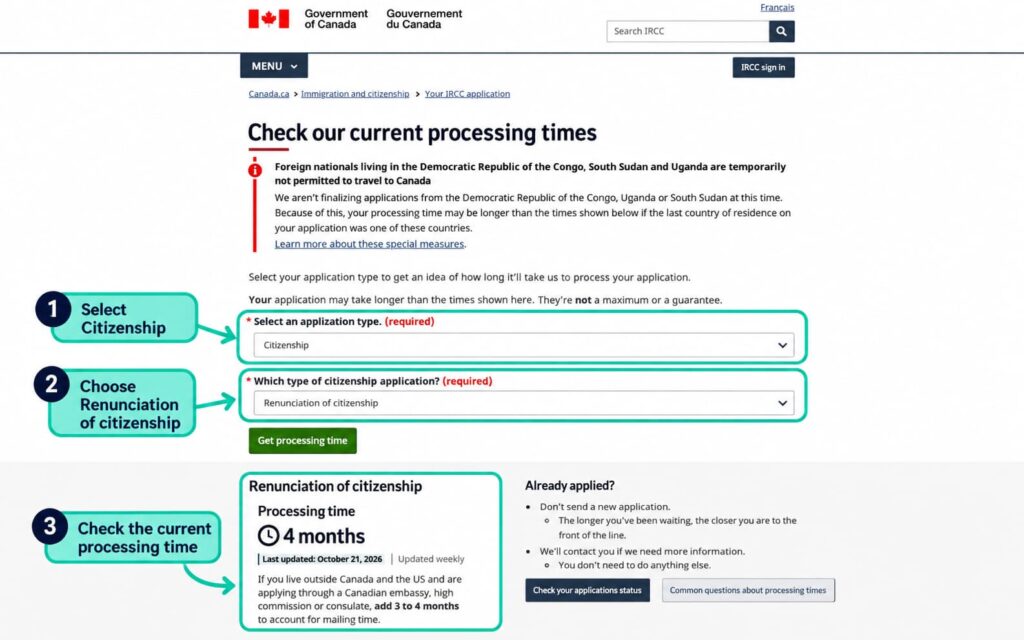
- Timing: There is no fixed global timeline, so use IRCC’s live processing-time tool before you send anything.
- Submitting from abroad: Outside Canada and the US, you usually submit through the Canadian mission responsible for your area.
- Main effect: You stop being a Canadian citizen and have no status in Canada by default.
Check whether you can renounce Canadian citizenship
Before you look at any Canadian citizenship renunciation form, check the basics. Under the standard route, you must usually:
- Be a Canadian citizen
- Live outside Canada
- Be aged 18 or over
- Not be in citizenship revocation proceedings
- Not be a threat to Canada’s security or part of a pattern of criminal activity
- Understand the significance of the decision
If your case involves a minor, a dependent adult, mental capacity concerns, or a complicated family history, use the official guidance for that route or get regulated advice before filing.
Renunciation does not let you keep Canadian status in reserve.
If you are unsure whether you are already recognized as a Canadian citizen, or whether you only became one automatically after a law change, sort that out before choosing a package. Sending the wrong route can waste months.
Wise for moving costs abroad
- Pay international costs: Hold and convert currencies for moving expenses
- Compare fees upfront: See conversion and transfer costs before you send
- Save on conversion costs: Mid-market rate with transparent, upfront fees

Know which renunciation route applies to you
Subsection 9(1) is the standard adult route for people who actively want to give up Canadian citizenship. R7.1 is a separate route for some people who automatically became citizens after changes to the Citizenship Act in 2009, 2015, or 2025, so check the correct package before you apply.
Make sure you will not become stateless
This is the most important decision point. Canada generally expects proof that you already hold another citizenship, or that you will become a citizen of another country if renunciation is approved, so do not confuse a future plan with evidence IRCC will accept.
If the other country says you must renounce Canadian citizenship first, confirm exactly what document it can issue before you send your package.
Do not assume an approved naturalization application elsewhere is enough. Confirm what proof IRCC will accept in your exact case.
Also check the nationality law of the other country yourself, because dual nationality rules and passport timing can differ from what IRCC needs.
A common mistake is relying on an embassy email or a lawyer’s summary without checking whether the other country will actually issue the certificate, passport, or approval letter you need on the timing IRCC expects.
Gather the forms and documents you need
Once you know which route applies, gather the pack before filling anything in:
Choose the right application form. The standard form is CIT 0302 for renunciation under subsection 9(1). If you fall under the automatic-citizenship route, use CIT 0496 instead.
Use the right checklist. CIT 0402 covers the standard route, while CIT 0501 is used for R7.1 cases.
Add proof of Canadian citizenship and proof of your other citizenship, or proof that you will become a citizen if approval is granted.
Include identification, the required citizenship photo, and the fee receipt where a fee applies.
Add IMM 5476 if a representative is acting for you.
Read the guide before filling in the form. IRCC can require color copies, original photos, or original documents in specific situations, and the R7.1 package may ask you to return Canadian citizenship certificates you still hold.
IRCC may ask for more documents later, especially if names, dates, or citizenship history do not line up neatly.
If you live abroad, the mission responsible for your area may not be the nearest Canadian office, so check jurisdiction before you pay for couriers or appointments.
Handle translations, certified copies, and name changes carefully
Any document that is not in English or French normally needs a translation, and IRCC says family members must not translate it. If you need certified copies, affidavits, or name-change evidence, check the local translator and notary rules in your country of residence before you submit, and make sure the same name appears across your citizenship, identity, and residence documents.
Pay the fee and submit the application
For most standard subsection 9(1) applications, the fee to renounce Canadian citizenship was 100 CAD when checked on 16 October 2026. IRCC says that fee is generally non-refundable once processing starts. Some R7.1 applications do not have a fee, so verify the live rule before you pay.
The table below compares where to submit your application and what to keep, depending on where you live and the applicable renunciation route.
| Where you live | Where to submit | Payment point | What to keep |
|---|---|---|---|
| United States, subsection 9(1) | Case Processing Centre in Sydney, Nova Scotia | Usually online | Receipt and tracked-delivery proof |
| Canada or the US, R7.1 | Case Processing Centre in Sydney, Nova Scotia | No fee if the R7.1 exemption applies | Copy of the full package and delivery proof |
| Outside Canada and the US | Canadian embassy, high commission, or consulate responsible for your area | Usually online, with some local overseas options | Receipt, copies, and courier tracking |
Verify the current address, mission, and payment method on IRCC before you mail anything. If several family applications go in one envelope, follow the current guide carefully so one incomplete file does not hold up the rest.
If you live outside Canada and the US, the application may still travel on to the Case Processing Centre in Sydney, so build in mailing time on both sides of the route.
What if you need urgent processing?
Urgent processing exists, but it is discretionary. You need to use the current official route and provide evidence of why the case cannot wait, and even then IRCC does not guarantee faster handling.
Track the application and reply quickly
After submission, timing can vary a lot. If documents are missing, names do not match, fees are wrong, or IRCC needs an interview or more evidence, the file can slow down or be returned. This is why tracked post or courier is worth using, especially from abroad.
If normal processing times have passed, check IRCC’s live tool, then use the IRCC web form, the department’s official online contact form, or contact the mission responsible for your region if you applied from outside Canada and the US.
If you apply from abroad, delays can happen before substantive processing even starts, because the file may need time to move from the Canadian mission to Sydney, Nova Scotia.
Plan for what changes after approval
Once your renunciation takes legal effect, you no longer have the rights associated with Canadian citizenship. The change does not depend on when you would otherwise have renewed your passport.
- Certificate or renunciation document: Under the standard route, you receive a certificate of renunciation. Under R7.1, IRCC issues a renunciation document showing the date you ceased to be a Canadian citizen.
- Loss of citizenship rights: You stop being a Canadian citizen.
- No status in Canada by default: IRCC uses this phrase to mean you do not keep a fallback right to live in Canada just because you used to be a citizen.
- Future travel or a move back: Visiting, studying, working, or settling in Canada later would depend on the immigration rules for the nationality you then hold and any status you later obtain.
- Document updates: If your wider life abroad depends on residence permits, employer files, tax records, or bank compliance checks, update those records once your status changes.
If you expect to travel soon after approval, check the entry rules for your other nationality before you make plans.
Do not assume renunciation returns you to permanent resident status, or that a Canadian passport or old citizenship record will solve that problem after approval.

Can you get Canadian citizenship back later?
Possibly, but only through a separate legal route. If you later want Canadian citizenship again, you would need to use whatever legal route exists at that time, with its own rules and conditions, so renunciation should never be treated as temporary.
Manage cross-border admin and money changes with a Wise Account
If your nationality change sits inside a bigger move, you may still need to pay for translations, courier costs, or everyday bills in another currency. A Wise Account may help eligible users hold, send, receive, or spend money in multiple currencies while living internationally. It does not provide legal or immigration advice, and it does not affect IRCC fees, eligibility, or processing. Wise is a financial institution, not a bank.
If that fits your situation, compare the account details and fees on Wise’s official site before opening anything.

Next steps
Before submitting your renunciation application, confirm the correct IRCC route, check your other citizenship evidence, and make sure your forms and documents are complete. Keep copies of your submission and proof of delivery, and monitor official processing information while your case is being reviewed. After approval, check how your changed citizenship status affects travel, residency, and administrative records. For international expenses associated with these changes, a Wise Account may be worth comparing with other available payment options.
FAQ
Renouncing Canadian citizenship
Can you renounce Canadian citizenship while living in Canada? 
Usually no, not under the standard subsection 9(1) route, because one of the normal requirements is that you do not live in Canada. But if you automatically became a citizen and may fall under R7.1, or think a special circumstance applies, check the official eligibility guidance before assuming you are blocked.
Do you need another passport to renounce Canadian citizenship?
You usually need proof of another citizenship, or proof that you will become a citizen if IRCC approves the application. That is not always the same as already holding another passport, so focus on the citizenship evidence IRCC asks for, not only the travel document.
How much does it cost to renounce Canadian citizenship?
The standard renunciation fee was 100 CAD when checked on 16 October 2026. Fees can change, and some R7.1 cases do not pay a fee, so confirm the live amount and rule on IRCC before submitting.
How long does it take to renounce Canadian citizenship?
There is no single processing time for renouncing Canadian citizenship, because IRCC timelines vary and can change. Missing documents, missing fees, translation issues, extra verification, or consular handling abroad can all slow the file.
What happens to your Canadian passport after renunciation?
Renouncing citizenship is broader than giving up a passport. Once approval takes effect, you are no longer a Canadian citizen, so you must follow the current official instructions for any Canadian travel or status documents linked to your case.
Can you return to Canada after renouncing citizenship?
Yes, you may be able to return, but not because you keep an automatic fallback right as a former citizen. After renunciation, short visits, work, study, or a permanent move would depend on whatever immigration status your other nationality allows you to apply for at that time.
Sources
Expatica’s experts are all about providing the most up to date and accurate information. All guides are fact checked, and whenever we use external sources (like government websites or research papers) we’ll make a note of them here so you can check them out too.
- Official process, eligibility, and consequences of renunciation, Give up (renounce) Canadian citizenship – Immigration, Refugees and Citizenship Canada
- Eligibility requirements for renouncing Canadian citizenship, IRCC – Eligibility
- Application instructions, fees, and submission routes, IRCC – How to apply
- Standard application guide for renunciation under subsection 9(1), IRCC – CIT 0302
- Application guide for certain people who acquired citizenship under legislative amendments, IRCC – CIT 0496, R7.1
- Guidance on urgent renunciation applications, IRCC – Apply to renounce citizenship urgently
- Current estimated processing times for immigration and citizenship applications, IRCC – Application processing times
- Official directory of Canadian diplomatic missions abroad, Government of Canada – Embassies and consulates
- Federal legislation governing Canadian citizenship, Citizenship Act – Justice Laws Website
- Background information on foreign-currency accounts and payments abroad, Wise – Is there a free foreign currency account?