
'%20id='ico-down'%20stroke='%23000000'%20stroke-width='1.5'%3e%3cg%20transform='translate(1092.250000,%20254.750000)'%3e%3cpolyline%20id='Path-2-Copy-4'%20transform='translate(5.500000,%202.750000)%20scale(1,%20-1)%20rotate(-180.000000)%20translate(-5.500000,%20-2.750000)%20'%20points='0%200%205.5%205.5%2011%200'%3e%3c/polyline%3e%3c/g%3e%3c/g%3e%3c/g%3e%3c/svg%3e)


Finance
Taxes
The tax system in Spain
Learn about the main types of tax payable in Spain, including what you pay on personal or corporate income, plus VAT and property taxes.


If you’re living or working in Spain, it’s important to be aware of your tax liability, which includes which taxes apply to you and how much you should pay. This will generally depend on your residency status, whether you own property, and any other investments you have. Spanish taxes are split between state and regional governments, so rates can vary across the country.
For more information on taxes in Spain, check out the following sections:
Balcells Group
Balcells Group provides legal advice to individuals, companies, investors, immigration agencies and other intermediary agents. They have over 40 years of professional experience, and have built their firm based on the integration of several generations of lawyers that offer a balanced vision based on experience and modernity.

The Spanish tax system
Spain’s tax agency, the Agencia Tributaria, regulates taxation. The Spanish tax year runs from 1 January to 31 December.
If you earn money from employment in Spain or run a company, you must pay tax on your income or profits. Income tax in Spain is unique, as the rate you’ll pay is a combination of the rate set by the national government and the rate set by your regional government. For most employees, tax is withheld automatically as part of their pay.
As an expat managing finances across borders, having the right financial tools is essential. Wise offers a multi-currency account that can simplify managing incoming payments and expenses across different countries while navigating Spain’s tax system.
Unlike most providers that often charge high fees for international transfers, Wise uses the mid-market exchange rate with low, transparent fees.

National taxes in Spain include capital gains tax, corporate tax, and VAT. Regional and local taxes include property taxes and wealth taxes. Inheritance tax rates and obligations vary from region to region.
What is new about taxes in 2026?
Spain’s income tax rates and bands are the same for 2026 as they were in 2025. They will remain so unless a new budget is adopted by the spring of 2026.
The standard corporate tax rate remains 25% for most companies, though certain smaller companies and micro-entities benefit from lower reduced rates under transitional rules.
Who pays tax in Spain?
Your tax liability in Spain is based on your residency status. Tax residents pay Spanish income tax on their worldwide income. You’re considered a tax resident if any of the following apply:
- You lived in Spain for more than 183 days in the last calendar year. This does not need to have been a consecutive period.
- Your family or business interests are located in Spain.

CPO and co-founder, Entre Trámites
Maria Durán
Insider Tip: Handling scary tax
Spain’s tax system isn’t scary with the right help.
I was overwhelmed when filing taxes in Spain for the first time. The deadlines, forms, and rules were completely new to me. What saved me was finding an advisor who specializes in expats – they explained everything simply and helped me avoid costly mistakes. It’s worth the investment.
Spanish tax residents must pay tax on income earned from employment, self-employment, rental properties, capital gains, and savings. Your taxable income is after deductions for social security and pension contributions, personal allowances, and professional costs.
For expats managing income from multiple countries, a Wise account can help you keep track of international finances while maintaining compliance with Spanish tax regulations.

How does tax work for expats?
If you live in Spain for less than 183 days in a calendar year, you will be considered a non-resident and will only pay income taxes on your Spanish income. Rather than the standard progressive rates residents pay, income tax for non-residents applies at a flat rate with no allowances or deductions.
Tytle
Tytle is your one-stop-tax-shop for advice, filings, bookkeeping, visa, and more in 30+ countries. Manage all your tax needs from a single dashboard, whether for one country or multiple, all at affordable rates. Tytle has a team of trusted advisors in Spain, helping you stay compliant and stress-free.
Spain has signed numerous tax treaties with other countries to prevent double taxation. These agreements ensure that individuals or businesses are not taxed twice on the same income in both Spain and their home country. The Spanish tax agency keeps an updated list of these treaties.
Managing finances across multiple countries can be challenging for expats, especially when dealing with different tax jurisdictions. A Wise multi-currency account allows you to hold, exchange, and send money in multiple currencies with low conversion fees, using mid-market exchange rate.
This can be particularly helpful when you need to transfer money to pay taxes in Spain from foreign accounts or receive money from abroad. When navigating cross-border taxation, many expats find that currency conversion fees or bad exchange rates can significantly impact their finances.
Wise offers a cost-effective alternative with transparent pricing and the mid-market exchange rate, helping you keep more of your hard-earned money when transferring between countries.

Do I need a Spanish tax ID number?
Residents and non-residents must register to pay taxes in Spain. First, you’ll need a tax ID number (NIE number). You can get this via your local Foreigner’s Office (Oficina de Extranjeros) or police station within 30 days of arrival in Spain.

You can fill out form 30 (Modelo 30) to register your obligation to pay Spanish tax as a resident or non-resident for the first time or to change your details.
Wise allows you to manage your finances internationally with minimal fees, which is especially useful when paying bills, receiving money from abroad, or sending money to your home country while maintaining your Spanish tax obligations.
Types of tax in Spain
Spanish income taxes
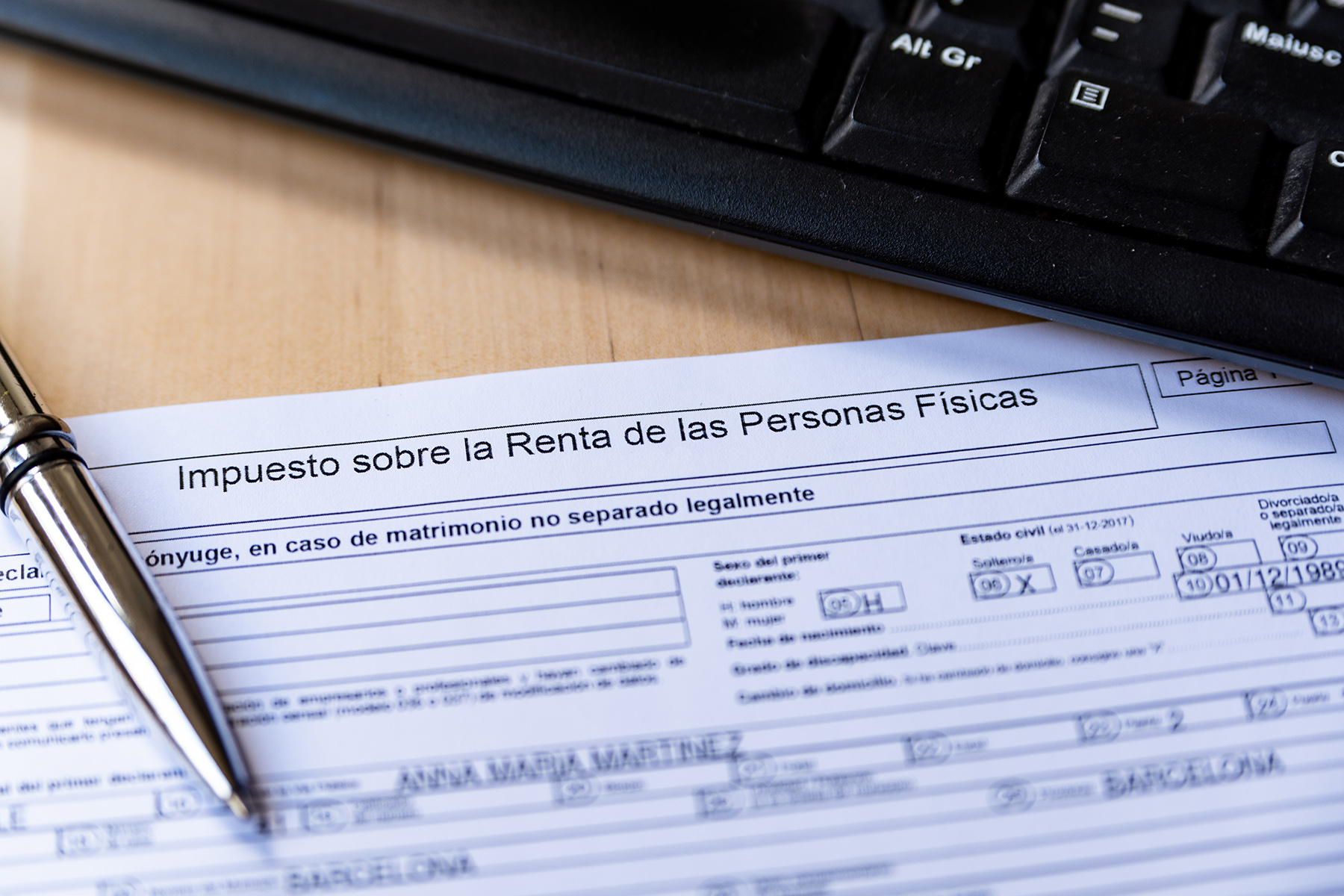
Personal income tax in Spain is called Impuesto de Renta sobre las Personas Fisicas or IRPF. Spain operates a pay-as-you-earn (PAYE) system, where employers withhold tax from your salary and pay it directly to the tax agency.
Income tax for residents
Income tax rates for residents generally range from 19% to 47%, with the rate payable broken down into six brackets depending on income. Your overall tax rate is a combination of the rate set by the government and your region. As some areas have different tax rates, your total bill will vary depending on where you live in Spain.

Residents can benefit from a series of deductions when filing their returns (e.g., having children, making pension contributions, or renovating properties). The basic tax-free personal allowance for Spanish residents under 65 is €5,550, €6,700 starting at 65, and €8,100 from 75.
Income tax for non-residents
The general income tax rate for non-residents is 24%, or 19% if you are a citizen of an EU or EEA country. Non-residents do not benefit from Spain’s personal tax allowances, although EU and EEA residents may deduct certain expenses directly related to the income earned in Spain.
Filing your tax return
In Spain, the income tax filing period usually runs from early April to the end of June, with exact dates confirmed each year by the Spanish Tax Agency.
In general, individuals may not need to file if their income consists solely of employment income below €22,000 from a single employer, fully subject to Spanish withholding. Other thresholds apply to savings income, multiple employers, rental income, and foreign income, and these can trigger a filing obligation even at lower levels.
When filing taxes that involve foreign income, you might need to convert currencies. Wise can help you manage these currency conversions more affordably, with transparent fees and the mid-market exchange rate.
This ensures you’re not losing money to hidden fees when paying your Spanish tax obligations from foreign income sources.
Beckham’s Law
Beckham’s Law was introduced in 2004 to attract more foreign workers and international companies to Spain.
The rule means that employees on assignment in Spain can pay a flat tax rate of 24% on income up to €600,000. Those who earn more than this amount pay 47% on additional earnings. A 3% tax rate is also payable on income from dividends, interest, or capital gains over €200,000. This preferential rate lasts for six years.
Income tax for self-employed workers
Tax residents who are freelancers or self-employed professionals (autónomos) pay income tax in Spain at the same rates as everyone else. Unlike employed workers, most self-employed people must file every quarter and make advance payments to the tax office. Freelancers may claim tax deductions on several grounds, provided they have proper invoices and receipts.
Allowable deductions include social security contributions, accounting and tax service costs, professional subscriptions, office expenses, phone, internet, and any vehicles used for work.
For freelancers and self-employed professionals working with international clients, receiving payments can be complex and expensive.
A Wise Business account provides a simpler solution, allowing you to receive payments in multiple currencies with low fees. You can get paid with local account details in 8+ currencies, including EUR, USD, and GBP, making it easier to bill international clients while keeping more of your earnings.
Additionally, the Wise Business account integrates with accounting software, making tax preparation more efficient by automatically categorizing expenses and simplifying record-keeping for your quarterly Spanish tax filings.
Property taxes in Spain
If you own a property in Spain, you need to pay a local property tax known as Impuesto sobre Bienes Inmuebles (IBI). Liability is determined by ownership on 1 January of each year, regardless of whether the property is occupied. IBI is calculated by applying a municipal tax rate to the property’s cadastral value (valor catastral), not its rental value. The tax applies equally to residents and non-residents.

There are also tasas de basuras, a rubbish collection tax. Non-resident property owners may also need to pay income tax flat rates on potential rental income on Spanish property.
If you buy a property in Spain, you must pay a property transfer tax, Impuesto Transmisiones Patrimoniales (ITP). When a property is sold, the local authority charges a tax on the increase in the value of the land, the plus valia.
Capital gains tax and tax on investment income
Spain’s capital gains tax (the tax on profits from selling property or other investments) is as follows:
- First €6,000: 19%
- €6,000–50,000: 21%
- €50,000–200,000: 23%
- €200,000–300,000 27%
- €300,000 or more: 30%
For assets acquired before 31 December 1994, limited transitional relief may still apply, subject to a lifetime cap on qualifying gains.
Capital gains on the sale of a main residence may be exempt if the seller is over 65, or if the seller is under 65 and reinvests the proceeds in another main residence within the permitted timeframe. These rates also apply to savings income such as interest and dividends.
Wealth tax
Wealth tax in Spain is payable on the value of your assets on 31 December each year. Assets valued at more than €10 million can be taxed up to 3.5%. Rates vary depending on your region, and some areas don’t charge the tax at all.
Everyone has a standard €700,000 tax-free allowance. Homeowners benefit from a further €300,000 against the value of their primary residence.
Corporate tax
The general rate of corporate tax in Spain is 25%. Newly formed companies can pay a rate of 15% for the first two years.
New rules came into force in 2025 offering reduced rates for smaller companies. For 2026:
- Small companies with less than €1 million turnover pay a rate of 19% on the first €50,000 of profit and 21% on the remainder. These figures will reduce further to 17% and 20% in 2027.
- Small companies with turnover between €1 million and €10 million pay a corporate tax rate of 23% on their profits. This will reduce by 1% each year, before settling at 20% in 2029.

Companies must file tax returns within 6 months and 25 days after the end of their accounting period. Corporate tax is paid in installments in April, October, and December.
A new ‘Complementary Tax’ was also introduced in 2025 to ensure large companies with revenues above €750 million pay a global effective tax rate of at least 15% wherever they operate.
The information provided here provides a general overview only; you should always seek professional advice from a Spanish financial professional regarding your company’s specific circumstances.
VAT in Spain
Spain has three levels of value-added tax (VAT) or Impuesto sobre el Valor Añadido (IVA):
- General: 21% on goods and services
- Reducido: 10% on passenger transport, toll roads, amateur sporting events, exhibitions, health products, non-basic foods, trash collection, pest control, and wastewater treatment
- Superreducido: 4% on essential foods, medicine, books, and newspapers

VAT for businesses
VAT returns are generally filed quarterly by smaller businesses, while companies with turnover above €6 million are required to file and pay VAT monthly. Certain VAT-registered businesses are required to submit detailed invoice data electronically within four days of issuance under the SII (Immediate Supply of Information) system. This applies mainly to companies with annual turnover exceeding €6 million, VAT groups, and businesses registered for monthly VAT refunds.
Inheritance tax and gift tax
Inheritance tax in Spain applies to both residents and non-residents. The Spanish government groups inheritance tax and gift tax liability together. Tax rates vary considerably depending on the sum inherited and the relationship with the deceased.
Since 2015, non-residents from within the EU/EEA have been treated the same as residents in terms of inheritance and gift tax. Before the change, non-residents paid around 80% more than residents. The Spanish Supreme Court ruled that non-residents who paid the higher rate in the past are entitled to a refund.

Inheritance tax rules and rates vary from region to region. In 2017, some regions, such as Andalucía, updated their inheritance and gift tax policies, which resulted in many families not having to pay the tax. Check your specific region’s laws for more information.
Road tax
Drivers in Spain must pay an annual road tax (Impuesto Sobre Vehículos de Tracción Mecánica – IVTM). This is based on your vehicle fuel type and your region. See your regional government’s website for details about tax in your area.
Tax avoidance and evasion in Spain
Tax evasion (evasión fiscal) is an ongoing problem in Spain, with billions yearly lost to unpaid taxes. Evasion comes in many forms, from large companies failing to fully declare their taxable bases to workers being paid ‘cash in hand.’
Penalties for tax fraud in Spain depend on the seriousness of the offence. Administrative tax infringements are generally penalised with fines ranging from 50% to 150% of the unpaid tax, depending on whether the infringement is classified as minor, serious, or very serious and whether aggravating factors are present.
If the undeclared tax exceeds €120,000 in a single tax year, the offence becomes criminal tax fraud and may result in prison sentences of between one and five years, together with fines of up to six times the amount of tax evaded.
The Spanish tax authority is increasing its efforts to clamp down on tax evasion. In 2023, it announced that it would double down on investigating digital nomads and remote workers who claim they don’t reside in Spain in an attempt to pay income tax at non-resident levels.
Tax fines and penalties
If you fail to file a tax return in Spain, penalties and interest may apply. Where a return is filed late voluntarily and before any tax office demand, a surcharge of 1% plus an additional 1% for each full month late applies, up to 12%. If the return is filed more than 12 months late, a 15% surcharge applies, plus statutory late-payment interest.
If the tax office formally demands the return or identifies non-compliance, additional penalties of between 50% and 150% of the unpaid tax may be imposed, depending on the seriousness of the infringement and whether there was intent or concealment.

Similar rules apply to corporate tax returns, with penalties and interest calculated using the same surcharge and interest framework.
Tax advice in Spain
Taxes in Spain can be complex. While the information above provides a general overview, you should always get professional advice from a financial expert regarding your individual tax situation. Experts such as those at Balcells Group and Tytle provide English-language advice for internationals living and working in Spain.
In addition, you can consult Expatica’s Spanish directory of accountants and tax preparers to find assistance.
While professional tax advice is essential for compliance, having the right financial tools is equally important for managing your international finances efficiently. Wise complements professional tax services by providing practical tools that make managing money across borders simpler and more cost-effective.
Unlike most providers that often charge high fees for international transfers, Wise uses the mid-market exchange rate with transparent fees, helping you save money when paying taxes from foreign accounts, receiving international income, or moving funds between countries.
Useful resources
- Agencia Tributaria – the Spanish tax authority provides information on all aspects of tax in Spain for individuals and companies
- Ministry of the Interior of Spain – responsible for the issuing of Spanish tax numbers
- Spanish National Police – processes NIE applications
Related Articles


Editor's picks
 Guide to getting health insurance in Spain in 2026Find out whether you need private health insurance in Spain in 2026, with insider info on costs, coverage, and medical professionals.
 Dating in Spain: finding love as an expatSingle and ready to mingle? Learn how to find love on Spain's dating scene, where casual meet-ups can spark genuine romantic connections.
 Top 10 Spanish foods – with recipesWhat better way to explore Spain than with your tastebuds? From tasty tapas to delicious dishes, here are the best Spanish foods.
Did you find this guide helpful?