'%20id='ico-down'%20stroke='%23000000'%20stroke-width='1.5'%3e%3cg%20transform='translate(1092.250000,%20254.750000)'%3e%3cpolyline%20id='Path-2-Copy-4'%20transform='translate(5.500000,%202.750000)%20scale(1,%20-1)%20rotate(-180.000000)%20translate(-5.500000,%20-2.750000)%20'%20points='0%200%205.5%205.5%2011%200'%3e%3c/polyline%3e%3c/g%3e%3c/g%3e%3c/g%3e%3c/svg%3e)




'%20fill='%23000000'%3e%3cg%20id='icons'%20transform='translate(56.000000,%20160.000000)'%3e%3cpath%20d='M144,7339%20L140,7339%20L140,7332.001%20C140,7330.081%20139.153,7329.01%20137.634,7329.01%20C135.981,7329.01%20135,7330.126%20135,7332.001%20L135,7339%20L131,7339%20L131,7326%20L135,7326%20L135,7327.462%20C135,7327.462%20136.255,7325.26%20139.083,7325.26%20C141.912,7325.26%20144,7326.986%20144,7330.558%20L144,7339%20L144,7339%20Z%20M126.442,7323.921%20C125.093,7323.921%20124,7322.819%20124,7321.46%20C124,7320.102%20125.093,7319%20126.442,7319%20C127.79,7319%20128.883,7320.102%20128.883,7321.46%20C128.884,7322.819%20127.79,7323.921%20126.442,7323.921%20L126.442,7323.921%20Z%20M124,7339%20L129,7339%20L129,7326%20L124,7326%20L124,7339%20Z'%20id='linkedin-[%23161]'%3e%3c/path%3e%3c/g%3e%3c/g%3e%3c/g%3e%3c/svg%3e)
'%20fill='%23000000'%3e%3cg%20id='icons'%20transform='translate(56.000000,%20160.000000)'%3e%3cpath%20d='M335.821282,7259%20L335.821282,7250%20L338.553693,7250%20L339,7246%20L335.821282,7246%20L335.821282,7244.052%20C335.821282,7243.022%20335.847593,7242%20337.286884,7242%20L338.744689,7242%20L338.744689,7239.14%20C338.744689,7239.097%20337.492497,7239%20336.225687,7239%20C333.580004,7239%20331.923407,7240.657%20331.923407,7243.7%20L331.923407,7246%20L329,7246%20L329,7250%20L331.923407,7250%20L331.923407,7259%20L335.821282,7259%20Z'%20id='facebook-[%23176]'%3e%3c/path%3e%3c/g%3e%3c/g%3e%3c/g%3e%3c/svg%3e)

Germany’s tax system is comprehensive, covering various types of taxes including income tax, value-added tax (VAT), property tax, and business tax. Residents are taxed on their worldwide income, while non-residents are only taxed on German-sourced income. Additionally, indirect taxes like VAT and excise duties contribute significantly to government revenue, ensuring the system funds public services effectively.
Learn what else you can expect from taxes in Germany in the following sections:
Use Wise for moving money abroad
Wise offers expatriate-friendly financial services including international money transfers at mid-market exchange rates with transparent, low fees, helping you save money when sending funds to family or managing finances across borders. Their multi-currency account allows you to hold, convert, and spend money in multiple currencies.

The tax system in Germany
Everyone residing or conducting business within the German borders must pay taxes on their consumed goods and services, property, income, wealth, and assets.
The revenue gained from taxes funds public spending in Germany, including the healthcare system, education, and social security. Most of this comes from income tax, corporate tax, and value-added tax (VAT).

Taxes in Germany are separated into those collected by:
- The national government (Bundesregierung)
- Regional states (Bundesländer)
- Local municipalities (Gemeinden), districts (Kreise), and cities (Städte)
The Federal Central Tax Office (Bundeszentralamt für Steuern – BZSt), which is a part of the German Federal Ministry of Finance (Bundesministerium der Finanzen – BMF), oversees the tax system on a national level. Hundreds of regional tax offices (Finanzämter) administer local taxes.
Like most countries, Germany has a progressive tax structure when it comes to personal income tax. That means the more you earn during the fiscal year (1 January to 31 December), the more taxes you pay. In 2026, the top tax rate in Germany is 45%.
What’s new about German taxes in 2025?
Germany usually announces its federal Budget once a year. Highlights and changes to the tax system for 2026 include:
- The income tax threshold (steuerlicher Grundfreibetrag) has increased from €12,096 in 2025 to €12,348.
- The total child tax allowance has increased to €9,756. The child cash benefit has increased from €255 to €259.
- The active pension (Aktivrente) policy comes into effect, giving tax breaks to pensioners who work past state pension age. They can now earn an additional €24,000 tax-free.
- The VAT rate for restaurant and catering services (excluding drinks) is reduced from the standard 19% to 7%.
Who pays taxes in Germany?
The German Central Tax Office distinguishes between resident and non-resident taxpayers:
- Resident taxpayers (Steuerpflichtiger) are taxed on their worldwide earnings
- Non-resident taxpayers (nichtansässige Steuerpflichtiger) pay taxes on their income earned in Germany

Under the law, a tax resident is someone who lives more than half of the calendar year (183 days) in Germany. As such, cross-border commuters (Grenzgänger – i.e., those working in Germany but living elsewhere) are considered non-resident taxpayers.
How do taxes work for expats in Germany?
Expat residents pay the same taxes as citizens in Germany, meaning they are taxed depending on their taxpayer status.
Non-resident taxpayers must pay tax on income derived from Germany, and will likely be paying additional taxes elsewhere. To prevent double taxation, Germany has tax agreements (Doppelbesteuerungsabkommen – DBA) with nearly 90 countries, including the Netherlands, France, Italy, and Switzerland.
If you do happen to be taxed twice, you can apply for a refund from either Germany or the other country.

When managing tax obligations across multiple countries, expats often need to transfer money internationally – whether to pay taxes in their home country, receive refunds, or manage savings held abroad.
Using a multi-currency account like Wise can help manage these cross-border financial obligations. Wise allows you to send money internationally using the mid-market exchange rate with low transparent fees, and their multi-currency account lets you hold and manage money in over 40 currencies, which can be particularly useful for expats dealing with tax matters in multiple jurisdictions.
Save on International Tax Payments to Germany
If you need to transfer funds from abroad to meet your German tax obligations or manage your finances as an expat, Wise offers a straightforward way to send money internationally using the mid-market exchange rate and transparent, low fees. This can help you handle tax payments and other financial requirements more cost-effectively while living in Germany.
Learn more about Wise.
Do I need a tax ID number in Germany?
You must have a tax ID number (Steueridentifikationsnummer or Steuer-ID) to pay taxes in Germany. This 11-digit ID number (Identifikationsnummer – IdNr) will automatically be assigned to you when you register your address in the country.
In addition, self-employed workers (Freiberufler/Freiberuflerin) and businesses must have a freelance tax number (Steuernummer) to administer and monitor their VAT liability. The tax authorities will provide you one when you register your company in Germany. Businesses that export to other EU countries must also have a VAT ID number (Umsatzsteuer-Identifikationsnummer – USt-IdNr).

As you establish your financial and tax affairs in Germany, you may also want to consider how you’ll manage money across borders.
Many expats find it helpful to use international payment services like Wise, which offers a multi-currency account that allows you to hold and convert money in 40+ currencies with low conversion fees – useful for managing ongoing financial obligations in both Germany and your home country. You can also get a Wise debit card to spend conveniently from your account in Germany, and abroad.
Types of tax in Germany
When living in Germany, you’ll come across several types of taxes. Some, like real estate property tax (Grundsteuer), are charged at the municipal level, while others are paid nationally. Below is an overview of each type.

German income tax
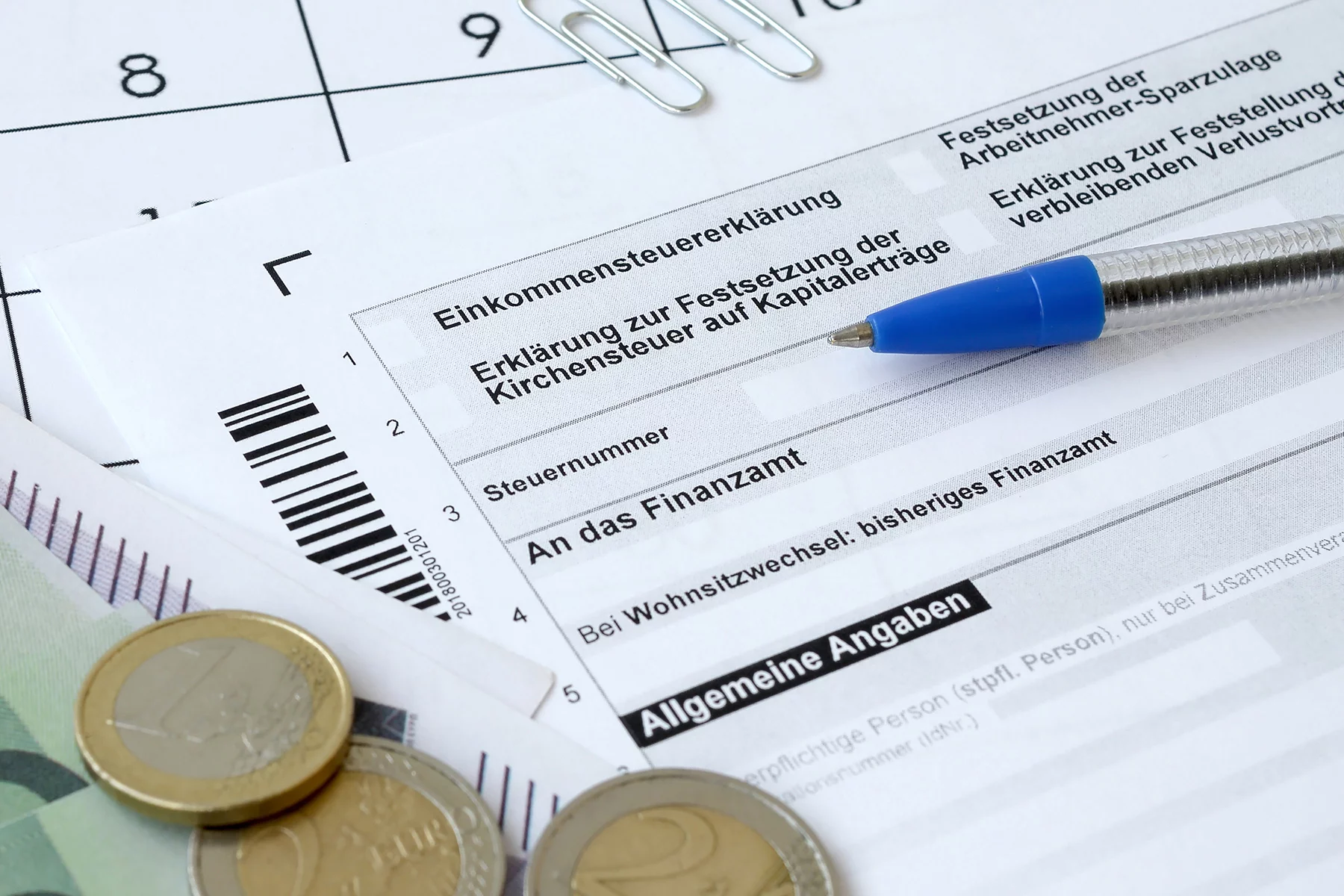
All residents in Germany pay income tax (Einkommensteuer) on their earnings from the previous year (1 January to 31 December). Taxable income can include:
- Your salary and other income from employment (e.g., bonuses)
- In-kind employee benefits (geldwerter Vorteil)
- State benefits and pensions
- Business profits
- Interest on savings or investments
- Property, wealth, and royalties
- Received rent (if you rent out your property)
German employers and pension providers typically withhold a percentage of your gross monthly salary or pension as payroll tax (Lohnsteuer). That way, when it’s time to file a tax return, you won’t be stuck with a hefty bill.
Social security
Salaried workers and pensioners in Germany must make mandatory social security contributions, depending on their residence status. Employers and pension providers will deduct these payments directly from your monthly salary.
In 2026, the social security contribution rates are:
- Public health insurance (Krankenversicherung) – 14.6% (employers and employees both pay 7.3%)
- Long-term care insurance (Plegeversicherung) – 4.2% (employees pay 2.9%), though this could be lower if you have more than one child
- Pension insurance (Rentenversicherung) – 18.6% (employers and employees both pay 9.3%)
- Unemployment insurance (Arbeitlosenversicherung) – 2.6% (employers and employees both pay 1.3%)
Freelancers do not have to pay the mandatory contributions. However, they won’t be able to receive state benefits if they haven’t made any payments.

Corporate tax
Companies based in Germany pay both national and municipal taxes (Körperschaftsteuer) on their business earnings.
In 2026, the total combined corporate tax rate is 30.1%, much higher than in other EU member states.
In addition to corporate tax, businesses may need to pay capital gains tax on the sale of business assets, trade tax, and dividend tax (more on this below).

Eligible companies and self-employed workers may offset certain tax credits and allowances against their corporate tax bills. These include municipal tax credits, and research and development credits (Forschungszulage).
Value-Added Tax
Value-Added Tax (Umsatzsteuer – USt, or more commonly, Mehrwertsteuer – MWSt) applies to the sale of most goods and services.
The standard VAT rate in Germany is 19%, though a reduced rate of 7% is available for certain everyday goods (Waren des täglichen Bedarfs). These include art, books, cultural services, (some) foods, hotel stays, magazines, and newspapers.
Certain goods and services are VAT-exempt and pay a 0% tax rate. These include financial services, deliveries within the EU, and insurance premiums.
Can you get a refund on VAT?
Visitors from outside the European Union may be eligible for a VAT refund on selected purchases in Germany. To reclaim VAT, you’ll need to have bought the items from a retailer that participates in the refund program. It’s worth noting that not every store participates; affiliated retailers generally display a sticker on their door.
You must inform the store owner at the time of purchase that the merchandise will be exported to a country outside the EU. You will then get a special export invoice (Ausfuhr- und Abnehmerbescheinigung).
Please note that some retailers use the refund scheme as a private Tax-Free Shopping Service. In these cases, you’ll be issued a Tax-Free Shopping Check.
More information about reclaiming VAT can be found on the website of the German Central Customs Authority (Bundeszollverwaltung – ZOLL).
VAT for businesses and freelancers
In 2026, companies and freelancers are required to register for VAT if their turnover exceeded €22,000 in the previous calendar year, or if their turnover is expected to exceed €50,000 in the current calendar year. Businesses that exceed these thresholds must charge VAT and show it clearly on their invoices.

Import and export taxes
Typically, anyone who imports products into Germany has to pay import duties and VAT. Excise items (e.g., alcoholic drinks, fuel, medicine, and tobacco products) are also subject to excise duties and other levies.
For more information about import and export duties, visit the ZOLL website.
German property tax
When you buy property in Germany, such as a home or commercial real estate, you are liable for real estate transfer tax (RETT – Grunderwerbsteuer). This varies between 3.5–6.5% of the sale price, depending on the federal state you’re moving to.
Property owners must also pay an annual property tax (Grundsteuer) to the municipality. The amount of the tax differs based on the property type, value, and the local tax rate. Local German governments use the revenue to finance public services, such as schools, daycare centers, swimming pools, libraries, and infrastructure.
Reforms have been introduced in 2025 to how Grundsteuer is charged, with bills being based on new property value assessments rather than historic data. The German government has published advice about the new system.
Road and vehicle tax
Vehicle owners must pay an annual motor vehicle tax (Kraftfahrzeugsteuer) based on the engine size and CO2 emissions. This tax typically costs €100–150 per year for low-emission vehicles, with diesel and higher-emission vehicles costing more.
The government provides this vehicle tax calculator to determine your yearly tax.
Environmental tax
Germany’s environmental taxes include those levied on aviation, carbon emissions, energy consumption (e.g., fuel and electricity), and motor vehicles. The country also taxes mineral resources through a water withdrawal levy, wastewater charge, and mining royalty.
At the same time, the manufacturing, agriculture, and forestry industries can benefit from tax breaks for electricity, heating oil, and gas. The service sector and private households, on the other hand, are more heavily taxed.

To help reach its goal of climate neutrality by 2045, Germany set the carbon price at €40 per ton in 2024, rising to €50 in 2025. For 2026, it will apply a market-based corridor of €55–65.
Tourist tax in Germany
In Germany, many municipalities charge a local overnight accommodation tax on stays in commercial lodging such as hotels, hostels, and short-term rentals. This tax can apply to all visitors, including German residents. Each municipality sets its own rules and rates.
For example, Berlin charges 7.5% of the net room price, Cologne charges 5%, Dresden applies a percentage-based accommodation tax, and Frankfurt levies a flat per-night charge.
The tax may be known by different names depending on the region, such as Übernachtungsteuer, Bettensteuer, Beherbergungsteuer, or Tourismusabgabe.
In addition, some spa and resort towns levy a Kurtaxe (spa or visitor tax), usually charged per person per night, with rates varying widely by location and season.
Tax on capital gains and wealth
Capital Gains Tax (Abgeltungsteuer) is a levy you must pay when you sell, get compensation, or get income from capital assets. Capital gains are taxed at a flat rate of 25%.
Taxable items in Germany include:
- Dividends and interests
- Income from investment funds
- Sales of company shares and stakes
If you sell real estate that you owned for less than 10 years, you are also liable for capital gains tax. The sale of property that has been in your possession for longer is exempt.

High-earners in Germany are liable for a 5.5% solidarity surcharge (Solidaritätszuschlag – Soli). In 2026, this levy is charged when your income, capital gains, and corporate tax bill is over €20,350 (for individual assessments) or €40,700 (for joint assessments).
Inheritance and estate taxes
After someone’s death, you are liable for tax on any inheritance you receive (Erbschaftssteuer). Similarly, if you are gifted something, you must pay Schenkungssteuer.
Inheritance tax rates are consistent throughout Germany, ranging from 7% to 50%. They apply to savings, property, and other valuable assets.
Various allowances and exemptions apply based on the relationship to the deceased. For example, spouses benefit from a €500,000 tax-free allowance, while siblings, nieces, and nephews have a much lower allowance of €20,000 and are taxed at progressive rates starting at 15%, rising as the value of the inheritance increases.

Other taxes in Germany
Dog licenses
Regular dog owners must register their pets with their local tax office and pay for a dog license (Hundesteuer). Service dogs, such as guide dogs for the blind and visually impaired, are exempt.

The license usually costs between €90–150 per year but may be higher if you have more than one dog. The municipality can use these funds to finance dog parks, for example.
Visit your local tax office’s website for more information on dog licensing, including fines for nonpayment.
Church or worship tax
German residents who officially declare themselves Protestant, Catholic, or Jewish may be liable for church tax (Kirchensteuer) or worship tax (Kultussteuer).
The federal states collect the 8–9% of your income tax liability on behalf of these religious institutions. However, you can deduct this amount in full as a special expense on your annual tax return.
If you want to opt out of the payment, you must officially leave the church (Kirchenaustritt). The process typically involves a visit to the district court, civil registration office (Standesamt), or church office.
You can learn more about Kirchensteuer and Kirchenaustritt on the Red Tape Translations website.
Tax avoidance and evasion in Germany
Germany takes tax avoidance (Steuervermeidung) and tax evasion (Steuerhinterziehung) very seriously.
However, despite its efforts, the international NGO Tax Justice Network estimates that the country loses around USD $26 billion in tax revenue each year to global tax abuse. Its 2024 Corporate Tax Haven Index ranks Germany 23rd out of 70 nations worldwide, giving it a score of 55/100. By comparison, neighboring Netherlands and Switzerland rank 7th and 4th, respectively.
What if I don’t do my taxes on time or at all?
If you cannot file your return or pay your taxes on time, you should get in touch with the tax office as soon as possible. In many situations, they can offer you an extension of the deadline and help organize a payment plan.

Depending on your (in)action, Germany’s tax fines and penalties include:
- Individuals and companies filing their taxes late are fined around €25 per month
- Late payments incur a penalty of 0.15% of the amount owed each month
Deliberately withholding information from or providing incorrect information to the authorities can be classed as tax avoidance. This crime is punishable by hefty fines or imprisonment (up to five years). The most severe cases can even lead to up to 10 years in prison.
Managing International Finances
Beyond tax advice, expats in Germany often need practical solutions for managing money across borders. If you need to send money internationally – whether for tax payments, supporting family abroad, or managing savings in your home country – Wise offers a straightforward way to transfer funds using the mid-market exchange rate with transparent fees.
Wise multi-currency account allows you to hold and convert in 40+ currencies, and spend money internationally, making it easier to manage financial obligations in multiple countries.
Tax advice in Germany
Doing your taxes in Germany can be challenging, especially if you’re still new to the system. This article offers a general overview, but you should always get professional advice from an expert regarding your individual tax situation.
Luckily, Germany has many financial experts who offer expat-friendly, English-speaking services, including:
If you’re a freelancer or business owner, you can also use an online platform like Finom to manage your corporate taxes. Likewise, trade bodies such as the International Federation of Accountants can help you find a tax advisor in Germany.

Useful resources
- Bundeszentralamt für Steuern – official website of the Federal Central Tax Office in Germany
- Find your local tax office – search function at the BZSt