




Employees who land abroad without data lose time fast. But nobody wants to deal with 100 separate expense claims for every individuals’ overseas roaming bill. That’s where a business eSIM, specifically designed for team travel and centralized management, can be extremely handy.
If you’re looking for the best business eSIM, this guide compares 3 providers that offer business features rather than consumer travel plans. We looked at coverage, admin controls, billing, support, and how quickly each service can connect your team.
Our top picks for business eSIMs
- Best for larger international teams: Airalo for Business, with strong network coverage, budget controls, and billing flexibility
- Best for frequent travelers: Holafly for Business, with unlimited-data plans and simple centralized management
- Best for IT-led teams: Nomad Enterprise, for web portal controls and integrations
Best business eSIM providers: quick comparison
The table below compares our 3 top picks for business eSIMs across key business features:
| Provider | Coverage | Central dashboard | Usage controls | Billing model | Calls and SMS | Best for |
|---|---|---|---|---|---|---|
| Airalo for Business | 200+ destinations | Yes | Organization and employee budget limits | Organization billing or employee card sync | Data-only and data, voice, and text options | Larger international teams |
| Holafly for Business | 160+ destinations | Yes | Plan and billing controls, but limited public detail on per-user reporting | Recurring business plans and enterprise quotes | Not clearly stated on the public business page | Frequent business travel |
| Nomad Enterprise | 200+ destinations | Yes | Web portal usage monitoring and admin controls | Pay as you go or post-paid invoicing | Not clearly stated on employee-travel pages | IT-led teams and integrations |
Compare Airalo against Holafly first if your travelers burn through data, or against Nomad if you need more portal control and integration options. That comparison usually shows the trade-off between deeper controls, unlimited data, and integration support.
How we chose and assessed these business eSIMs
We assessed these providers using official business product pages and public material checked on 6 October 2026. We did not open live business accounts for this article, so dashboard usability, support responsiveness, and reporting depth were assessed from provider documentation rather than first-hand testing. For UK context, we also checked Ofcom’s Spring 2026 update, which says at least one network provides predicted good outdoor 4G coverage across 96% of the UK, while all 4 networks cover 84%.
Expatica may receive commission from some provider links, but rankings were based on editorial criteria, not commercial preference.
Airalo for Business
Good for: larger international teams
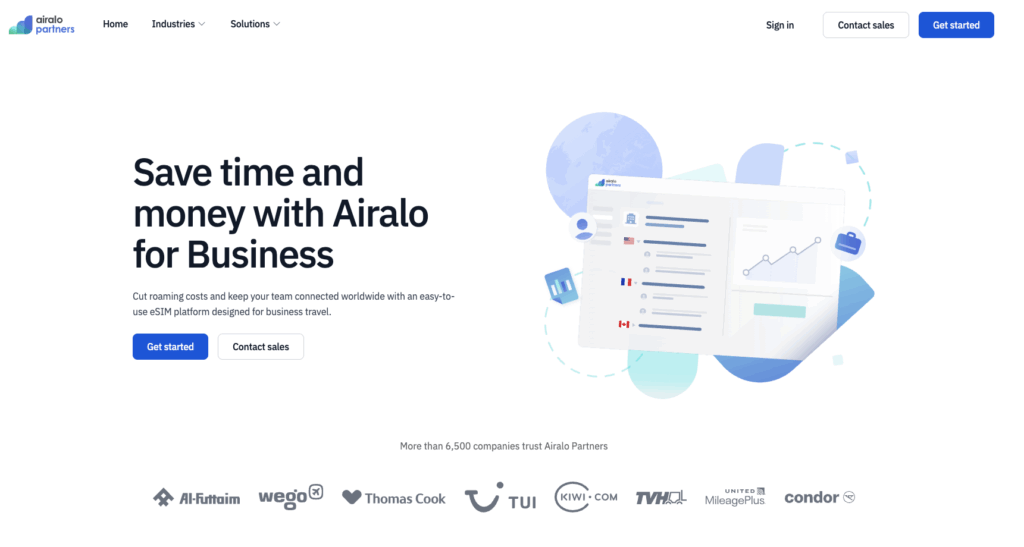
Airalo for Business suits companies that care as much about admin control as coverage. Its public business pages describe a platform built around centralized buying, assignment, reporting, and billing, which is the sort of structure you need once more than a few people travel each month.
On the coverage side, Airalo offers local, regional, and global options across 200+ destinations. It also says businesses can use one global eSIM for data, calls, and texts in 130+ countries, which helps if your travelers move between markets and do not want to swap plans trip by trip.
Admins can assign eSIMs directly or let employees buy them in the Airalo app under company rules. Self-purchase only helps if finance keeps control, and Airalo addresses that with organization and employee budget limits, multi-level branch structures, and consolidated monthly invoices for organization-billed purchases.
If your company has several offices or cost centers, the branch structure should make spend easier to track by team instead of rebuilding it from card statements after the trip.
Airalo is also the only provider here whose public business pages clearly highlight SSO, meaning single sign-on, plus SCIM for automated user provisioning on its enterprise setup. That makes offboarding easier when staff leave or when contractors only need short-term access.
The main drawback is pricing transparency. Airalo does not publish a public business rate card, so you may need a sales conversation before you know what your actual cost will be.
Choose this provider if you need centralized control, branch reporting, and flexible ways to buy and assign eSIMs.
Consider another provider if you want public upfront pricing or mostly need unlimited data for frequent travelers.
Holafly for Business
Best for: frequent business travelers
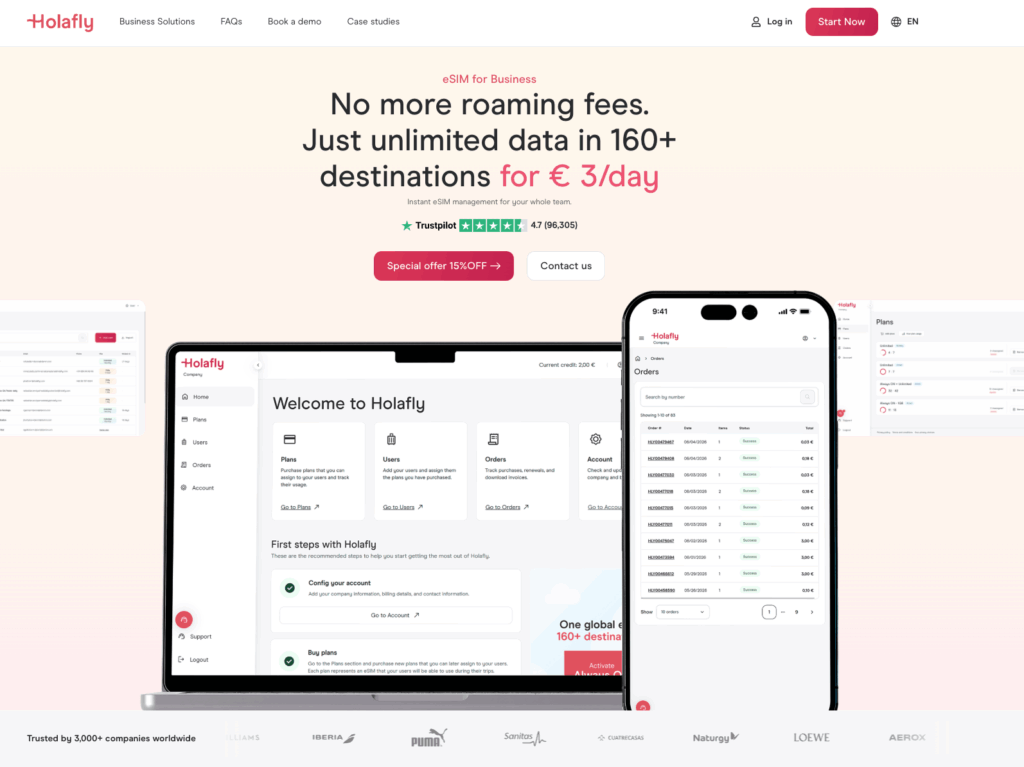
Holafly’s business offer centers on unlimited data and one Business Center for managing plans.
For businesses with frequent travelers, that can be appealing. Holafly’s business offer covers 160+ destinations, supports centralized management through the Holafly Business Center, and lets admins assign eSIMs, add or remove plans, manage users, and track billing cycles and invoices from one place.
The plan structure also fits regular travel better than one-off holiday-style bundles. Holafly lists daily, monthly, annual, and enterprise options, so you can match the plan to how often employees travel instead of buying every trip from scratch.
That can work especially well for relocation trips or project work that lasts several weeks. Instead of guessing how many top-ups one employee will need, you choose a time-based plan that matches the travel pattern and keep the process consistent.
Holafly’s own FAQs say the Business Center does not show individual data usage per eSIM, which is an important limitation if you want user-level reporting or tighter policy control.
Calls, SMS, and local numbers are also not clearly explained on the public business pages. Treat Holafly as a data-first business travel option until sales confirms anything more specific in writing.
Choose this provider if your team travels often, uses a lot of data, and wants a recurring unlimited-data setup.
Consider another provider if you need deep per-user reporting, public pricing, or clearly documented voice and SMS options.
Nomad Enterprise
Best for: IT-led teams and integrations
Nomad Enterprise suits companies that want an admin layer and room to connect eSIM provisioning to wider internal systems later. Its enterprise materials focus on travel connectivity, not one-off staff purchases.
Nomad’s enterprise solution is available to businesses worldwide and provides connectivity in 200+ destinations. Admins can allocate eSIMs through a web portal or automate that through its API, which helps if travel connectivity needs to fit existing workflows.
Its FAQs say admins can distribute eSIMs through the enterprise portal, monitor each eSIM’s status and data use, and add as many admin users as needed. Two-factor authentication by email is supported by default.
Billing is also more flexible than the public sales-led setup might suggest. Nomad says companies can use pay-as-you-go payments or monthly post-paid billing, and it can integrate with expense-management systems such as Concur, depending on scope. That combination makes sense for businesses that want eSIM costs tracked centrally without forcing every employee to expense data separately.
Hotspot and tethering are supported, which matters for staff who need to connect a laptop on the road. Calls, SMS, and local numbers are not clearly explained on the employee-travel pages, so treat Nomad as a data-first option unless sales confirms more.
The main drawback is pricing visibility. The enterprise pages do not list public business prices, and the FAQ says employee top-ups on traveler accounts are not attributed to the company account at this stage.
Choose this provider if you want web-portal oversight, multiple admins, and room for API or expense-system integrations.
Consider another provider if you want public upfront pricing or a simpler setup with fewer moving parts.
Business plans, coverage and prices may vary by destination, usage, team size and contract terms. Check the provider’s current business offer and request a written quote before committing.
How to choose a business eSIM provider
Choose based on travel patterns, IT control needs, and how finance wants billing to appear.
Start with your actual routes. A team that mostly travels between London, Paris, and New York does not have the same needs as engineers moving between secondary cities or staff relocating for months at a time. Ofcom’s coverage data is a reminder that UK networks are generally strong, but results still vary by operator and location.
Then check the buying model. A distributed team working across several countries may care more about branch structures and consolidated invoices, which is where Airalo looks stronger. A sales team that travels every week may care more about unlimited recurring plans, where Holafly has the clearest pitch. A business that wants a web portal now and API or expense-system integration later may find Nomad more useful.
Pooled data and fixed per-user plans solve different problems. Pooled data means one shared allowance across several employees. It can work well when some travelers use very little and others use a lot. Fixed individual plans are easier to monitor, but can lead to waste if heavy users top up while light users leave data unused. None of the 3 public business pages makes pooled data a core selling point, so ask about it if shared usage matters.
Think about employee behavior, too. A consultant who mainly answers email has very different needs from a manager who uses hotspot data for laptop work all day, or a relocated employee who may need a local number for weeks. The risk here is buying on headline price, then discovering the plan does not fit the way work actually happens.
Also check:
- Whether your employees need calls, SMS, or just data
- Whether hotspot use is allowed for laptop work
- Whether personal devices are allowed, or company policy requires company-managed phones
- Whether you need SSO, meaning employees sign in with the same company login they already use
- Whether IT needs MDM, short for mobile device management, or an API, which is a way to pass data between systems automatically
- Whether offboarding is easy when an employee leaves or changes role
If you use employee-owned phones, offboarding matters just as much as onboarding. You need to know who removes the plan, what happens to any stored balance, and whether the provider gives admins enough control to cut access quickly.
Business eSIM versus roaming and local SIM cards
Business eSIMs usually beat roaming on cost predictability and central oversight, but they are not always the best answer if an employee needs a local number for a long stay.
| Option | Usually best for | Main drawback |
|---|---|---|
| Managed business eSIM | Teams that need central assignment, reporting, and billing | Voice, SMS, or local number features may be limited |
| Corporate roaming | Very short trips where zero setup matters most | Costs can be harder to predict |
| Local SIM cards | Longer stays or cases where a local number matters | More admin, more reimbursements, less visibility |
| Individual travel eSIMs | Occasional solo travelers | Little or no company control over usage or invoicing |
Corporate roaming is often the easiest option for the traveler because nothing changes on the device. The trade-off is that the company usually loses cost predictability. Local SIM cards can be cheaper in some long-stay cases, but they shift the work back onto the employee and the expense team.
Local SIM cards can still make sense for longer stays, especially if an employee needs a local number or wants to compare mobile phone plans in the UK. If you are comparing staff connectivity with consumer options, Expatica’s guide to the best eSIM in the UK covers individual travel plans rather than managed company accounts.
Which business eSIM should you choose?
Start with Airalo for Business unless your main priority is unlimited recurring data, where Holafly may fit better, or portal controls and integrations, where Nomad is stronger. Before signing, confirm route coverage, voice or SMS needs, and exactly how invoices, top-ups, and support will work in practice.
FAQ
Frequently asked questions
What is a business eSIM? 
A business eSIM is a digital SIM your company can assign and manage for employees instead of handing out physical SIM cards or relying on roaming. The difference from a standard travel eSIM is the admin layer, which may include budgeting, centralized billing, and user management.
Can one company manage eSIMs for multiple employees?
Yes. The stronger options let admins assign plans, monitor spend, and control who can buy or top up connectivity.
Are calls and SMS included with business eSIMs?
Not always. Many business travel eSIM offers are still data-first, so you should confirm in writing whether calls, SMS, or a local number are included on the specific plan you want.
Can business eSIMs be installed on personal phones?
Yes, if company policy allows bring-your-own-device use and the phone is unlocked and eSIM-compatible. If you go that route, make sure offboarding is clear so company-funded connectivity is removed when the role or trip ends.
Sources
Expatica’s experts are all about providing the most up to date and accurate information. All guides are fact checked, and whenever we use external sources (like government websites or research papers) we’ll make a note of them here so you can check them out too.
- Connected Nations update: Spring 2026, Ofcom
- eSIMs for business travel, Airalo for Business
- What is Holafly for Business and how does it work, Holafly Business
- FAQ Nomad eSIM Business solutions, Nomad eSIM for businesses
We checked the sources above on 6 October 2026. Product details, coverage, and business terms can change, so confirm the current offer before you buy.