
'%20id='ico-down'%20stroke='%23000000'%20stroke-width='1.5'%3e%3cg%20transform='translate(1092.250000,%20254.750000)'%3e%3cpolyline%20id='Path-2-Copy-4'%20transform='translate(5.500000,%202.750000)%20scale(1,%20-1)%20rotate(-180.000000)%20translate(-5.500000,%20-2.750000)%20'%20points='0%200%205.5%205.5%2011%200'%3e%3c/polyline%3e%3c/g%3e%3c/g%3e%3c/g%3e%3c/svg%3e)


Move
Visas + Immigration
Work visas in Thailand
If you want to find employment in Thailand, bring yourself up to speed with work visa requirements, what’s available, and how to apply.


Thinking of moving to Thailand for work? Then you’ll need to sort out a visa before you travel. This is usually fairly straightforward if you’ve already found a decent job, but you’ll need to be aware of the necessary procedures.
Find out all about Thailand work visas and permits by reading up on the key information, including:
Working in Thailand
Thailand is one of the world’s tourism hotspots, attracting people from all over the globe thanks to its rich culture, lush beaches, tasty cuisine, and reasonable cost of living. However, although short-stay tourist visas (วีซ่าท่องเที่ยวระยะสั้น) are fairly easy to obtain, getting permission to work in the country takes a bit more planning.
Although Thailand has a thriving economy, with popular industries including tourism, real estate, teaching, and hospitality, foreigners looking for employment need to meet certain requirements, in fact, working legally in Thailand usually means applying for both a visa and a work permit, so you’ll need to steady yourself for a fair amount of bureaucracy.
It’s also essential to be aware that, since 1979, there have been around 40 occupations or professions prohibited or restricted for foreigners (PDF). These include wood carving, hairdressing, Thai massage, secretarial work, and construction.

Thailand has a low unemployment rate of only 1.1% (2023). Although the country relies to an extent on foreign labor, the majority of its positions are filled by workers from low-income neighboring countries looking for a better quality of life. There is also a sizable irregular, or informal, workforce that accounts for as much as 50% of the total working migrant population. These workers mainly fill the constant supply of insecure and low-wage jobs. Officially, migrant workers make up 7.6% (PDF) of the labor force in Thailand (2019).
Thailand currently has a cap on foreign workers set at a maximum of 20% of the total workforce, although this doesn’t apply to growth industries promoted by the Thai Board of Investment (BOI) (คณะกรรมการส่งเสริมการลงทุนบีโอไอ).
The Thai Immigration Bureau (สำนักงานตรวจคนเข้าเมือง) is responsible for entry visas into the country, while the Ministry of Labor (MoL) (กระทรวงแรงงาน) deals with work permits.
Do you need a work visa for Thailand?
Anyone entering Thailand intending to take up legal employment needs to apply for a visa or work permit. This is the case even for short-term assignments in Thailand. The only exceptions are for certain diplomatic positions, where visa waivers are possible.

Residents of certain countries can enter Thailand without applying for a visa beforehand and stay for 14–90 days visa-free. However, they will still need to apply for a work permit in the country before taking up employment.
Types of work visas in Thailand
There are four main types of work visas for Thailand. These are:
- Non-immigrant visas (วีซ่าคนอยู่ชั่วคราว) – this subcategory includes the standard employment visa for work and business
- Smart visa (สมาร์ตวีซ่า) – a new permit for executives and entrepreneurs
- Long-term resident (LTR) visa (วีซ่าผู้พำนักระยะยาว) – a more permanent visa for certain categories of migrants, including highly skilled professionals
- Diplomatic and official visas (วีซ่านักการทูตและวีซ่าราชการ) – for diplomats and those in Thailand on official visits
Non-immigrant work visas for Thailand
There are several different categories of work-related non-immigrant visas for Thailand, which are:
- B visa (วีซ่าประเภทบี )– general visa for work, business, and internships
- IB visa (วีซ่าประเภทบี) – business investment visa for those investing in the Thai economy through the BOI
- M visa (วีซ่าประเภทบี) – media visa to work as a journalist, reporter, or as part of a film crew in Thailand
- R visa (วีซ่าประเภทบี) – for official missionary work or other religious activities in Thailand
- EX visa (วีซ่าประเภทบี) – to work as a specialist or expert in a particular field
- RS visa (วีซ่าประเภทบี) – to conduct scientific research, training, or teaching in a Thai research institute
- F visa (วีซ่าประเภทบี) – to perform official duties using a regular passport
You will generally need a job offer or letter of approval/invitation from a licensed Thai business or organization to apply for one of these visas. Additionally, you’ll need evidence of the necessary skills and experience for the position. For example, those carrying out scientific research will need proof of their educational qualifications.
How to apply
You must apply for a Thai work visa at the Thai embassy in your home country before traveling. Nowadays, it’s possible to do so online through the Thai E Visa portal, which provides details of application requirements and processes. You must create an account to start an application.
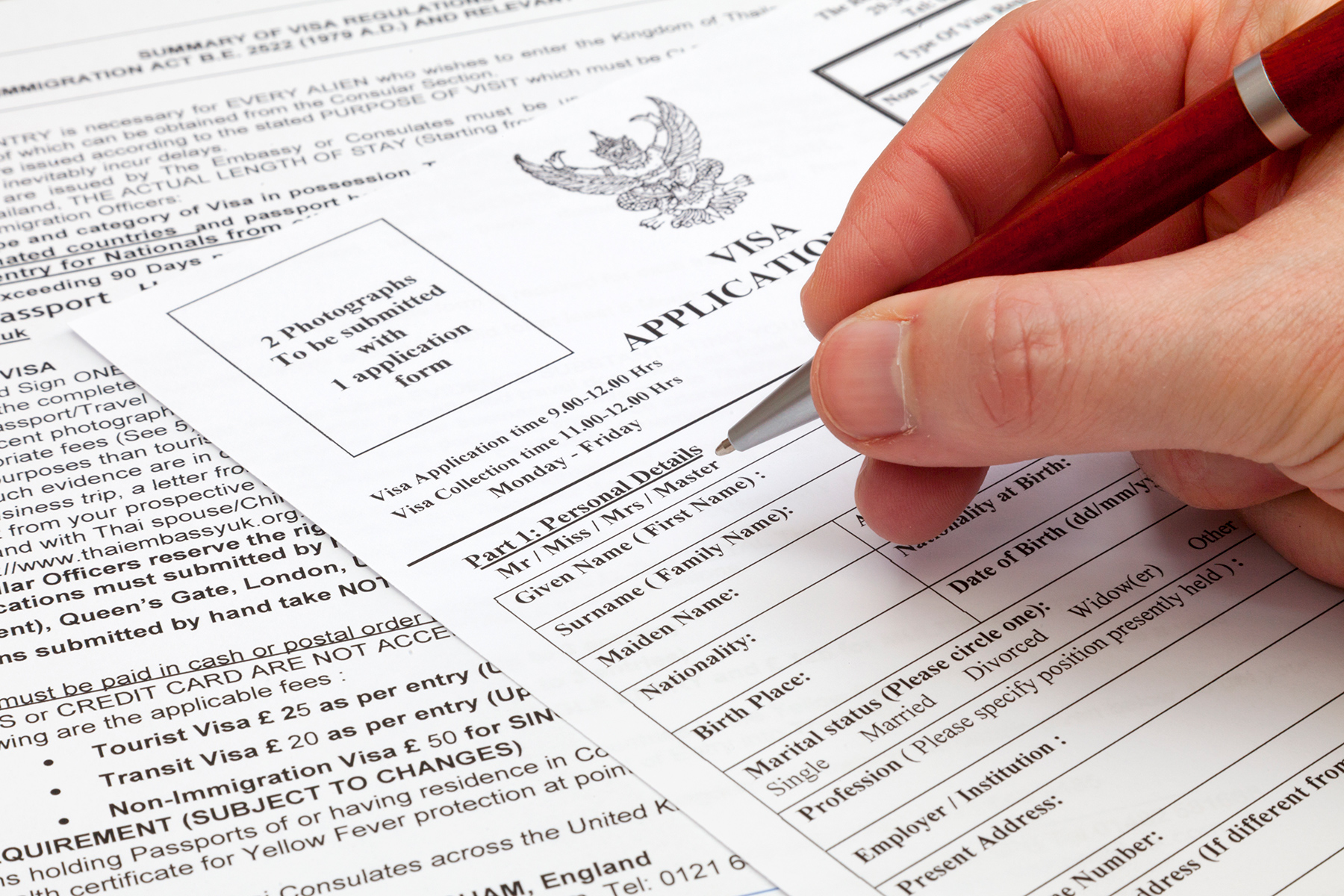
To give the authorities time to process everything ahead of your travels, you should submit your application at least 15 working days before your travel date. Documentation to provide includes:
- Your completed application form
- Passport valid for at least the next six months (or 18 months if applying for a multi-entry visa)
- Passport photograph (4x6cm) taken within the last six months
- Evidence of at least ฿20,000 per person or ฿40,000 per family
- Proof of job offer through a letter of approval from the MoL (obtained by your prospective employer once they file for a work permit) (B visa)
- Employment contract, including salary details, signed by the company executive of your prospective employer (B visa)
- Business registration and license details from prospective employer (B visa)
- Letter of approval from BOI (IB visa)
- Official letter of invitation with details of the purpose of your visit from a licensed Thai organization (M, R, EX, RS, F visas)
- Media permit from MFA Media Online Service (M visa)
- Proof of any educational qualifications and experience needed for the role
Additionally, prospective employers may have to send company documents, including shareholder details, a list of foreign workers, and tax returns. Documents must be submitted in English or Thai – if translated into English, they must be notarized.
Once you have submitted your application, it usually takes around 10 days to process.
Visa length
Single-entry non-immigrant visas are valid for three months, while multi-entry ones are valid for up to one year. You can apply for a three-year multi-entry B visa for business purposes if you need to make return visits to Thailand over a longer period. Each visit can last up to 90 days, and you cannot seek employment while in the country on this visa.

You can apply for an extension to your non-immigrant visa through the Thai Immigration Bureau. Extensions are usually granted for up to one year, sometimes longer, and are made at the bureau’s discretion. In any case, you must report to the bureau at least once every 90 days during your stay.
Visa costs
Non-immigrant visa fees are:
- ฿2,000 – single-entry visa
- ฿5,000 – multi-entry visa
- ฿10,000 – three-year multi-entry visa
You must pay these fees as part of your application. All standard payment methods, for example, Visa, Mastercard, and American Express, are accepted.
Smart visas for Thailand
The Smart Visa is a new Thai work visa introduced in 2018 to encourage investment and innovation in the Thai economy. This visa is open to foreign experts, executives, entrepreneurs, and investors looking to work, start a business, or invest in one of the 13 so-called S-Curve industries. These are:
- Affluent, medical, and wellness tourism
- Agriculture and biotechnology
- Alternative dispute resolution
- Automation and robotics
- Aviation and logistics
- Biofuels and biochemicals
- Digital
- Environmental management and renewable energy
- Food for the future
- Human resource development in science and technology
- Medical hub
- Next generation automotive
- Smart electronics

To qualify for a smart visa to Thailand, you will need a letter of endorsement from the BOI before applying. In order to obtain this, you must meet the following requirements:
- Smart T (Talent) visa: Expertise in a science or technology industry and a job contract offer of at least one year with a minimum salary of ฿100,000 a month (or ฿50,000 if working for a startup)
- Smart I (Investor) visa: Minimum investment of ฿5 million in a startup or ฿20 million in a technology-based business in one of the targeted industries
- Smart E (Executive) visa: Degree or minimum 10 years’ experience and a job contract offer of at least one year for a senior position with a minimum salary of ฿200,000 a month
- Smart S (Startup) visa: Minimum of ฿600,000 in bank account and a director or minimum 25% shareholder role in a startup business in one of the targeted industries, plus health insurance covering yourself and any dependents
How to apply
The first step in the application process is receiving a letter of endorsement from the BOI. You can get this from the Smart Visa Unit (หน่วยวีซ่าสมาร์ต) at the Thai Immigration Bureau’s One Stop Center for Visas and Work Permits (OSS – ศูนย์บริการ).
You can then proceed with your visa application through the Thai embassy in your home country or by setting up an account on the Thai E Visa portal. It takes 10–14 days to process most smart visa applications, so give yourself plenty of time ahead of your planned travel date.
Along with your completed application form and accompanying forms, you must supply:
- Passport with at least six months of validity remaining from the travel date
- One passport-sized photo (4×6 cm)
- Letter of endorsement from BOI
- Proof of health insurance for yourself and any dependants if applying for the Smart S visa
Visa costs
Thai smart visas cost ฿10,000 per year to process, and you will need to pay full costs upfront when you apply. For example, if you apply for a two-year smart visa, you’ll pay ฿20,000.
Visa length
These visas are available for up to four years (or two years for the startup visa) and are usually renewable. The added benefit of the smart visa is that you don’t have to subsequently apply for a Thai work permit once you arrive in Thailand. You also only have to report to the Thai immigration authorities once a year rather than 90 days, which is the standard requirement for other visas.
Long-term resident (LTR) visas
The relatively recent LTR visa is valid for long-term stays of up to 10 years and is renewable. It is mainly aimed at wealthy individuals who don’t need to work, but it also includes two employment-related categories:
- Remote workers of overseas companies
- Highly-skilled and high-earning professionals working for businesses, academic institutions, or government agencies

Applicants need a job offer with a salary of at least $80,000 (equivalent to approx. ฿2.8 million), at least five years’ experience, and health insurance covering themselves and any dependants. The minimum salary requirement is waived for employees of government agencies.
Benefits of the LTR visa include unlimited re-entry, no taxation on overseas income, and a flat 17% income tax rate for highly skilled professionals.
How to apply
Before completing your application, you must register with the BOI visa service for LTR visas to get prior approval. This means providing evidence of employment offer/contract with the required salary, necessary qualifications and experience, and health insurance.
This initial process can take up to three working days. Once you have BOI approval, you can proceed with your visa application through the Thai embassy in your home country or the Thai E Visa portal. Along with the completed application forms, you will need to supply:
- Passport with at least six months of validity remaining from the travel date
- One passport-sized photo (4x6cm)
- Letter of endorsement from BOI

The LTR visa can take up to 20 days to process.
Visa costs
An LTR visa costs ฿50,000 for 10 years but may also involve additional processing or admin fees if you apply through a Thai embassy abroad. You will need to pay in full when you make your application.
Visa length
Visas are available for up to 10 years and are renewable. Typically, they are valid for five years initially, and you can then renew the visa for an additional five years through immigration services. Similar to the smart visa, you only have to report to the Thai immigration authorities once a year rather than every 90 days.
Diplomatic/official visas
The Diplomatic or Official Visa is for holders of diplomatic (red) or official visit (blue) passport holders to conduct official international business in Thailand on behalf of overseas government agencies.
These are usually valid for three months and can be extended by applying to the Department of Protocol within the Ministry of Foreign Affairs (MFA).
Work permits in Thailand
Work permits in Thailand are separate from work visas – a visa allows you to enter the country, while a work permit gives you permission to begin employment. However, if you come to Thailand on a smart visa, you won’t need an additional work permit.

Typically, your employer submits an initial permit application to the MoL to get approval for the work visa. One of you will then need to apply to the MoL to pick up the work permit once you arrive in Thailand. You should do this within 90 days of arriving (extended to one year for LTR visas), but bear in mind that you need it in place before starting your job.
Both employer and employee need to meet certain conditions before issuance. Companies employing foreign workers in Thailand must:
- Be a registered company in Thailand paying tax (and VAT, if applicable)
- Be registered for Social Security
- Employ at least four Thai nationals for every foreign worker, although this does not apply to businesses in industries promoted by the BOI
- Provide evidence of at least ฿2 million capital per work permit applied for
Employees generally need:
- A Thai work visa
- Proof of either health insurance or access to public health services through employer insurance
- Details of accommodation in Thailand
- Three passport-sized photos (4x6cm)

If you are applying through the BOI, for example, for an LTR visa, then they will usually support you with your work permit applications. Fees consist of:
- ฿100 processing fee
- ฿750 for a permit valid for three months
- ฿1,500 for a permit valid for 3–6 months
- ฿3,000 for a one-year permit
Thai work permits are usually issued to cover one employment position. If you want to change jobs in Thailand, you should contact the Thai Immigration Bureau.
Work visa income requirements
Internationals – especially in the corporate sector – must earn the monthly minimum wage or above to retain their Thai work permit.
These are as follows:
| Nationality | Minimum monthly wage |
| Canada, Japan, and the United States of America | ฿60,000 |
| Australia, Europe, and the United Kingdom | ฿50,000 |
| Hong Kong, Malaysia, South Korea, Singapore, and Taiwan | ฿45,000 |
| China, India, Indonesia, the Middle East, and the Philippines | ฿35,000 |
| Africa, Cambodia, Laos, Myanmar, and Vietnam | ฿25,000 |
However, there are some exceptions to the above minimum wages.
For example, employees working outside the corporate sector may still get a work permit with an official letter from the relevant government agency confirming the waiver of salary limits. This is most common for teaching jobs and those working in NGO organizations, where the salaries are often below the minimum pay for international employees.

Can you work in Thailand on a student visa?
Unlike in many countries, foreigners on a student visa in Thailand are not permitted to work while studying. You will need to show that you have sufficient funding to support yourself independently of employment during your studies.
If you wish to work while studying in Thailand or look for work after graduation, you will have to apply for a relevant work visa.
Thai work visas for self-employed, freelancers, and entrepreneurs
Thailand doesn’t have a self-employment visa, and it can be a challenge to move there and begin freelancing. In general, entrepreneurs and those wanting to strike out alone need to meet very specific conditions. Also, bear in mind that there are certain professions that are prohibited to foreigners in Thailand.

If you are an entrepreneur or are looking to set up a business in Thailand, you can apply for one of the following:
- Non-immigrant IB visa – if you wish to set up or invest in a registered company. Bear in mind that businesses not approved by the BOI or Department of Business Development (DBD) can have a maximum of 49% foreign ownership.
- Smart visa for Investor (I) – if you are investing a large amount (minimum ฿5 million) in a startup or business in a BOI-approved targeted industry
- Smart visa for startups (S) if you have minimum capital for your own enterprise or have a 25% share in a BOI-approved startup

You can technically work as a freelancer in Thailand for an established company based overseas. However, this remote worker visa is only available to those earning a minimum salary of $80,000 (approx. ฿2.8 million) from a business, so you will need to provide some sort of contract from the company showing that you will earn and pay tax in Thailand on this amount each year.
Work visas for seasonal/temporary workers in Thailand
There are no temporary worker visas available in Thailand. For short-term work, you can apply for a B visa or other suitable documentation if both you and your employer meet the conditions for the visa and work permit.
Visas are issued for a three-month period and are usually renewable for up to one year for longer contracts.
Thai work visas when volunteering and gaining work experience
If you take up an internship in Thailand, you can use the non-immigrant B work visa. The processes and requirements are generally the same as if you were applying for a visa for standard employment.
If you want to do voluntary work for a charity, NGO, or association in Thailand, you can apply for a non-immigrant O visa. This is an “Other Categories” visa that can be used for a variety of purposes, including family visits, medical treatment, or taking part in the judicial process.

To apply for this visa for volunteering purposes, you will need to provide:
- A passport with at least six months’ validity on it
- A passport photo taken within the last six months (4x6cm)
- A letter confirming voluntary work signed by an authorized person at the organization
- Registration details of the organization
As with the non-immigrant work visas, you can apply for an O visa through the Thai embassy in your home country or the Thai E Visa portal. Fees are ฿2,000 for a three-month single-entry visa or ฿5,000 for a one-year multi-entry visa. You won’t need to apply for a work permit.
Do your family members need separate work visas in Thailand?
You can bring your spouse and any children under 20 (older if they cannot support themselves due to health reasons) with you on a work visa to Thailand. They need to apply for separate family member visas linked to your work visa. For example:
- If you have a non-immigrant work visa, they will apply for a non-immigrant O visa
- If you have a smart visa, they will need a Smart O visa
- For the LTR visa they will also apply for an LTR visa as a family member
Family members cannot work on a non-immigrant O visa. If they want to seek employment, they must contact the Thai Immigration Bureau about a change of visa and apply for a work permit. Spouses with Smart Visas or LTR visas, on the other hand, are allowed to work. LTR visa holders will need a work permit. However, those with Smart O visas are exempt from this requirement.
Children of those with Smart T visas can work if they are 18 or over.

Along with the standard documentation, you will need to provide proof of relationship, such as a marriage or birth certificate, along with proof of finances. This amount is currently:
- ฿20,000 (individual) or ฿40,000 (family) for a standard O visa
- ฿180,000 per individual for a Smart O visa (only if accompanying someone on a Smart S visa, otherwise there is no financial requirement)
What is the work visa appeals and complaints procedure in Thailand?
Unfortunately, there is no appeals process if your Thai visa application is denied. Furthermore, application fees are non-refundable. However, you may be offered the chance to amend or resubmit your application.
You should receive a refusal letter giving full details of why your application was declined. If you feel you have been unfairly denied a Thai visa, you can take the case to a Thai court. However, it’s wise to consult a legal professional in Thailand before doing this – it is expensive, time-consuming, and rare for decisions to be overturned.
Because visa extensions are at the discretion of the immigration services, it is also difficult to appeal against an extension refusal.
Useful resources
- Thai Immigration Bureau – deals with immigration and visa issues in Thailand
- Ministry of Foreign Affairs (MFA) – information on Thai visas
- Thai E Visa portal – MFA portal where you can apply for visas in Thailand
- Ministry of Labor (MoL) – issues work permits in Thailand


Did you find this guide helpful?