
'%20id='ico-down'%20stroke='%23000000'%20stroke-width='1.5'%3e%3cg%20transform='translate(1092.250000,%20254.750000)'%3e%3cpolyline%20id='Path-2-Copy-4'%20transform='translate(5.500000,%202.750000)%20scale(1,%20-1)%20rotate(-180.000000)%20translate(-5.500000,%20-2.750000)%20'%20points='0%200%205.5%205.5%2011%200'%3e%3c/polyline%3e%3c/g%3e%3c/g%3e%3c/g%3e%3c/svg%3e)


Education
Higher Education
Master’s Degrees in the Netherlands: How to Compare Programs
Comparing master’s degrees in the Netherlands starts with understanding what happens inside the classroom, not just reading the degree title.


The real difference starts with institutional structure – research universities (WO) focus heavily on theory and academic analysis, while universities of applied sciences (HBO) emphasise practical, job-ready skills.
Because Dutch universities set their own entry requirements, tuition rates, and application deadlines, relying on generic rules usually leads to surprises down the line. This guide breaks down programme types, practical costs, and key application steps to help you find the right academic fit.
Key takeaways
- A Dutch master’s degree can be offered by a research university or a university of applied sciences, fundamentally shaping the teaching style and career path.
- Many programmes last at least one year, but research, technical, and some specialised routes can run longer, so check ECTS credits, the workload measure, plus the thesis and start date.
- English-taught master’s programmes are common, but not every internship or support service will be in English.
- Admissions vary by institution, faculty, and programme.
- Tuition fees vary by nationality, institution type, and programme length.
- Always confirm language, accreditation, deadlines, and total first-year costs on the institution page, and cross-check accreditation through Study in NL or NVAO when needed.
What types of master’s degrees can you study in the Netherlands?
The Dutch higher education system is binary, so a master’s degree in the Netherlands can sit in more than one track. Start with institution type because it shapes teaching style, admissions, and the final project.
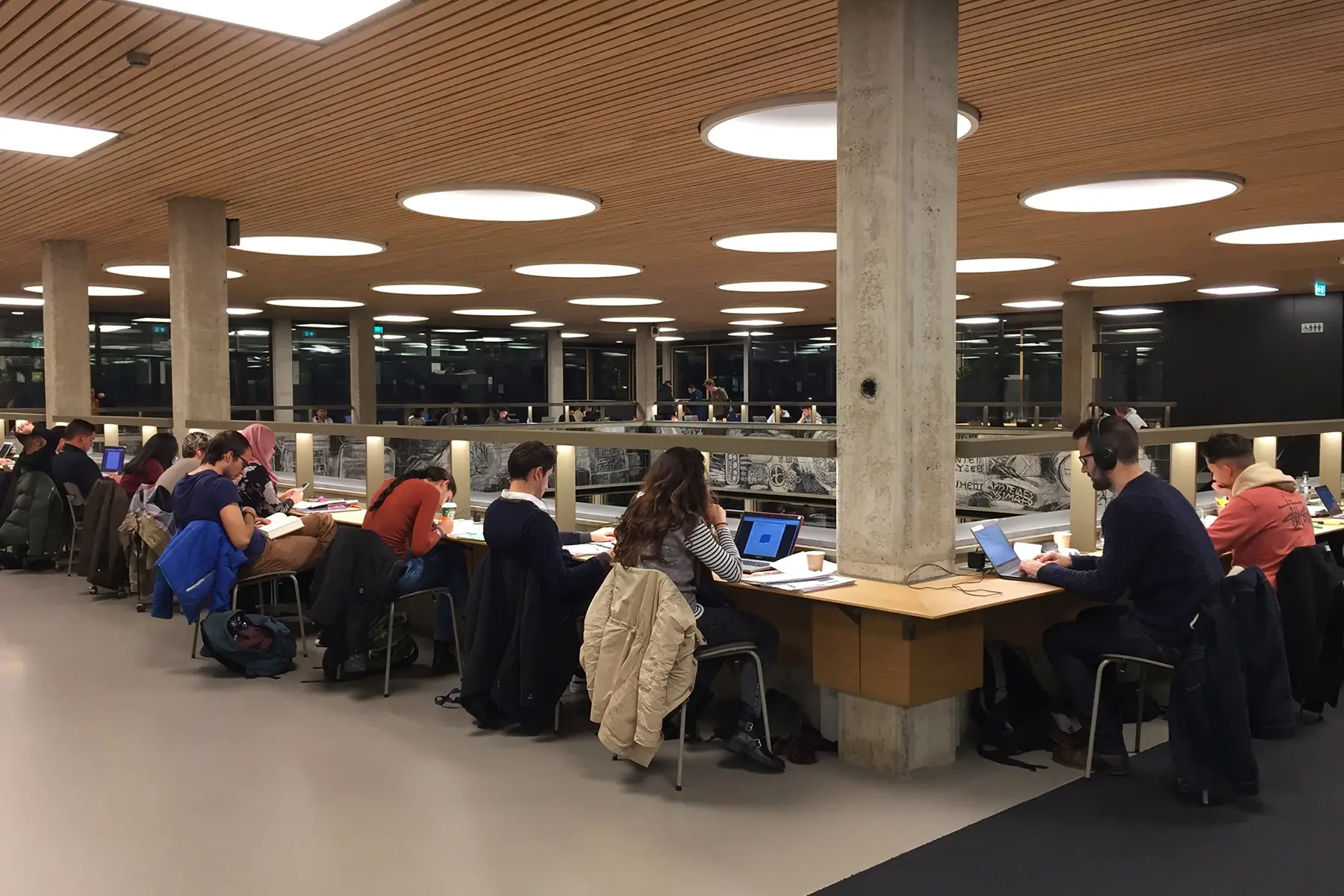
Research universities vs universities of applied sciences
English-language programme pages can make Dutch institution types sound more similar than they are. Check whether a course sits in a universiteit, a research university, or a hogeschool, a university of applied sciences.
| Topic | Research university (WO) | University of applied sciences (HBO) | What to verify |
|---|---|---|---|
| Main focus | Academic research | Professional practice and applied research | Whether the course is theory-led or practice-led |
| Teaching style | More theoretical and method-based | More practice-based, often built around cases | Class format, projects, contact hours |
| Final work | Usually a thesis with a strong research element | Thesis, final project, or applied research output | Final assessment and thesis expectations |
| Common fit | Research roles, PhD preparation, or theory-led specialist work | Profession-facing roles or applied specialisation | Entry profile, work experience, career outcomes |
| Dutch label to check | Universiteit, WO | Hogeschool, HBO | Institution type on the programme page |
Neither route is automatically better. Government.nl describes HBO as higher professional education and WO as research-oriented higher education, which is why similar course titles can lead to different study experiences.
Course names in the Netherlands can be deceptive. Two degrees with the exact same English title can offer completely different experiences depending on whether they sit in a research university (universiteit) or a university of applied sciences (hogeschool). Check the school type first to know what daily study actually looks like.
One-year, two-year, and research master’s options
Many Dutch master’s programmes are one year, but duration is not universal. WO master’s programmes are often one year, while technical, natural science, and research master’s courses are often two years.
A research master’s usually means a more method-heavy, academic route that can suit students considering PhD study or research-led work. Check the programme page for ECTS, thesis load, internship requirements, start month, and intake options.
On Studyfinder for 2026 and 2027, Erasmus University Rotterdam lists a one-year, 60 ECTS Philosophy master’s, while Wittenborg University of Applied Sciences lists a 1.5-year, 90 ECTS MBA in International Management, showing real variation.
How to choose the right English-taught master’s program
Looking beyond global league tables gives a much clearer picture of daily study life. Use this section to compare real classroom formats alongside long-term career directions.
A shortlist checklist for international students
Use this checklist when you compare Dutch master’s programmes:
Curriculum structure: Review core modules, electives, and whether the course ends in a research thesis, capstone, or professional project.
Teaching style: Look for seminars, lab work, studio work, case-based learning, or employer-linked assignments.
Language of instruction: Confirm that the programme is fully in English if that matters to you. English-taught does not always mean every internship or career event will be in English.
Internship and final project expectations: A professionally oriented master’s may lean more on applied projects or workplace exposure than a research-only track.
Location and housing pressure: A lower headline fee may not help much if local rent is high or housing support is limited.
Post-study direction: If you are unsure whether you want research, immediate employment, or a later PhD path, compare likely outcomes early.
That can mean choosing between a research-heavy thesis path and a professionally oriented capstone. Focus on which format matches the work you want to do after graduation.
What entry requirements should international students expect?
Admissions are set by institutions and often by individual programs, so compare patterns, not national rules. Start with the department or faculty page for each course on your shortlist.
Degree background and academic fit
Many programmes expect a relevant bachelor’s degree or clear subject fit, but the exact prerequisite mix can vary. Some departments want specific prior coursework, while others look more at your overall profile.
Nuffic can help you understand what your foreign diploma is broadly comparable to in the Dutch system. Even so, the institution makes the final admissions decision. Double-check required subjects, curriculum prerequisites, and faculty admissions pages before assuming you are eligible.
English requirements and common application materials
For English-taught master’s applications, document lists often ask for:
- Transcripts and diploma documents
- A CV or resume
- A motivation letter or statement of purpose
- Proof of English, if required
- Sometimes a portfolio, interview, GRE or GMAT score, or research proposal
Many applicants assume language rules are interchangeable, but they are not. Study in NL says institutions generally accept tests such as IELTS, TOEFL, Cambridge English, Pearson, LanguageCert, and TOEIC, but scores, exemptions, and accepted tests vary by programme.

How much does a master’s degree cost in the Netherlands?
There is no single national price tag for a master’s degree in the Netherlands. How much you actually pay depends on your residency status and whether your chosen institution is public or private.
Tuition fees and what changes the price
In Dutch higher education, tuition can reflect very different pricing models. Government-funded institutions may show a statutory fee, the regulated public rate for eligible students, and a higher institutional fee for others, while approved or private institutions can set their own fees.
| Factor | Why it matters | Where it changes | What to verify |
|---|---|---|---|
| Nationality | EU/EEA and non-EU/EEA students often face different fee structures | Institution and programme page | Your fee category for the year |
| Institution funding model | Government-funded, approved, and private institutions price differently | Institution profile and fee page | Statutory or institutional fee |
| Programme length | A two-year course can raise total cost more than a cheaper first-year fee suggests | Programme overview | Total fee across the duration |
| Course format | Specialised, technical, or professional formats may be priced differently | Faculty or programme page | Extra course, studio, or lab costs |
As of the 2026 and 2027 Studyfinder entries, Erasmus University Rotterdam lists an EU/EEA fee of €2,694 for its one-year Philosophy master’s in 2026 to 2027, while Wittenborg lists an institutional fee of €21,300 for its 1.5-year MBA in Entrepreneurship and Innovation. However, it’s good to remember that these figures show range, rather than a national average.
Funding, proof of funds, and paying from abroad
Start with scholarship filters in Study in NL, then move to the university funding page as eligibility is often programme-specific. Part-time work can help with daily costs, but rules and realistic earnings differ by nationality, schedule, and permit status.
Non-EU/EEA students may also need to show enough funds for residence permit purposes. On IND’s required amounts page, the study amount for higher professional education or university study is €1,130.77 per month for 2026, but figures can change, so check the current IND page and your institution’s payment instructions before you budget.
If your institution accepts it, some students use services such as Wise to pay tuition invoices from abroad, move money into euros for living costs, or hold multiple currencies before arrival. Use it only as an optional payment tool and follow the university’s accepted methods first.
Simplify international tuition payments with Wise
Paying tuition or transferring living funds to the Netherlands from abroad can be costly. Wise lets you convert and send money at the mid-market exchange rate with low, transparent fees, helping international students manage multi-currency expenses efficiently before and during their studies.

No commitment required
How and when do you apply?
Treat the application stage as planning. Institutions may use Studielink, their own admissions portal, or both, and timing can shift by intake, scholarship route, nationality, and housing support.
Studielink, institution portals, and deadlines
For most applicants, the central gateway is Studielink, the official Dutch registration and application portal. However, official platform guidelines note that certain institutions handle international applications directly through their own portals, making the individual university page your main source of truth.
Standard national cut-offs fall on 15 January for capacity-restricted (numerus fixus) courses and 1 May for non-restricted routes. Master’s programmes often operate on independent timelines, meaning scholarship deadlines, visa processing, and local housing shortages can require submitting applications much earlier.
What to verify after you get an offer
Once you have an offer, compare the practical conditions, not just the course title. Check deposit timing, tuition payment method, housing deadlines, document legalisation or translation, and any conditions tied to final transcripts.
For non-EU/EEA students, also confirm whether the institution is the recognised sponsor for the residence permit process and what documents they expect from you. Do not assume the school handles every step automatically because some tasks still sit with the student.
What should you plan beyond admission?
This is where a shortlist becomes a workable move. The main planning areas are living setup and life after graduation.
Housing and living costs
Housing pressure is a real comparison factor in the Netherlands, not just a late admin detail. When you compare cities, weigh rent and housing support alongside tuition fees because a lower course fee does not always mean a cheaper first year.

Expatica Tip: A slightly pricier programme can still be easier to manage if the city has better student housing support or a lower rent baseline.
Visas, residence permits, and post-study planning
EU and EEA students usually have a simpler path than non-EU and non-EEA students, who may need sponsor-based residence permit steps through their institution. For the full immigration process, use Expatica’s guide to Dutch student visas and then confirm the latest rules with IND and your university.
Post-study plans often influence your choice of course earlier than expected. Key elements like programme length and local job prospects directly affect your decision, while the orientation year visa (zoekjaar) offers a helpful search window rather than a guaranteed outcome. Many international students also set up a multi-currency account or travel card such as Wise before arriving to manage initial spending and cross-border transfers.
FAQ
Frequently Asked Questions about master's degrees in the Netherlands
Are most master's degrees in the Netherlands taught in English? 
The Netherlands offers many English-taught master’s programmes, but not every programme is in English. Some courses still involve Dutch-language internships or support services, so check the official programme page.
What is the difference between a research university and a university of applied sciences in the Netherlands?
A research university master’s is usually more academic and research-focused, while a university of applied sciences master’s is more profession-oriented and practice-led. That affects teaching style, final assessment, and career fit.
How much does a master's degree in the Netherlands cost for international students?
There is no single national fee for all international students. Costs depend on nationality, institution type, programme, and duration, so compare first-year costs and current institution figures.
Do all Dutch master's programmes have the same admission requirements?
No. Institutions and programmes set their own academic, language, and document requirements, so check the department-level admissions page before assuming you qualify.
When should international students apply for a master's in the Netherlands?
Start months in advance because deadlines, scholarships, housing, and residence permit steps do not always move together. Study in NL gives general signals, but the institution page is the final source for dates.
Sources
- Tertiary (higher) education – Government.nl
- Studyfinder – Study in NL
- The Netherlands – NVAO
- Studying in the Netherlands with a foreign diploma – Nuffic
- Required amounts income requirements – IND
- Studielink portal – Studielink
- Master’s degrees in the Netherlands – Study in NL
- Master programmes – TU Delft
- What’s the difference between HBO and WO? – TU Delft
- Education in the Netherlands – UniPage
- Master’s Degrees in the Netherlands – Study.eu
- Admission requirements – Study in NL
- How to apply – Study in NL
- Higher education – Nuffic
- Student residence permit for university or higher professional education – IND
Related Articles


Editor's picks
 Where to live in the Netherlands: the best cities for expatsAlthough Amsterdam is typically the number one hub for expats, there are plenty of other cities in the Netherlands worth your while.
 Higher education in the Netherlands: a guide to Dutch universitiesThe Netherlands is home to some of the world's top universities. Learn all about the different subjects available at Dutch institutions.
 Child benefits in the NetherlandsYou can claim different types of child benefits in the Netherlands, to help with the costs of child-rearing, schooling, and childcare.
Did you find this guide helpful?