
'%20id='ico-down'%20stroke='%23000000'%20stroke-width='1.5'%3e%3cg%20transform='translate(1092.250000,%20254.750000)'%3e%3cpolyline%20id='Path-2-Copy-4'%20transform='translate(5.500000,%202.750000)%20scale(1,%20-1)%20rotate(-180.000000)%20translate(-5.500000,%20-2.750000)%20'%20points='0%200%205.5%205.5%2011%200'%3e%3c/polyline%3e%3c/g%3e%3c/g%3e%3c/g%3e%3c/svg%3e)


Education
Higher Education
Study Physiotherapy in the Netherlands in English
Studying physiotherapy in the Netherlands in English is a popular route for international students, but the options are limited to a handful of universities.


While your lectures and coursework run in English, clinical placements and professional registration tend to bring Dutch language requirements into play much earlier than many applicants expect. This guide compares English-taught programs, admission rules, true first-year costs, and what it actually takes to qualify as a practising physiotherapist.
Key takeaways
- English-taught physiotherapy bachelor options in the Netherlands are limited and can change from year to year.
- The shortlist sits in the university of applied sciences sector, also called HBO, not the research university sector, also called WO.
- Admission to a degree and permission to practice later are separate checks.
- A program taught in English can still involve Dutch during local placements and patient contact.
- Verify tuition, deadlines, English requirements, placement language, accreditation, and BIG register implications directly before applying.
What to know before you apply
Many international students misunderstand how Dutch higher education is structured. On the shortlist, physiotherapy sits in the university of applied sciences sector, known in Dutch as HBO, where programs are profession-focused and practice-led rather than broad research degrees. Expatica’s guide to studying in the Netherlands explains how HBO differs from WO, the Dutch research university route.
Because the teaching model is hands-on, expect skills labs, placements, and patient-facing learning, not just lectures. The number, structure, and language route of English-taught options can shift between admission cycles.
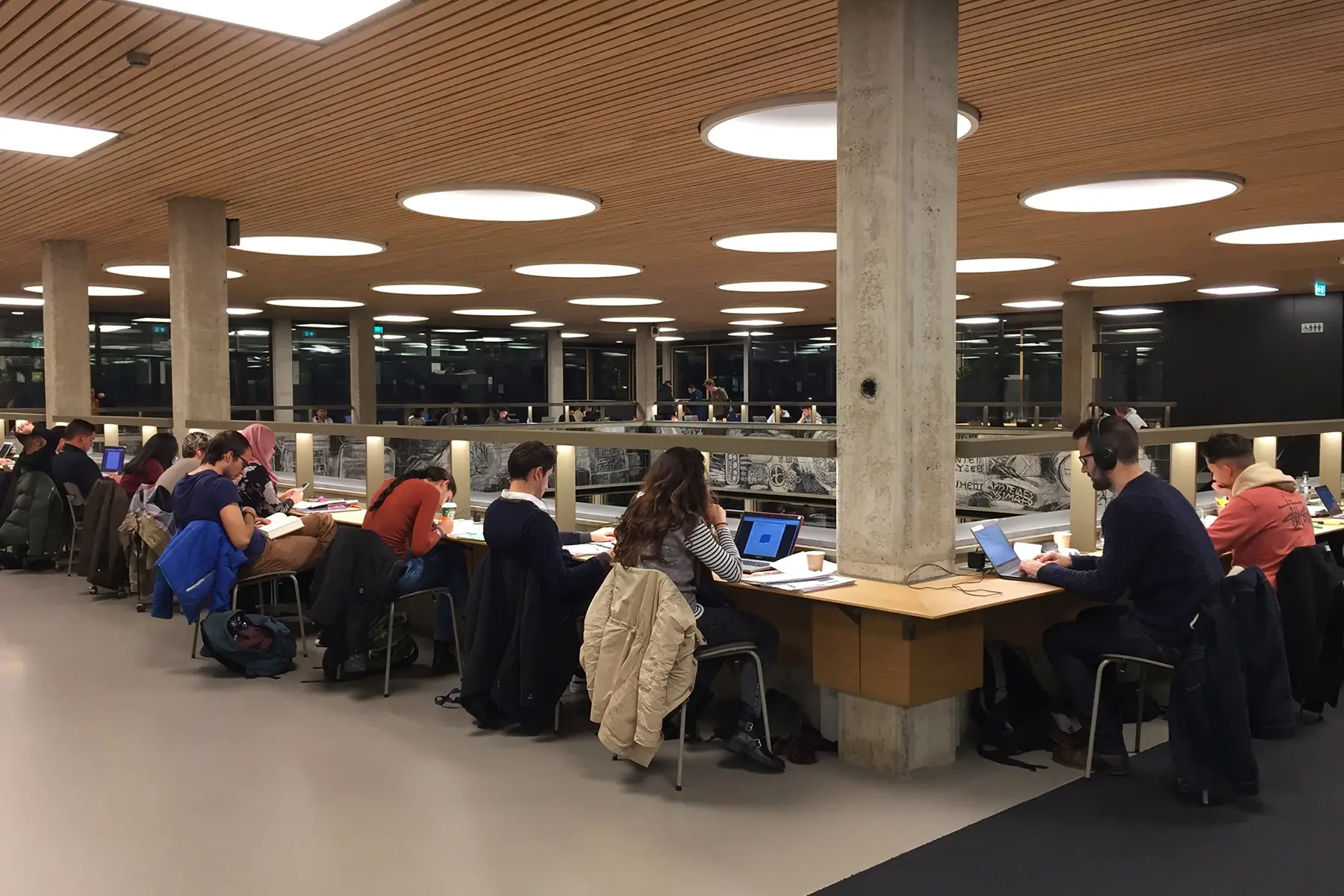
Key checks to make before shortlisting a programme:
- Confirm the degree sits within a university of applied sciences rather than a research university.
- Determine whether clinical placements require functional Dutch, even if classroom teaching runs in English.
- Look out for selective admission caps, which set strict application limits and candidate testing.
- Double-check that current NVAO accreditation and BIG-register recognition details are listed on the official course page.
Expatica Tip: Ask each school two separate questions by email. Is the degree taught in English, and can placements in the Netherlands be completed without Dutch? The answers are often not the same.
Compare the English-taught physiotherapy options
| Institution | City | Duration | Admissions note | Placement or Dutch note |
|---|---|---|---|---|
| Amsterdam University of Applied Sciences | Amsterdam | 3 years | Selection route, Studielink by 15 January 2027 | Dutch is needed for internships in the Netherlands |
| Hanze University of Applied Sciences | Groningen | 4 years | Selection route with a 15 January deadline | Includes Dutch language and culture content in year 1 |
| Saxion University of Applied Sciences | Enschede | 4 years | Check the current deadline and intake steps on the official page | English classes do not by themselves mean direct registration to work in the Netherlands |
| Fontys University of Applied Sciences | Eindhoven | 4 years | International deadline listed as 1 June on the current page | Verify current placement-language rules directly |
| THIM University of Applied Sciences in Physiotherapy | Nieuwegein | 4 years | 1 August for EU or EEA, 1 June for other students | Dutch becomes important for senior internships in the Netherlands and later BIG registration |
Amsterdam University of Applied Sciences
At Amsterdam UAS, the European School of Physiotherapy is a 240 ECTS honors bachelor compressed into three years, with a faster pace and selection route.
- AUAS says ESP has 100 places.
- The current admissions page asks for Dutch VWO-equivalent secondary education and English proof such as IELTS 6.5 or an accepted equivalent.
- AUAS also states that internships in the Netherlands require Dutch.
Hanze University of Applied Sciences
Hanze follows the more typical Dutch HBO model with four years, 240 ECTS, junior internships, and room for a minor.
- Hanze asks for HAVO-equivalent secondary education and English proof, with IELTS 6.0 on its pages.
- The current route includes Studielink registration by 15 January, then internal forms, tests, and ranking steps.
- Hanze’s course catalogue lists Dutch Language and Culture A1 in year 1, which is useful context for international students.
Saxion University of Applied Sciences
Saxion’s Enschede program starts in September, builds internships into the degree from year 1, and clearly separates graduation from Dutch registration.
- Saxion lists the route as a four-year English bachelor.
- The program page highlights practical classes and internships from year 1.
- Saxion says students from the international class cannot directly register as physiotherapists in the Netherlands without proving Dutch language competency.
Fontys University of Applied Sciences
In Eindhoven, Fontys runs a four-year English physiotherapy bachelor with supervised work and real patients from year 1.
- Fontys describes the program as English-taught, full-time, and starting each September.
- Its current admissions page says international students can usually apply until 1 June.
- Check the live page for tuition, housing, and placement-language details.
THIM University of Applied Sciences in Physiotherapy
THIM, in Nieuwegein, is a smaller specialist school with an English international class and a fee model that differs from public HBO routes.
- THIM lists a four-year Bachelor of Science in Physiotherapy in English.
- Its current page says Dutch becomes important for senior internships in the Netherlands and for later BIG registration.
- THIM also lists 1 August for EU, EEA, or Swiss students, 1 June for others, and tuition of €10,400 for 2026.
What are the entry requirements?
The common building blocks are usually the same across the shortlist, including a secondary-school diploma that matches Dutch entry level, proof of English, and completion of any selection process the school uses. Physiotherapy is rarely an open-entry program. Universities frequently cap intake numbers or require motivation statements, entrance exams, and practical tasks as part of their screening.
Secondary diploma evaluations carry significant weight because Dutch higher education distinguishes between general secondary streams (HAVO) and pre-university tracks (VWO). Nuffic evaluates foreign qualifications against these benchmarks, while Study in NL and Studielink indicate whether a program uses standard registration or a selective numerus fixus process with capped places and candidate ranking.
Verify these points before you submit anything:
- Required diploma level, including whether the school expects HAVO or VWO equivalency
- Accepted English tests, minimum scores, and any exemptions
- Whether biology, math, physics, or chemistry are recommended or required
- Whether the program uses Studielink, the Dutch higher-education application portal, or its own route
- Whether physiotherapy counts as a selective or capped choice for your intake year
What do tuition fees and living costs look like?
Tuition can differ a lot. Public HBO routes may show one fee level for EU or EEA students and a much higher one for non-EU students, while specialist providers can sit in a different price band altogether. Because fee pages update often, use only the current tuition page, calculator, or official Study in NL listing and label any figures with the date you checked them.
Your total budget is larger than tuition. Housing is often the biggest pressure point, and you also need room for insurance, transport, books, and placement travel.

Build your budget around:
- Tuition for your exact nationality route and institution type
- Rent, deposit, and local housing fees
- Health insurance and daily living costs
- Public transport or bike costs, plus placement travel
- Books, uniforms, equipment, or laptop requirements
Simplify international tuition and living costs with Wise
Paying Dutch tuition or transferring money for living expenses can be expensive with traditional banks. Wise lets you hold multi-currency balances and send money to the Netherlands at the mid-market rate with low, transparent fees, making student budgeting stress-free.

No commitment required
How do placements, Dutch language, and practice rights work?
Placements are often the most misunderstood part. An English-taught degree can still lead into Dutch-speaking clinical settings, because patient and workplace communication are not the same as classroom teaching. Some schools build placements abroad or in international contexts, while others expect Dutch healthcare settings.
Graduating is also not the same as getting permission to practice in the Netherlands. Physiotherapy is a regulated profession, and the BIG register is the Dutch register used for certain healthcare professions. BIG guidance makes clear that language proof and recognition rules are separate from your degree, so extra steps may still follow graduation.
Insider Tip: When you contact a school, ask for both the placement-language expectations and the route for graduates who later want to work in the Netherlands. Admissions teams often answer the first question more easily than the second.
Compare these points side by side:
- Can placements be done in the Netherlands, abroad, or both?
- If placements are in the Netherlands, what level of Dutch may be needed for patient-facing work?
- Does the school explain recognition and BIG registration as a separate process?
- If you hope to stay and work, what does the institution tell graduates to verify with BIG and Dutch language testing bodies?
How to apply step by step
Build a short list. Start with the small verified market, then compare city, duration, admissions style, placements, and cost.
Check live availability. Confirm on the official program page that the English route is still open for your intake year.
Check diploma equivalency. Use Nuffic to compare your school-leaving qualification and read the institution page for any route-specific subject expectations.
Prepare your English proof and documents. Gather test scores, transcripts, passport copies, and any motivation materials early.
Apply through the correct route. Many programs use Studielink, but some schools also run extra internal steps, tests, or interviews after registration.
Track deadlines and permit planning. Selection routes can close as early as 15 January, while other dates may differ by school or nationality. If you are a non-EU applicant, move to Expatica’s guide on Dutch student visas once you have an offer or start residence-permit planning.
Before you apply, send the same shortlist email to each institution, confirmIng current English-track availability, tuition for your fee category, placement-language expectations, current accreditation status, and what graduates must verify for recognition. Doing this early can stop you spending time and application fees on a route that no longer fits your goals.
FAQ
Frequently asked questions about studying physiotherapy in the Netherlands in English
Can you study physiotherapy in the Netherlands entirely in English? 
Yes, some bachelor routes are currently taught in English. But that does not automatically mean every placement or later work route in the Netherlands can be completed without Dutch, so check each institution.
Do you need Dutch for physiotherapy placements in the Netherlands?
Sometimes, yes. It depends on where the placement happens, whether patients and staff work in Dutch, and whether the school offers placements abroad or in other English-speaking settings.
Which universities offer physiotherapy in English in the Netherlands?
The current verified shortlist in this guide includes Amsterdam UAS, Hanze, Saxion, Fontys, and THIM. Recheck official pages before you apply, because English-track availability can change.
What are the entry requirements for physiotherapy in the Netherlands?
Most applicants need a school-leaving diploma that matches Dutch entry expectations, proof of English, and any required selection materials. The exact diploma level, test scores, and procedure can vary by institution.
Can international graduates work as physiotherapists in the Netherlands after graduation?
Possibly, but graduation alone does not guarantee practice rights. You must verify BIG registration, Dutch-language requirements, and any recognition steps that apply to your own route before assuming you can work locally.
Sources
- European School of Physiotherapy programme page – Amsterdam University of Applied Sciences
- Bachelor of Physiotherapy page – Hanze University of Applied Sciences
- Bachelor of Physiotherapy page – Saxion University of Applied Sciences
- Bachelor of Physiotherapy page – Fontys University of Applied Sciences
- Bachelor of Science in Physiotherapy page – THIM University of Applied Sciences
- Studyfinder – Study in NL
- Education Systems Overview – Nuffic
- Step-by-step plans – Studielink
- Student residence permit information – Immigration and Naturalisation Service (IND)
- Registration guidance – BIG-register
- Netherlands Procedures – NVAO
- Study Physiotherapy in Holland – Study in Holland (UK Guide)
- Physiotherapy Bachelors in Netherlands – Bachelorsportal
- Elf opleidingen beperken instroom Engelstalige trajecten – Erasmus Magazine
- What’s the difference between hbo and wo? – TU Delft
Related Articles


Editor's picks
 Child benefits in the NetherlandsYou can claim different types of child benefits in the Netherlands, to help with the costs of child-rearing, schooling, and childcare.
 Primary schools in the NetherlandsConfused by the primary school system in the Netherlands? We explain how it works, from educational approaches to international options.
 Human and civil rights in the NetherlandsFrom the right to protest to protection from discrimination, here's what you need to know about human rights in the Netherlands.
Did you find this guide helpful?