
'%20id='ico-down'%20stroke='%23000000'%20stroke-width='1.5'%3e%3cg%20transform='translate(1092.250000,%20254.750000)'%3e%3cpolyline%20id='Path-2-Copy-4'%20transform='translate(5.500000,%202.750000)%20scale(1,%20-1)%20rotate(-180.000000)%20translate(-5.500000,%20-2.750000)%20'%20points='0%200%205.5%205.5%2011%200'%3e%3c/polyline%3e%3c/g%3e%3c/g%3e%3c/g%3e%3c/svg%3e)


Working
Self-Employment
Starting a business in France
Do you dream of starting a business in France? From legal structures to logistics, read on to find out how to get set up. Whether you’ve just arrived or are already a local, searching for jobs in France may simply not be your tasse de thé. An alternative option is to consider starting up a business in France.


Managing finances across borders can be challenging for internationals, which is why many expats use business accounts like Wise to simplify international money transfers and manage multiple currencies.
This article will provide you with the guidance needed to do just that. It covers the following topics:
Flamingo Compliance App
Flamingo Compliance is a professional tax residency and visa tracking app for expats starting a business in France. Monitor your cross-border presence, receive early alerts as you approach residency or tax thresholds, and generate audit ready reports to share with your accountant, HR team, or immigration adviser as you set up and operate in France.

French business culture
In the past, the image of France as a country with strong unions and a focus on joie de vivre may have made foreign entrepreneurs hesitant. However, recent reports (such as the OECD Productivity Insights – PDF) have confirmed that despite long holidays and a 35-hour work week, French workers are highly productive compared to other EU and OECD countries. Nonetheless, some critics suggest that the French economy faces problems such as a rigid labor market, complex tax system, weak competition, relatively poor management practices, and skills mismatch.

According to EY’s latest business attractiveness survey, France remained the leading foreign direct investment (FDI) destination in Europe, ahead of both the UK and Germany. Life sciences and e-commerce are considered the best sectors for business investment. Although there was a sharp drop in investments during the COVID-19 pandemic, France launched a major economic recovery plan, France Relance, to support business ventures. Perhaps as a result of this, 74% of investors believe that France’s attractiveness will improve in years to come.

In any case, the number of LLCs in France has been steadily growing. In 2020, there were over 218,000 new companies registered. France’s current government has highlighted its support for start-ups, with a large-scale movement called La French Tech. It aims to attract global businesses to France by bringing together start-ups, investors, policymakers, and community builders. Its website includes an interactive map showing the level of investment, start-up activity, and funding rounds in each region of France.
Who can start a business in France?
To start a business in France, you’ll need a residence permit or to be an EU citizen. You’ll also need a social security number and a French address. In addition, you have to be at least 18 years old. Depending on your field of work, you may need qualifications or diplomas that French authorities recognize.
You should also seek professional advice from a French accountant or financial expert when starting your own business in France. One way to handle the registration quickly and efficiently is by using a one-stop shop, such as:
The Ministry of Economy’s website also includes guidelines for foreigners who wish to open a business in France, with links to the relevant forms.

When setting up your business in France, managing your finances efficiently across borders is crucial. You can consider using multi-currency accounts like Wise Business for your international transactions.
With a Wise Business account, you can hold, send, and receive money in multiple currencies, including euros, making it easier to work with international clients and suppliers while avoiding excessive fees or unfavorable exchange rates. This can be particularly helpful during the initial setup phase when you’re managing expenses between your home country and France.
Legal structures for French businesses
You will need to decide which business structure – and tax regime – suits your enterprise. At this stage, it’s a good idea to contact your relevant Chamber of Commerce or professional body. Factors that affect your choice include whether you have personal assets you want to protect and how you want your company to pay tax. Below are the main types of legal structures.
Micro-entreprise
In principle, the micro-entreprise is not a business structure but a tax status, and the simplest way for freelancers to set up their activity. Accounting obligations are limited – you do not charge VAT or claim expenses on your business. Your professional and personal assets merge since you and the business are one legal entity. This status was previously known as the auto-entreprise and is still sometimes referred to as such.

Entrepreneur individuel à responsabilité limitée (EIRL)
The EIRL scheme provides sole trader status with a form of limited liability. You can work under your own name or a company name. It is also quick and easy to set up, and URSSAF, the French social security organization, has a handy step-by-step guide in English.
Entreprise unipersonnelle à responsabilité limitée (EURL)
Another limited liability structure, the EURL is the equivalent of a SARL (see below) but for a single person and single shareholder. It’s a good initial structure to choose if you anticipate hiring others soon. Your personal and professional assets are separate, so you can charge expenses to your business. However, it is a more complex structure to set up, requires articles of association, and you must pay a registration fee. You also need to publish a legal announcement to mark the creation of the EURL, which costs €121 in mainland France. Depending on how much legal help you need, you can expect to pay between €400 and several thousand euros.

Société par Actions Simplifiée Unipersonnelle (SASU)
A SASU is a separate legal entity for sole traders with no upper limits to turnover. Your liability is limited to the contributions you pay in when you set up your company. You can then open it up to multiple shareholders. There is no minimal capital needed, and you pay corporate tax (impôt sur les sociétés). It’s also easy to bring in employees and transform your SASU into a SAS (see below). Much like with the EURL, however, you need to create articles of association and jump through some legal and administrative hoops. You also need to generate monthly payslips for yourself. The total cost can be anywhere between €225 and €1,500.
Société à Responsibilité Limitée (SARL)
A natural progression from a EURL, the SARL is a limited liability company with between two and 100 partners. Liability is limited to the capital investment, and no minimum capital is required to set up a SARL. All associates must sign the articles of association, and there can be more than one company head. Founding partners must agree to allow in new associates. This structure is advised especially for business projects between family members or friends because access to share capital is restricted. It is possible and common to transform a SARL into a SAS.

Société par Actions Simplifiée (SAS)
The SAS status gives associates greater legal freedom when drawing up the articles of association. It functions much like a SASU (see above) but for collective projects. The flexibility makes this a favorite choice among start-ups. Associates can be physical or moral entities, and they nominate a president who manages everyday affairs. This status also gives associates very good social security coverage.
How to start a business in France as an expat
The good news is that according to the World Bank, you will only need four days to start up a business in France as long as you already legally reside there. But you’ll need to research the market, make budget forecasts and financial plans, and, if necessary, look for funding. You’ll also have to select your legal status and register your business.
To simplify the procedure, you could contact a company that specializes in setting up international businesses, such as Companow. In addition, LegalPlace offers detailed information about setting up a company depending on your business project and country of origin.
Obtaining a French business visa
A new French Tech Visa system has been created to promote business creation and investment from outside the EU. It is open to start-up employees, founders, and investors. It has no diploma requirements, automatically extends to immediate family members, and is valid for a minimum of four years. This is an accelerated procedure to get a French residence and work permit. However, it is just the most recent of many different types of work visas you can apply for – each one has its own requirements.

Choosing a business category in France
In France, businesses belong to one of four different categories:
- Commercial or industrial – for example, running a shop, purchasing for resale, and rental services
- Trades/artisan – this includes construction, other manual jobs, some manufacturing, and services like hairdressing
- Independent or freelance professional – for those working independently and providing an intellectual service
- Agricultural
Each category has its own registration center (Centre de Formalités des Entreprises or CFE) local to each department in France.
Registering your French business
Depending on the category of your business, your first step is to contact your CFE (registration center):
- Chambre de Commerce et d’Industrie (CCI) – if you want to set up a shop or a commercial company with no craft, trades, or artisan element.
- Chambre de Métiers et de l’Artisanat (CMA) for manual trades and craftspeople.
- Les Greffes des Tribunaux de Commerce for companies of regulated professionals.
- URSSAF for liberal professions and intellectual services like translators or website designers.
- Chambre d’agriculture for agricultural professions.

Setting up your business through the CFE may give you more personalized guidance and advice. However, another option is to go directly through the government website Formalités d’entreprises (business formalities) to set up your business online.
Regulated and unregulated businesses in France
Regardless of which category your business comes under, you will need to check whether your activity is regulated (réglementée) or unregulated (non-régleméntée). Unregulated activities cover things like copywriters, interpreters, musicians, and consultants. Meanwhile, regulated professions include lawyers, architects, medical professionals, hairdressers, builders, and even wine dealers. If your business is one of these regulated professions, you must register with the appropriate organization. You may need to prove that you have the right qualifications, experience, and insurance liability before you can work.

The French government’s list of regulated activities is not exhaustive, and they recommend contacting your relevant Chambers of Commerce or professional body to be certain.
Getting Siret, Siren, and APE numbers
Once you have registered your business with the relevant CFE, they will send you an official document, called an extrait Kbis, to confirm the registration. This document will include the Siret and Siren numbers that identify your business to both your clients and the authorities.
The Siren is made up of nine numbers unique to your business. The Siret is made up of the Siren number followed by the five digits of the NIC (for Numéro interne de classification – internal classification number). The latter identifies the geographic location of your business. As such, while your company’s Siren number always stays the same, you get a new Siret number whenever you change your company address. The Siret number must appear on all your company’s official documentation, including invoices.
You will also have an APE (Activite principale de l’entreprise – principal company activity) or NAF code. This identifies the main activity of your business. Each business category in France is categorized using these codes, which consist of four digits and a letter.
Choosing your company name
You can check online and free of charge whether your desired name is already in use by another company through the Institut national de la propriété industrielle (INPI – National Institute of Industrial Property). If you want to protect your business name or logo, you must register it as a trademark (dépôt de marque) with the INPI. If you don’t, and someone else starts using the same name or logo in the future, you will have no legal right to keep it.
When you create a website, check that the name you want is available through the AFNIC, the registry for .fr domain names.
Documentation needed to register your French business
What documents you need to register will vary depending on your type of business. You will certainly need the following:
- Proof of address (such as a utility bill or rental agreement)
- Valid ID (a valid passport, national travel ID, or residence card)
- A social security card
In addition, you may be asked to provide:
- Articles of association that cover the legal, fiscal, and social regulations governing your business structure (this applies to businesses set up as EURL, SARL, SA, or SAS, for example, but not for auto-entrepreneurs or EIRLs)
- Proof of authorization relating to the intended use of your future business premises
- Previous tax statements or other relevant financial documentation
- A completed application for registration
Starting up an online business in France
If you want to start an e-commerce business (boutique de vente en ligne) in France, the process is much the same as described above. Whether you plan to offer services or sell goods online, you still need to choose a business category and legal status and register your business.

By far the easiest way to start is to set up a micro-entreprise. Since you don’t need to include VAT in your pricing, you can remain competitive for potential clients.
Moreover, your social security payments are proportional to your earnings, which you declare every trimester. So if you have no turnover, you have no expenses. It’s a great way to launch a secondary source of income since you can be a micro-entrepreneur while being employed elsewhere at the same time.
The only thing to bear in mind is that there is an upper limit on the revenue you can declare as a micro-entrepreneur before you need to transform your business status. For online intellectual services, the upper limit is €72,600, and for e-commerce sales, it is €176,200.
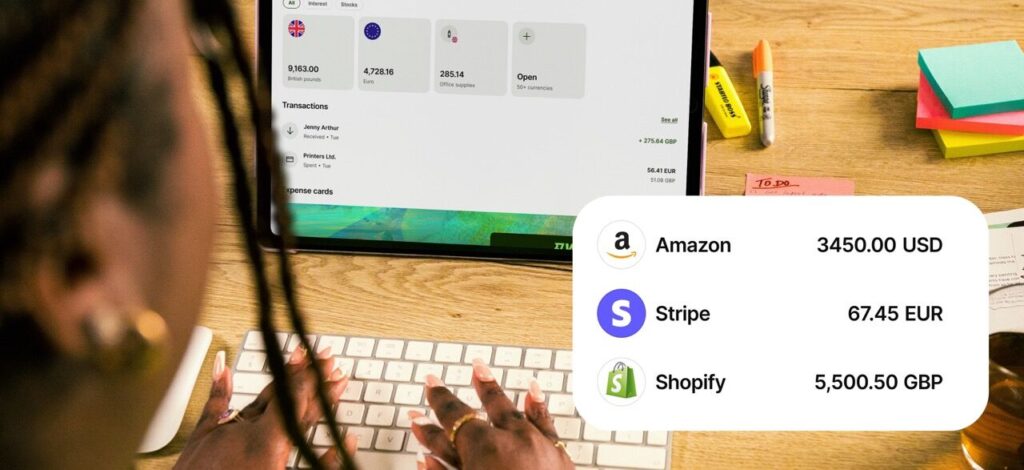
For online businesses serving international customers, managing payments across different currencies is essential. Wise Business offers international businesses the ability to receive payments in multiple currencies with local account details for EUR, USD, GBP, and several other currencies.
This means your international customers can pay you as if you had a bank account in their country, often avoiding international transfer fees on their end. Additionally, you can invoice clients in their local currency, making your services more accessible to a global market while maintaining competitive pricing.
Foreign companies opening up a French branch or subsidiary
If you want to set up a foreign-owned company in France, there are a few forms to choose from:
- A liaison office for non-commercial activities (bureau de liaison) – this can be an initial step that allows you to prospect in the French market without needing to establish a legal or fiscal entity. The activities covered by such a structure can include canvassing, advertising, information, storage, or any other activity of a preparatory and auxiliary nature. You still need to contact the relevant CFE (business registration center) and receive Siret and Siren numbers for your venture.
- A branch (succurasale) – this structure will not have its own legal entity or capital in France separate from the parent company. However, it is subject to the French tax regime. If the country of the parent company and France do not have a bilateral agreement, profits will be subject to double taxation. The branch must be registered with the Registre du commerce et des sociétés (Trade and Commpanies Register). In addition, the parent company’s articles of association and application to register the branch must be handed into the Tribunal de commerce (commercial court).
- A subsidiary (filiale) – this structure will be a legal entity in its own right, with assets and capital in its name. As such, the process for setting up a subsidiary will follow the same steps as described above.
Starting up a non-profit company in France
In France, a condition for setting up a non-profit or charity, known simply as an association, is that at least two people must be involved in the project. The steps are relatively simple:
- Pick a name for your organization – check which names and acronyms are already in use.
- Write up the articles of association – this needs to cover the functions of the different positions within the association and details such as membership contributions and procedures for excluding members.
- Register the organization – you can do this through the e-création portal, but you already need a social security number to access it.
- Open a separate bank account for the non-profit – you only need to signal revenue to state financial services if your non-profit generates over €72,432 per year. You will also need to go through the same accounting and administrative obligations as for-profit companies.
Administrating your French business
It’s always a good idea to get professional advice when you’re starting up a business in France. An accountant (expert comptable) can advise on taxation, charges, the law, and any available rebates. Find an accountant through the French accountants’ professional body, the Ordre des Expert-Comptables, your local Chamber of Commerce, or our Business Directory. If you want to set up a limited company, consult a good notaire through Notaires de France.

Some essential points to bear in mind in terms of business administration in France are:
- Keep on top of paperwork.
- Keep all receipts.
- Have a separate business bank account.
- Put money aside to pay tax, social charges, and VAT (if applicable).
Fortunately, there are firms specializing in helping foreigners with their tax affairs. French Tax Online, for example, offers expert assistance to internationals who need to file a tax return.
Invoicing in France
All your business invoicing must include the following information:
- Invoice date
- Date and description of the service or sale
- The price minus any discounts
- The total amount excluding VAT (prix HT – hors tax), the VAT (TVA) or a specific mention that TVA is not charged, and the total sale price (TTC)
- Client name and address
- Company name, company form (e.g., SARL)
- Registered address
- Siren number (RCS if applicable)
Hiring employees in France
Employing workers is expensive in France. If you want to take on employees, bear in mind that you will have to pay social charges for your staff in addition to the social charges for your company. This means you must pay employees a net salary plus a further 75% in employers’ and employees’ contributions.

Workers are well protected by labor law in France. It’s a good idea to get professional advice on employment contracts, working conditions, employment law, and the minimum wage.
Support and advice when starting up a French business
It’s worth looking into whether specific support exists that’s relevant to you and your business in France. Here are a few examples that may relate to your situation:
- Women entrepreneurs – support structures and networks include Action’elles, Les Premières, Wom’Energy, CIDFF, and Force Femmes. In addition, there are specific business funding schemes like La Garantie ÉGALITÉ Femmes and advantageous loans through the Réseau Initiative France.
- Young entrepreneurs – if you’re under 28, still studying, or recently graduated, you can apply for étudiant-entrepreneur status. Once you’ve completed your business plan, you present it to your local student-entrepreneur network, Pépite. If your project is accepted, you benefit from a co-working space, guidance, and training to launch your business.
- Economie sociale et solidaire (ESS) – France provides a range of support and specific funding to support and encourage emerging businesses with a social and solidarity component. Such organizations can focus on sustainable development, culture, helping vulnerable populations, education, or international solidarity. If you want your business to include these goals, register it with the ESS – you can find a list of related grants and funding on les-aides.fr.
- Other options to help kick-start your business include business angels, microcredits, and crowdfunding.
- Finally, there may be specific support and financial aid available depending on your sector of activity or geographic area.
- For general support and advice, reach out to the Réseau Entreprendre association. Additionally, les-aides.fr is a national directory of business grants, loans, and other support.
Corporate social responsibility in France
One of the main axes of corporate social responsibility (CSR – responsabilité sociale des entreprises, RSE) is contributing to sustainable development. To launch a CSR strategy within your business, here are a few pointers:
- Take a look at the UN’s 17 sustainable development goals and see which your business could make a positive contribution to.
- CSR action in France can be related to reducing gender inequality within the company, innovation to reduce energy consumption in its products and services, or improving human rights and fighting corruption in stakeholder relations.
- Reach out to your local Chamber of Commerce and Industry to run a diagnostic on your business and define clear and precise CSR objectives and personalized advice.
- Visit Portail RSE, where you can disclose data about your company’s positive environmental, social, and good governance practices.
- Join the Plateforme RSE, a national platform for global action on CSR, for more general advice and recommendations for businesses.
Finding office space in France
When starting a business in France, you’ll probably need to rent an office or commercial space. There are several places you can search for this online, such as in the Bureaux et Commerces (offices and businesses) section of leboncoin.fr.
Alternatively, look for co-working spaces (éspaces co-working). These are increasingly popular across France as freelancing and remote working gain in popularity. Some communal spaces may be free to use, or you can rent a desk or whole office by the hour, day, week, or month.
Business training courses in France
If you’re just starting, whether you want to work in a manual trade, commercial services, or a freelance profession, one option is to follow a Stage de Préparation à l’Installation (Preparation Course – SPI). This training course used to be obligatory for craftspeople launching a new business, but it now covers essential topics related to setting up any small business in France. It will cover aspects like administration, legal and fiscal statuses, social security contributions, and basic business management. SPI courses cost roughly €200, last about 4–5 days on average, and you get a certificate at the end. Contact your CFE to sign up, even if you want to follow the course online.
Educademy also has more in-depth state-funded business courses. Once you have set up your business, you can access such courses free through your Compte Personnel de Formation (CPF). These are specifically aimed at auto-entrepreneurs and cover topics like funding and support, accounting, and online marketing.
Useful resources
- Economie.gouv.fr – Ministry of the Economy website with information to support businesses
- Chamber of Commerce and Industry (CCI) – includes guidelines for opening a business as a foreigner in France and setting up a foreign company in France
- La French Tech – Official website of the start-up scene in France
- Formalités Entreprises – a one-stop shop for creating, modifying, and closing a business in France
- Institut national de la propriété industrielle (INPI) – online guide to creating your company name, brand, logo, and protecting your intellectual property
- Les-aides.fr – Chamber of Commerce and Industry platform with listings of business grants, loans, business support structures, and a calendar of related events and contacts



Did you find this guide helpful?