
'%20id='ico-down'%20stroke='%23000000'%20stroke-width='1.5'%3e%3cg%20transform='translate(1092.250000,%20254.750000)'%3e%3cpolyline%20id='Path-2-Copy-4'%20transform='translate(5.500000,%202.750000)%20scale(1,%20-1)%20rotate(-180.000000)%20translate(-5.500000,%20-2.750000)%20'%20points='0%200%205.5%205.5%2011%200'%3e%3c/polyline%3e%3c/g%3e%3c/g%3e%3c/g%3e%3c/svg%3e)


Housing
Buying & Selling
Mortgages in Germany: home loans and interest rates in 2026
From mortgage calculators to applications, here’s how you can get a home loan in Germany in 2026 to finance your dream house.

When you want to buy a home in Germany, you’ll almost certainly need to take out a mortgage. Thankfully for new arrivals to the country, German banks and other lenders offer a range of mortgages, including fixed-term and variable-rate deals.
What’s more, most internationals can take out a mortgage in Germany in 2026 with no restrictions. However, the amount you can borrow and your deposit depends on your residency status and financial circumstances.
Keep reading to learn more about the following topics:
Wise
When transferring large sums for your German property purchase, Wise offers the mid-market exchange rate with no hidden markup, unlike banks that typically add to their exchange rates on international transfers. Wise’s transparent fee structure shows all costs upfront, eliminating surprise charges. They also offer volume discounts on large transfers, making it highly cost-effective for property payments.

Mortgages in Germany in 2026
Less than 50% of residents in Germany own their own home – one of the lowest rates in the EU (2024). A report from the General Federal Bank (Bundesbank) attributed Germany’s low homeownership rate to high real estate purchase costs, the inability to deduct mortgage interest payments when filing your taxes, and the country’s successful social housing sector.
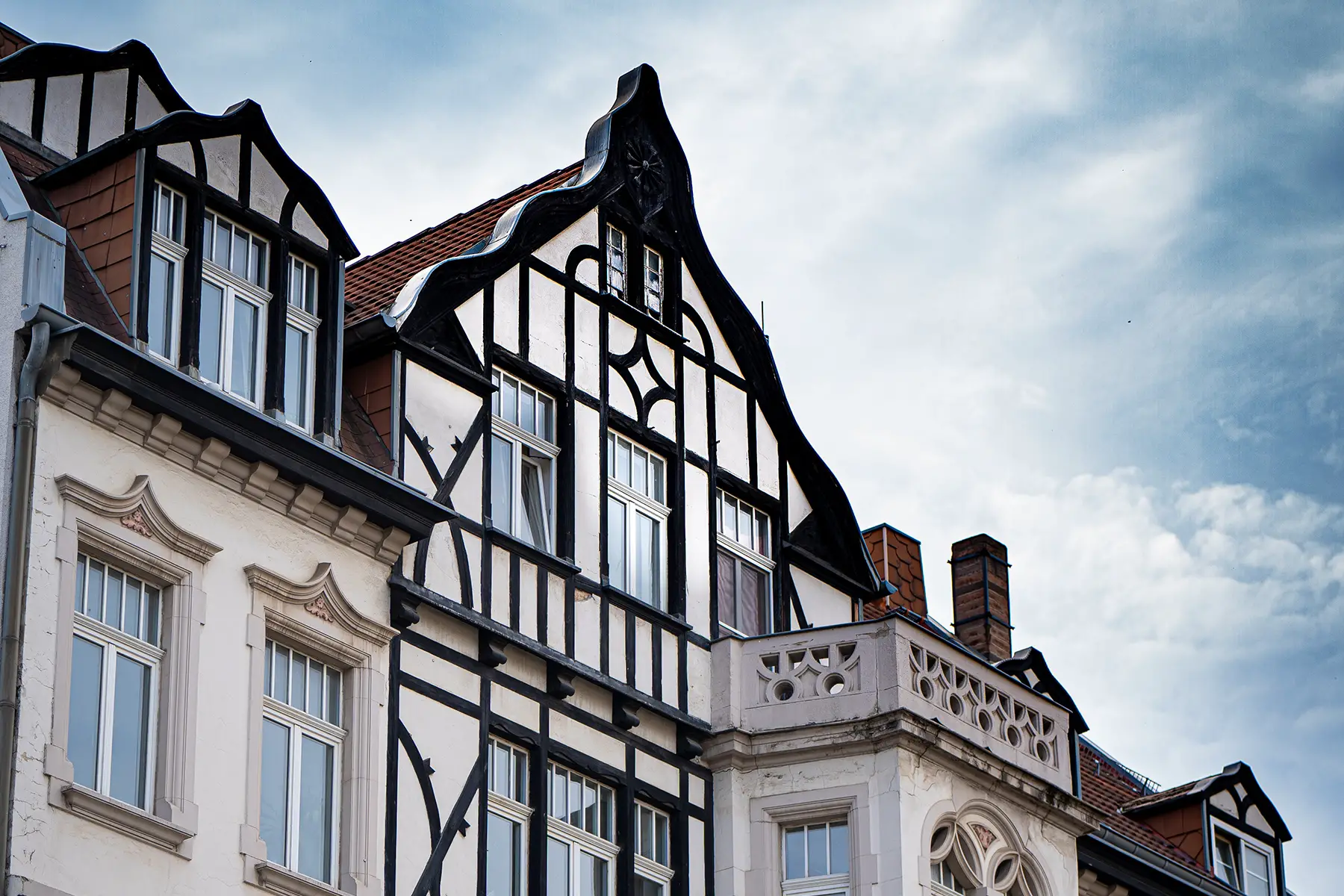
House prices in Germany vary significantly by region, and many areas — especially major cities — have experienced substantial growth over the past decade. National house price indexes show considerable cumulative increases since the early 2010s.
The additional costs of buying a home in Germany can also add up. Property transfer tax (Grunderwerbsteuer) is between 3.5–6.5% of the value of the property. You’ll also need to factor estate agent and notary fees into your calculations.

Can you get a mortgage in Germany as a foreigner?
There are no restrictions on internationals getting a mortgage in Germany, and many lenders are willing to offer mortgages for non-residents. However, international buyers may face more restrictions and tougher eligibility requirements. For example, although it’s possible to borrow up to 100% of the property amount in Germany, this is usually only available to German residents.
If you’re an EU citizen, you should be able to borrow on the same basis as German nationals, as long as you’re living and working in Germany. Self-employed workers may find that lenders require greater evidence of consistent income before approving a mortgage.
If you’re a non-EU citizen or have a temporary residence permit, you’ll need the following to get a mortgage in Germany:
- A job in Germany for at least three months
- To be out of your probation period
- A minimum income (this varies between mortgage lenders)
Non-EU citizens may find it more difficult to get approved without a big deposit unless they have a permanent residence permit.
A few of the major banks in Germany that currently offer mortgages to expats include DKB and Santander.
Hypofriend
Buying a home in Germany? The certified German mortgage broker Hypofriend can help. They combine advanced algorithms to tailor the right mortgage product to your needs. Unlike most comparison websites, they're not only focused on the cheapest option but on the product that is right for you, ensuring long-term financial security.
German mortgage rates in 2026
As of 2026, mortgage rates in Germany generally range from about 3.5% to 5% for fixed-rate home loans, though the exact rate you might receive will depend on several factors:
- Loan term and product – for instance, a typical 10-year fixed-rate mortgage tends to average around 4.2% while longer or shorter terms can lead to slightly different rates
- Borrower profile – credit history, loan-to-value ratios, and individual financial circumstances all play a significant role in determining your specific rate
- Market conditions – rates are influenced by broader economic factors, including European Central Bank policies and market demand for credit
For up-to-the-minute mortgage rates for each region of Germany, check out the daily tables provided by Hypofriend.

Co-founder and CEO, Hypofriend
Nick Mulder
Insider Tip: Interest rates and the market
People often think the European Central Bank (ECB) decides mortgage interest rates.
While they generally set the tone and direction, the market decides the interest rates that banks can borrow at, which can be observed in the 10-year German Bond. This correlates very closely with German mortgage interest rates.
How much can expats borrow for a German mortgage?
The amount an expat can borrow when taking out a mortgage in Germany will depend on several factors, many of which are related to residency:
- Full residents: may be able to borrow a high proportion of the property value, often around 80–90%, with 100% financing possible only in exceptional cases for very strong borrowers. Purchase costs are usually paid separately.
- Non-full residents living and working in Germany: may access similar loan-to-value levels, but lenders typically expect a deposit for more favourable rates, and closing costs must usually be covered from personal funds.
- Non-residents: typically face lower loan-to-value limits, often around 50–60%, meaning a deposit of 40–50% is commonly required.

German mortgage lenders will only allow your repayments to be a maximum of 35% of your monthly income. So if you earn €3,000 per month, your repayments will be capped at €1,050 per month.
While it can be possible to get a loan without a down payment (as explained above), you’ll need to carefully analyze what rate you’ll be eligible for. Mortgage lenders base their rates on risk – primarily the risk that you’ll default on your repayments. Taking this into account, a mortgage with a smaller down payment (or no down payment at all) may come with a much higher rate.
Online mortgage calculator
Online home loan calculators give you an indication of how much you might be able to borrow when applying for a mortgage. Check the below mortgages calculators to discover your home loan options for Germany:
Types of German mortgages
The most common mortgage in Germany is an annuity-fixed rate mortgage (Annuitätendarlehen). With this scheme, you will decide how much you want to pay off each year as a percentage of the overall loan (for example, 5% each year), and your mortgage rate will be based on this.
You will also choose how many years to fix your rate (anything from one year to the entire mortgage term). It is common to fix it for 10 years, as after this time, you are allowed to refinance your mortgage with no additional fees.
If you move houses during your fixed term, you will almost always need to pay a fee to the bank. This can be very expensive, so much so that some homeowners choose to rent their property out to avoid paying this fee.
Of course, an annuity-fixed mortgage isn’t the only scheme available. You can also apply for the following:
- Repayment mortgage (Volltilgerdarlehen) – This type of mortgage involves you specifying a period after which you will have repaid the mortgage (e.g., 20 years) and your monthly repayment is set based on this target
- Variable rate mortgage (variables Darlehen) – Your mortgage rate will change every three months depending on European Central Bank trends. Variable rate deals allow you to make larger payments or switch without penalties but lack the stability of fixed-rate mortgages.
- Interest–only mortgage (endfälliges Darlehen) – These mortgages mean paying only the interest each month and paying back the capital amount in one go at the end of the term. These deals require big deposits and are usually only available on buy-to-let properties.
Mortgages in Germany are generally available with fixed interest rates of 10 to 15 years and repaid over 25 or 30 years. Many borrowers can also make extra payments of up to 5% each year (Sondertilgung) if they wish to pay off their loan sooner.
Green mortgages in Germany
If your house contributes towards a sustainable lifestyle, you may be lucky enough to get a German green mortgage. This is a subsidized loan to help you improve your home’s energy efficiency.
To be eligible, you must:
- Purchase a home that with an energy level of A or B
- Renovate your home to improve its energy efficiency
- Construct a home with an energy level of A or B
If you fit the bill, you could benefit from lower interest rates (this differs between banks) and significant savings on your utility bills. For more information, check with your bank to see what green mortgages schemes are on offer for your circumstances.
Buy-to-let mortgages in Germany
Germany’s property system encourages investment in the rented sector, with favorable tax incentives available for residents who purchase buy-to-let properties.

Investors who live and pay tax in Germany can benefit from mortgage rates and repayment terms similar to those available for owner occupiers – a system at odds with some other European countries, where rates on buy-to-let mortgages are significantly higher. Investors can also deduct their mortgage interest payments from their rental income when filing their taxes.
How do you apply for a home loan in Germany?
Find out how much you can borrow and get advice
First, use a German mortgage calculator (see above) to get an idea of how much you might be able to borrow when taking out a home loan. Once you’ve got this indication, you may want to take advice from an independent mortgage advisor. Given that there are over 500+ banks across Germany, mortgage brokers can help compare for you and maybe even save you thousands in interest.

Get an agreement in principle
Before starting your search for a property, it can be worth getting an informal agreement in principle from a lender. This is also known as being pre-approved. It involves a lender scoring your application and checking your credit report.
The bank will then provide a certificate outlining how much you can borrow, subject to passing more in-depth checks during a formal application. The informal search (Konditionenanfrage) on your credit report won’t affect your score or be visible to other lenders. Your exact mortgage will only be confirmed once you have submitted a formal application.
Formally apply for your mortgage
Once you’ve made an offer on a property, you should check with your mortgage broker or lender and get the home valued. This will confirm that the price you’re planning to pay is reasonable.
After this, you will need to work out which type of mortgage you need and share your documents. The documents you’ll be asked to provide are:
- A copy of your passport
- Proof of residence
- Proof of funds for your down payment
- Salary slips confirming your income
Once you have paid a reservation fee for the property, you’ll have time to formally apply for your mortgage. After you’ve sent in your application, it will take up to 10 days for the bank to process it. This will include fully querying your SCHUFA score (Kreditanfrage) to assess the level of risk involved in your application and providing your final mortgage offer.
Sign your mortgage contract
Once your mortgage is approved, you’ll have around two weeks to sign your contract. After this, you can progress with the other formalities of buying the property (such as signing the purchase contract). After you’ve exchanged contracts and your notary has set a date to finalize the purchase, you’ll pay your down payment. The mortgage lender will then transfer the remaining money directly to the seller.
Once your mortgage has commenced, you’ll usually make your repayments on the same day each month. As mentioned earlier, your lender may allow you to make higher payments to reduce your balance more quickly.
Taxes and tax relief on German mortgages in 2026
Interest on German mortgages for owner-occupied properties is not tax-deductible. However, if you rent out a property in Germany, expenses for generating rental income can be offset on your tax bill.
These include mortgage interest, maintenance, repairs, and home improvements that cost less than 15% of your property’s value. Major home improvements are subject to different taxes.
Do you need property insurance to get a mortgage in Germany?
When buying a house in Germany, you’ll usually need building insurance (Gebäudeversicherung). This provides cover if your property is damaged (for example, if there is a fire or flood).
People buying apartments don’t usually need buildings insurance as this should be included in the block’s insurance policy. You’ll pay your share of this via your service charge. Contents insurance (Hausratversicherung) isn’t required by law, but you may wish to take out a policy to protect your belongings.

Banks may require you to take out protection insurance (Risikolebensversicherung) when you apply for a mortgage. This is likely to be the case if you’re borrowing at a high loan-to-value ratio or are the sole earner in your family. This insurance covers your mortgage repayments in the event of serious illness or death.
How can you refinance a mortgage in Germany?
When you come to the end of your fixed term, you will need to refinance your mortgage (Umschuldung). This involves switching to a new mortgage with your current bank or a different provider.
Homeowners in Germany can refinance after 10 years without facing any penalties. If you wish to change before then, you’ll need to pay early repayment charges (Vorfaelligkeitentschaedigung). This is charged as a percentage of the loan. These charges can be very high, so it’s better to wait until the end of your term to switch deals.
Germany has a unique type of remortgage product called a forward mortgage. This allows you to arrange a new deal up to 5 and a half years before the end of your current one and means you can lock in a rate immediately but start paying it several years down the line. Forward mortgages allow you to get ahead of possible interest rate rises, but if rates drop, you’ll be tied into the deal for a long time.
Useful resources
- Hypofriend – professional mortgage brokers offering the latest mortgage rates
- BaFin – German Financial Supervisory Authority, the official body regulating mortgages in Germany
- European Central Bank – indexes the latest interest rates
- European Mortgage Federation report on Germany



Did you find this guide helpful?