





Monaco can be a realistic move for some UK residents, but it’s rarely casual. After Brexit, long-term relocation is usually expensive, document-heavy, and tied to both French visa steps and Monaco residency rules. If you’re researching moving to Monaco from the UK, the real question is whether the move works on paper and in daily life: you’ll need the right residence route, enough budget for housing, and a clean UK departure plan. This guide covers visas, accommodation, costs, healthcare, money setup, and your first 90 days in Monaco.
This guide is for general information only and isn’t legal, tax, immigration, or financial advice.
Key takeaways
- Visa route: UK citizens can usually visit Monaco and the wider Schengen area for up to 90 days in any 180-day period without a visa, but longer stays usually move through the French long-stay visa channel for Monaco and then the Monaco residence-permit process.
- Residency basics: Monaco residency usually depends on 3 basics: accommodation in Monaco, sufficient financial resources, and recent official documents that fit your route.
- Housing: A short base in nearby France can help with viewings, but it usually doesn’t count as Monaco accommodation for Monaco residency.
- Proof of funds: Requirements are route-specific. Figures quoted online are only indicative, and banks or the Residency Section may ask for different evidence.
- UK tax: HMRC applies its own Statutory Residence Test. Moving abroad doesn’t automatically end UK obligations.
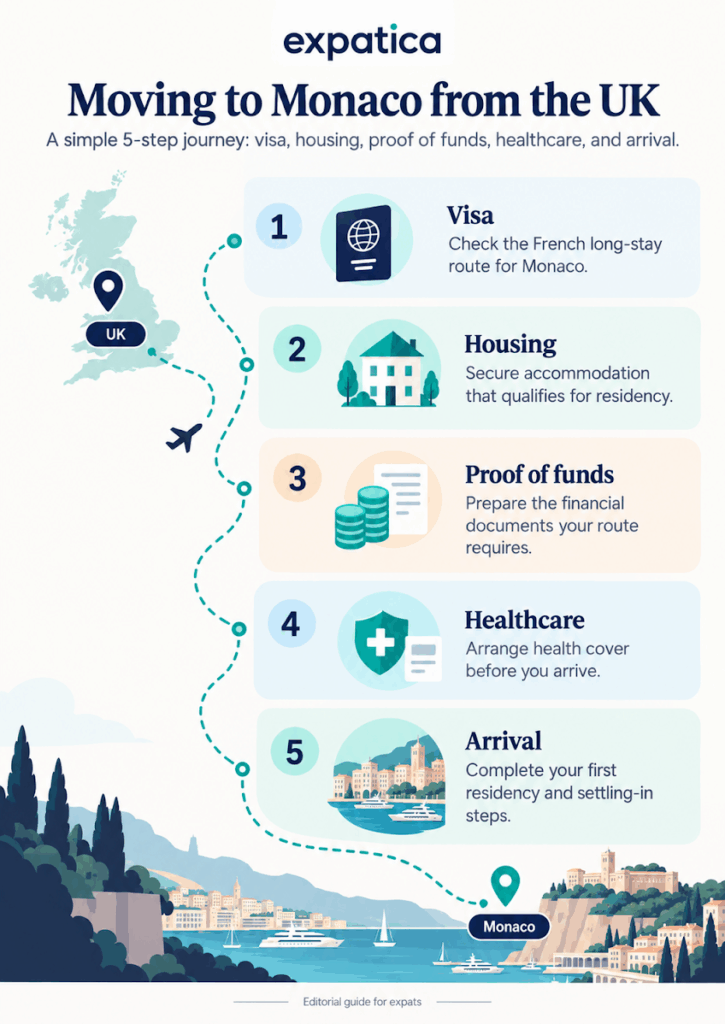
Step 1: check whether Monaco is realistic for your move
Most UK movers start with 1 of 4 aims: work, business, retirement, or a self-funded lifestyle move. Those routes can all be possible, but they don’t all suit the same budget, timeline, or tolerance for paperwork.
Monaco works best when the numbers already make sense. Space is tight, housing is costly, and even simple administration can take longer than new arrivals expect.
A useful fit-check is to ask whether you can:
- Define your route clearly, for example employment, business, retirement, or self-sufficient residence
- Cover housing costs, deposits, and a fallback if your first property choice falls through
- Handle a small-home, high-cost market rather than a short-stay version of Monaco
- Keep good records for residency, banking, and UK departure administration
What UK residents need to know about residency routes
British citizens are treated as non-European Economic Area (EEA) nationals for long-term settlement in Monaco. In practice, many cases start with a French Type D long-stay visa for Monaco, then move into the Monaco carte de séjour, or residence permit, process.
The broad routes are usually employment, business activity, or showing that you can support yourself without local employment. Monaco doesn’t offer an official golden visa, even if some market commentary uses that label informally.
What living costs look like in practice
Many readers ask whether Monaco is only expensive at the luxury end. Day to day, housing usually drives the decision, but deposits, insurance, schooling, and routine spending can all rise faster than UK movers expect.
- Rent is usually the biggest monthly cost, and smaller homes can still be very expensive because supply is limited.
- Upfront cash often includes a deposit, agency costs, and money for temporary stays during viewings or handover gaps.
- Private health cover or employment-linked cover needs checking early because the UK’s Global Health Insurance Card (GHIC) and European Health Insurance Card (EHIC) don’t work in Monaco.
- Peak periods, including Grand Prix season, can tighten availability and lift some short-term prices.
Wise for managing money during your move
- Hold GBP and EUR while you plan relocation costs.
- Convert money before rent or other move-in costs.
- Make larger payments and spend in euros during the move.

Step 2: plan your visa and residence permit application
Official requirements can change, so check the live Monaco and France-Visas pages before you book appointments, translate documents, or move money.
Separate a short stay from a long move. British citizens can usually follow the Schengen 90/180 rule for visits, but that isn’t the same as settling in Monaco.
Confirm whether you need the French visa channel. For many British citizens moving to Monaco after Brexit, the long-stay route starts with a French Type D visa for Monaco through the French consulate that covers your place of residence.
Secure qualifying accommodation in Monaco. A hotel or flat in nearby France may help while you search, but it doesn’t usually satisfy the Monaco accommodation requirement for residency.
Build the document pack early. Civil-status records, police certificates, proof of funds, translations, and any apostille checks can take longer than the visa booking itself. An apostille is an official certificate used to validate certain foreign documents abroad.
Submit the residence application. Monaco allows a first application online or offline, and an admissible file usually leads to an individual interview.
Attend the interview with the originals. Once approved, you pay the issuance fee and collect the first residence permit. Monaco currently lists €80 for a first permit.
Documents and proof you usually need
You’ll usually need:
- A valid passport, plus the relevant long-stay visa if your route requires one
- Proof of accommodation in Monaco, such as a registered lease, property deed, or a certificate of free accommodation from an eligible host
- Proof of financial resources, such as employment documents, pension proof, third-party support, or a Monaco bank reference
- Civil-status documents, including birth, marriage, divorce, or child records where relevant
- Police record documents for the countries where you lived during the 5 years before arrival, plus any required sworn translations or apostilles
Applications are often delayed by documents that are too old, untranslated, unregistered, or presented in the wrong format. A lease can also need supporting proof, such as current utility evidence, depending on the case.
How the application timeline typically works
The usual order is research, visa preparation, accommodation proof, residence application, interview, and card issuance. Some tasks can run in parallel, such as ordering police records and arranging translations, but housing proof and route-specific financial evidence often slow the file down.
A self-funded retiree, for example, may gather civil documents and UK police records early, but still need the right Monaco housing paperwork and bank evidence before the application is really ready.
Use this quick verification list before each stage:
- Confirm the current long-stay route on France-Visas or through the relevant French consulate
- Check Monaco’s Residency Section page for the latest document list and interview process
- Ask how long police records, translated documents, and bank references remain valid for your planned filing date
- Leave room for appointment delays in busy travel periods
Step 3: secure housing and proof of accommodation
Housing is both a lifestyle choice and a legal step in the move. Monaco wants accommodation in the Principality that is suitable for the household, so a base just over the border isn’t the same as a residency-ready address.
This catches people out because you’re choosing not only a home, but also a document trail. Renting usually suits people testing the move, buying suits people with a settled long-term plan and substantial cash, and staying with family or a partner only works if the host can provide the right official accommodation evidence.
Renting versus buying in Monaco
The following table compares the main accommodation routes and the practical question to check before committing.
| Option | Usually best for | Upfront cash reality | Main question to ask |
|---|---|---|---|
| Renting | First movers, workers, and people testing the move | High deposit and fee pressure, but less commitment than buying | Is the lease registered and usable for residency? |
| Buying | Movers who already know Monaco suits them | Very high capital outlay and slower transaction risk | Does the ownership structure fit the residency plan? |
| Staying with family | Family-linked moves with strong paperwork support | Lower property spend, but only if the host qualifies | Can the host provide the official accommodation certificate and supporting papers? |
Monaco property can be possible and still be difficult. Ask agents or landlords exactly what paperwork you’ll receive and when, before you transfer funds.
What counts as acceptable proof for residency
Having a place to stay isn’t enough on its own. Check that your housing evidence includes:
- A Monaco address, not a nearby French Riviera address
- A registered lease or property deed, depending on whether you rent or buy
- The current supporting proof the authorities ask for, which can include a recent electricity bill
- If you’re hosted, the host’s deed or lease, their ID, and the official certificate of free accommodation
- Enough space and occupancy suitability for everyone included in the move
Beausoleil or Cap d’Ail can be practical during property visits, but they aren’t the same as proving Monaco accommodation for Monaco residency.
Step 4: set up your money, banking, and healthcare
This is the part many people leave too late. You may be able to visit Monaco with cards and existing UK accounts, but settling works more smoothly when your money plan and health cover are mapped out before arrival.
Start by making sure you can access funds and pay in euros, then work out which tasks depend on residency, employment, or a local banking relationship. Keep identity and funds documents in digital and paper form, and don’t rely on 1 payment method only.
Opening a local account and managing GBP to EUR
Monaco banking relationships can involve strict onboarding, strong source-of-funds checks, and provider-specific expectations. A bank reference for residency and an everyday banking setup are related, but they aren’t always the same step.
Before you move money, check:
- Which ID and address documents the provider will accept
- Whether proof of tax residence, source of funds, or source of wealth is needed
- How large incoming transfers should be evidenced before they arrive
Also check your existing UK banking terms with providers such as Barclays, HSBC, and Lloyds because some services or address rules can change once you live abroad.
Health cover and other essentials to arrange before arrival
Healthcare in Monaco for expats needs an early check because cover can depend on whether you’re arriving with employment, private insurance, or another qualifying arrangement. GOV.UK says Monaco doesn’t accept the EHIC or GHIC, so don’t assume your UK card will cover routine treatment there.
Confirm your health insurance start date, any waiting periods, prescription access, how claims are made, and what proof a clinic may ask for. Keeping digital and paper copies of insurance records, prescriptions, and medical summaries can save time when several institutions ask for the same evidence.

Step 5: sort your UK departure and cross-border administration
Moving to Monaco doesn’t automatically end UK obligations. Many people assume Monaco residency and UK tax residence are the same test, but they aren’t.
Your UK departure needs its own checklist alongside the Monaco move. Day counting, banks, pensions, post, records, and any ongoing UK income all need attention.
Use this UK-side checklist before you leave:
- Record your departure date and keep a running count of UK days after the move
- Review any UK property income, pension income, or other continuing UK-source income
- Tell banks, pension providers, insurers, and key institutions that your residence status may change
- Keep evidence of travel, lease dates, residence paperwork, and shipping records
UK tax residence, pensions, and ongoing obligations
- Statutory Residence Test: HMRC uses this to work out whether you’re UK resident for a tax year.
- Split-year treatment: This can sometimes divide a tax year into a UK part and an overseas part, but it’s rule-based and isn’t automatic.
- Ongoing UK income: UK rental income, some pension situations, and other UK-source income may still matter after the move.
- Days and ties: Family, available accommodation, work, and time spent back in the UK can all affect the result.
Track your UK days carefully, review your ongoing UK ties, and test your position using HMRC guidance rather than assumption. If your finances are complex, especially around pensions, property, or business income, check your position with a qualified advisor before acting.
Shipping, pets, driving, and document prep
Keep the last-mile logistics simple and centralized:
- Book removals only after checking the document list for customs, access, and timing
- Prepare a clear inventory for shipping and keep copies with your main move file
- Verify pet vaccination, health, and entry paperwork well in advance if animals are traveling with you
- Store identity, housing, tax, and finance papers in 1 master folder
A delayed shipment or incomplete pet paperwork can disrupt the first week badly. Verify requirements before collection day rather than assuming a mover or transporter can fix missing documents later.

Step 6: move and settle in for your first 90 days
Once you arrive, the priority shifts from planning to proof. You need to keep the residency file moving, make sure your money is accessible, and avoid small administration gaps that turn into bigger delays.
Daily life is the real stress test. If rent, health cover, transport, and record-keeping work smoothly, the move usually feels manageable. If 1 of them fails, Monaco can feel expensive and rigid very quickly.
Prioritize these arrival tasks:
- Confirm every residency follow-up date and keep copies of what you submitted
- Make sure you can access euros for rent, groceries, and transport without relying on 1 card only
- Check that your accommodation, phone, and utility records match the address you use elsewhere
- Keep monitoring expiration dates for temporary proofs or insurance papers
- Build a local contact list for your landlord, insurer, employer, and any advisor helping with the move
If you want 1 simpler tool during the first weeks, see how the Wise Account works for ongoing GBP to EUR transfers and everyday euro spending while the move settles. Wise is a financial institution rather than a bank.
First-week checklist after arrival
- Confirm your next residency or interview step and store every confirmation email.
- Check that rent, deposit, and daily spending methods all work in practice.
- Book any healthcare or insurance follow-up you need soon after arrival.
- Store digital and paper copies of your passport, lease, policy documents, and receipts together.
- Track which institutions already have your correct Monaco address and which still need updating.
Keeping 1 shared digital folder for every move document can save time when multiple offices ask for the same proof.
Common mistakes that delay settling in
- Assuming a nearby French address works as Monaco proof
- Sending a large payment before checking what evidence the receiving provider may ask for
- Relying on outdated UK tax advice from before the move plan changed
- Underestimating how often translations, registration, or document recency matter
- Waiting until arrival to think about health cover or euro access
Verify the requirement with the current official source or the institution involved, not just an older relocation article or forum thread.
Next steps
Moving from the UK to Monaco is mainly about getting the order right: confirm your residence route, secure qualifying accommodation, prepare your documents, and organize your UK departure. Housing, proof of funds, health cover, and document timing can all affect how smoothly the move goes. Keep checking the current French, Monaco, and UK guidance as your plans develop. For day-to-day GBP and EUR management during the move, the Wise Account can be one practical option alongside your local arrangements.
FAQ
Frequently asked questions about moving to Monaco from the UK
How much money do you need to move to Monaco from the UK? 
There’s no safe one-size-fits-all figure. Separate living costs, housing deposits, and any bank or proof-of-funds expectations, then verify what applies to your route because published market figures can vary a lot.
Do you need a Monaco bank account to get residency?
Monaco bank references often appear in market practice, especially for self-sufficient applicants, but that isn’t the same as a universal rule for every route. Check the latest official requirements and the institution’s policy before you assume a local account is mandatory.
Can you keep your UK bank account after moving to Monaco?
Sometimes yes, sometimes no. It depends on the provider’s policy, the product you hold, and your new tax and residence status, so check the terms with your current bank before you move and keep a backup plan for payments.
Is Monaco really tax free for UK residents?
Monaco is often attractive from a tax point of view, but living there doesn’t automatically settle your UK tax position. UK residence, UK-source income, and your own facts still matter, so don’t assume the move guarantees a particular tax outcome.
Sources
Expatica’s experts are all about providing the most up to date and accurate information. All guides are fact checked, and whenever we use external sources (like government websites or research papers) we’ll make a note of them here so you can check them out too.
- Monaco residence-permit process, accommodation rules, document categories, and first-permit fee. Checked 1 October 2026., Mon Service Public: How to apply for a residence permit
- Monaco long-stay visa supporting-document guidance through French visa channels. Checked 1 October 2026., France-Visas: Monaco
- Short-stay rules, passport validity, and immigration handling for Monaco. Checked 1 October 2026., GOV.UK: Monaco entry requirements
- UK tax residence and split-year guidance. Checked 1 October 2026., HMRC: RDR3 Statutory Residence Test
- UK guidance on healthcare access in Monaco. Checked 1 October 2026., GOV.UK: Monaco health
- Wise Account features for holding currencies, converting, and spending. Checked 1 October 2026., Wise Help Centre: What is a Wise Account?
- UK-facing Wise Account product information. Checked 1 October 2026., Wise Account: Multi-currency account