
'%20id='ico-down'%20stroke='%23000000'%20stroke-width='1.5'%3e%3cg%20transform='translate(1092.250000,%20254.750000)'%3e%3cpolyline%20id='Path-2-Copy-4'%20transform='translate(5.500000,%202.750000)%20scale(1,%20-1)%20rotate(-180.000000)%20translate(-5.500000,%20-2.750000)%20'%20points='0%200%205.5%205.5%2011%200'%3e%3c/polyline%3e%3c/g%3e%3c/g%3e%3c/g%3e%3c/svg%3e)


Finance
Taxes
How to file your income tax in Japan in 2026
Learn more about income tax in Japan, from recent updates and national and local tax brackets to filing your annual tax return.


If you’re living and working in Japan, you’ll likely need to pay income tax. Calculating your tax (税金) burden can be complicated, especially since the Japanese tax system (所得税制度) is so complex.
To help you get started, here’s a brief overview of the topic:
H&R Block
Filing U.S. taxes from Japan? H&R Block’s expat tax experts simplify the process with easy online registration and remote filing. Whether it’s answering tricky tax questions or managing paperwork, they’ve got you covered. Stay compliant, stress-free, and up-to-date – contact H&R Block today.

Income tax in Japan: overview and latest developments
Income tax (所得税) is a mandatory levy that people and businesses have to pay on their worldwide earnings of the previous year (1 January to 31 December). In Japan, this is charged at the national, prefectural (regional), and municipal levels.
Tax revenue pays for a range of government activities and public services, such as education, public transport, and defense. The Ministry of Finance’s annual report details a breakdown of expenditures (2025).

In Japan, taxable income includes:
- Your salary and other income from (self)employment, including in-kind benefits (e.g., private medical insurance or company car use)
- State benefits and pensions
- Business profits
- Interest on savings and investments
- Rental income (if you rent out a home)
- Occasional income (e.g., lump-sum payments, life insurance maturities, or prize winnings)
In addition to this, employees pay social security (社会保障) contributions to cover state benefits, pensions, public health insurance (公的医療保険), and social care.
Most Japanese employers and pension providers withhold income tax from your gross monthly income, meaning you won’t face a hefty tax bill at the end of the year. However, if you have earnings from another source or you are a sole proprietor, you must make other concessions.
The National Tax Agency (国税庁) oversees the Japanese tax system. This is part of the Ministry of Finance (MoF – 財務省).
Latest news about income tax in Japan (2026)
Every year, the MoF announces any planned changes to the tax system in the National Budget. In December 2025, it published its 2026 tax reform proposals which included:
- Increasing the minimum taxable income tax threshold to ¥1.78 million.
- Raising the basic deduction for individuals with an annual income of under ¥23.5 million.
You can find more information on local and federal taxes in our article on the Japanese tax system.

Tax rates: how much tax will I pay in 2026?
Japan divides taxable income into seven tax brackets, and you will pay proportionately more tax as your income increases. The national income tax rates are as follows:
| Income | Rate | Deduction |
| Up to ¥1,95 million | 5% | – |
| ¥1,95–3,3 million | 10% | ¥97,500 |
| ¥3,3–6,95 million | 20% | ¥427,500 |
| ¥6.95–9 million | 23% | ¥636,000 |
| ¥9–18 million | 33% | ¥1,536,000 |
| ¥18–40 million | 40% | ¥2,796,000 |
| ¥40 million or more | 45% | ¥4,796,000 |
Until 2037, Japanese households also pay a 2.1% surcharge on their national income tax bill. This is a special ‘solidarity’ tax to fund the reconstruction of areas hit by the March 2011 earthquake and tsunami.

In addition to the national income tax, all residents are liable for individual inhabitant tax (or resident tax – 住民税). This is split between a 6% municipal tax (市民税) and a 4% prefectural tax (県民税), totaling 10% of their income.
Self-employed individuals are also subject to inhabitant tax. In addition, certain types of self-employed business income may be subject to enterprise tax. This ranges from 3.5–7% depending on the location and business income.
You can use one of many online tax calculators to determine how much tax you are likely to pay in Japan.

If you’re receiving salary payments from a foreign employer, you might find it helpful to use a multi-currency account like the Wise Account to receive and manage these international payments efficiently, allowing you to hold funds in other currencies until you need to convert them to yen.
Who pays income tax in Japan?
Everyone living and earning an income in Japan needs to pay income tax. The exact rules for income tax vary depending on your residency status.
Taxpayers are split into three categories:
- Non-residents (非居住者) – expats living in Japan for less than a year without a primary Japanese residence are only liable for income tax on income earned in Japan
- Non-permanent residents (非永住者) – internationals who have had a residence in Japan for at least a year but who don’t qualify as permanent residents must pay tax on earnings from Japan and foreign income paid in or sent to Japan
- Permanent residents (永住者) – residents who have lived in Japan for at least five years or have official permanent residence status are subject to Japanese income tax on their worldwide income
The most significant difference is that non-residents pay income tax at a flat rate (rather than a progressive rate), and they’re not eligible for any deductions. More on this below.
Who needs to file a tax return?
Technically, all residents in Japan must submit a tax return (確定申告), including salaried workers, self-employed workers, sole-proprietors, and corporations. However, some exceptions apply.
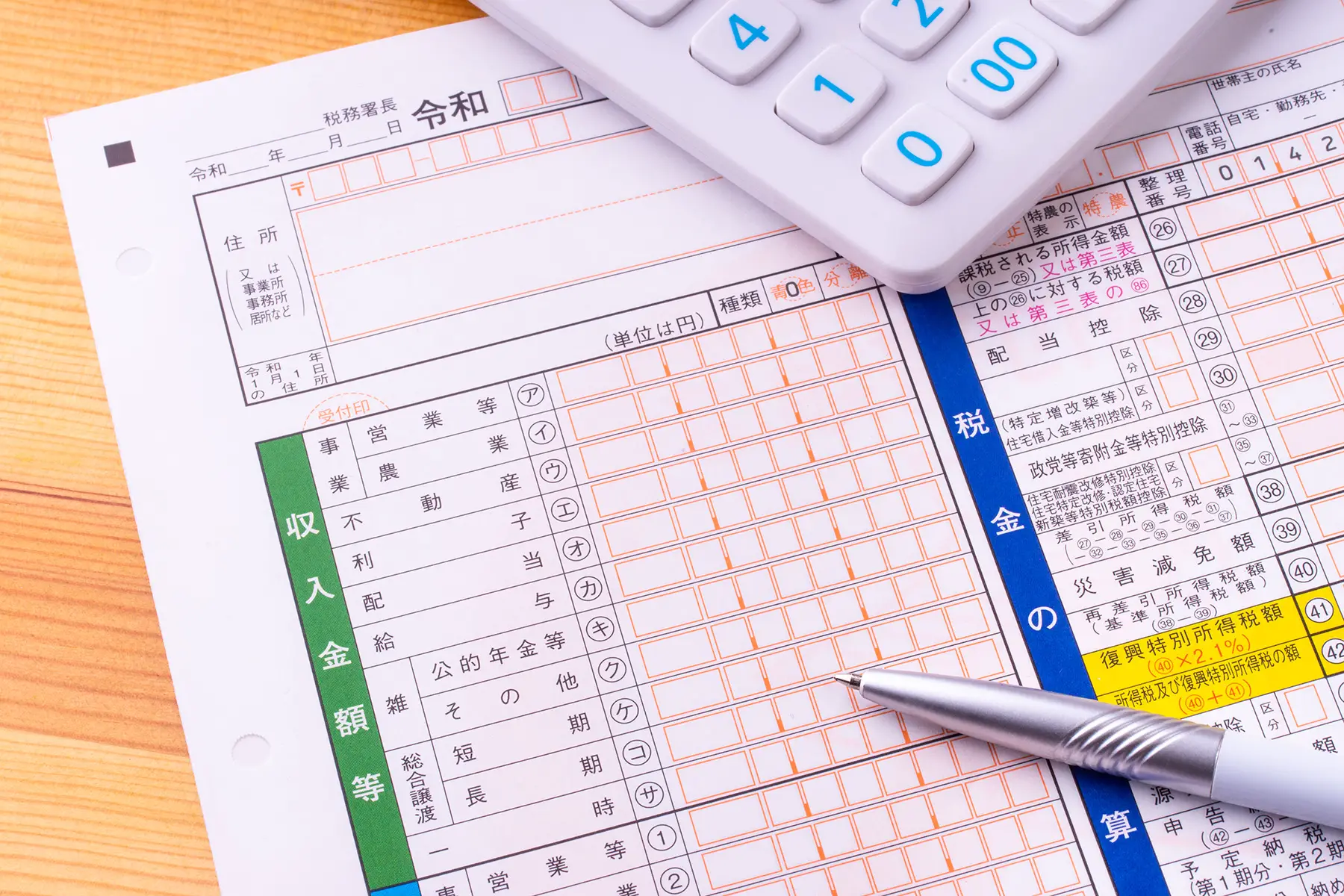
For most employees and pensioners, their income tax will already be withheld from their gross monthly income. As such, they don’t need to file a final tax form. You will need to submit a tax return when you:
- Have not had your tax withheld
- Are a freelancer or a self-employed person
- Are an employee who earns more than ¥20 million a year
- Are a retiree whose state pension is not taxed at source through withholding
- Have a side income of more than ¥200,000 in a year
- Have more than one employer
- Have a foreign employer in Japan or receive a salary from abroad
- Are a director of a family company or a relative of the director and receive payments such as:
- Interest on loans
- Rent for a store, office, or factory
- Charges for the use of machines and tools
- You leave Japan before the end of the tax year
You must also file a return when the amount of tax calculated is greater than the amount of your credit for dividends.
Regardless of who must or mustn’t, it’s recommended that you always double-check your tax form. You may be able to declare extra deductibles, which can lower your tax bill.
Japanese income tax for foreigners
The tax rates for expat residents are the same as for Japanese nationals. However, non-resident foreigners pay a flat rate (typically 20.42%) and cannot apply tax deductions.
If you receive a foreign pension, it may be subject to Japanese law, depending on your residency status. The rules for non-permanent residents with a non-Japanese retirement can be complicated and may require you to file a tax return. You should consider seeking expert advice for your specific situation.

In addition, Japan has treaties with more than 50 countries to prevent double taxation, including:
- Austria
- Belgium
- France
- Germany
- Italy
- Luxembourg
- The Netherlands
- Spain
- Switzerland
- United Kingdom (UK)
You can view the full list of countries with double taxation treaties on the MoF website.
Filing US taxes from Japan
Every US citizen and Green Card holder must file a tax return with the IRS, even those living abroad. Many US expats are unaware of this obligation, assuming that, as expats, they don’t need to file or pay taxes in the US. The good news is that as long as you’re paying taxes in another country, you usually don’t owe anything to the IRS, but it’s essential to make sure, and the law says you still have to file.
Learn how to file your US tax returns from Japan by reading our article on taxes for American expats. Alternatively, you can seek advice from a company that offers a specialized tax filing service for expats, such as H&R Block.
Wise offers a multi-currency account, allowing you to hold over 40 currencies in one place and convert them at the mid-market exchange rate with transparent, low fees. This can be particularly useful when you need to convert foreign salary or income to JPY for income tax reporting purposes, potentially reducing costs compared to other providers on specific currency routes.
Who is exempt from paying income tax in Japan?
Residents who earn less than ¥25 million are allowed a basic exemption when filing their tax return. The rates are as follows:
| Income | Exemption |
| Up to ¥23.5 million | ¥580,000 |
| ¥23.5m to ¥24.5m | ¥320,000 |
| ¥24.5m to ¥25m | ¥160,000 |
Deadlines to file and pay a tax return in Japan
Japan’s tax year runs from 1 January to 31 December. Tax returns, for both residents and non-residents, are due between 16 February and 15 March. If March 15 falls on a weekend or national holiday, it will be extended to the following business day.

Payments are due by the return deadline. If you file an income tax return every year, you’ll need to make prepayments in July and November. These are calculated based on the previous year’s income.
In practice, this means you’ll have already paid most of your tax by the time the deadline comes around. If you’ve just moved to Japan, you won’t make prepayments in the first year, as there’ll be no income on which to base the calculations.
The individual inhabitant tax is usually levied in June, August, October, and January. As a practical example, if you filed your tax return for 2025 in March 2026, you’ll make 2026 contributions in June, August, and October 2026, and then January 2027.
Your municipal tax authority will most likely send you a collective Tax Notice (納税通知書) or Tax Payment Slip (納付書) for the total resident tax due. Some, however, will have made agreements with employers to withhold the jūminzei from your monthly salary.
To find out more, you can visit the website of your local tax office.
How do you file your tax return in Japan?
Residents can submit their tax forms most conveniently online through the government’s e-Tax system (website in Japanese). However, you can also file a paper return by mail or in person at your local tax office (税務署). The latter also offers assistance in filling out the forms if you do not speak Japanese.
If you prefer to file your Japanese tax return on paper, there is now a single return form (確定申告書) used by all individual taxpayers. Different types of income — such as employment income, pensions, business income, or capital gains — are declared by completing the relevant sections and supplementary schedules.
The National Tax Agency provides guidance on filing tax returns in several foreign languages, including English, Chinese, and Portuguese. However, the English-language materials are the most comprehensive and up to date, while guidance in other languages is generally more limited and high-level.

Unlike in some other countries, Japanese tax returns can only be filed individually – there are no joint returns for couples.
How to register for tax in Japan?
Like most official services, your tax return is linked to the Individual Number (My Number – マイナンバー). You will automatically be assigned this 12-digit ID number within two or three weeks of registering your Japanese address.

Similarly, when setting up a business in Japan, you’ll be allocated a corporate number (法人番号) by the NTA. This 13-digit number works as a standard identifier for every company in the country and is used for tax purposes as well.
Deductibles and tax credits
Japan offers plenty of ways to save on your income tax bill. For example, the salary income deduction is a standard ‘earned income’ deduction that all workers may apply. This ranges from ¥550,000 to ¥1.95 million, depending on your earnings.

Other allowances and deductibles in Japan include:
- Mortgage interest – interest is not deductible, but a mortgage credit may be available for up to 10 years if you meet specific conditions. If your property qualifies for the deduction, you can offset 0.7% of your remaining mortgage per year against your tax bill.
- Medical expenses – medical costs are deductible, albeit with some limitations
- Social security and insurance premiums – this includes premiums for national health insurance, social medical insurance for the old-aged, national and employee pension insurance, and long-term care insurance
- Life insurance premiums –includes life insurance policies, long-term medical care insurance, and individual annuity insurance
- Single parents exemptions – single parents can claim a fixed allowance against their tax return. This currently amounts to ¥350,000.
- Working student allowance – working students may claim a deduction of ¥270,000, provided their total income does not exceed ¥750,000.
- Disability allowances – deductions are available for individuals with disabilities or those supporting them, ranging from ¥270,000 to ¥750,000, depending on the severity and circumstances.
- Charitable contributions – donations to qualifying organizations in Japan may be deductible. In general, the deductible amount is the total donations made minus ¥2,000, subject to applicable limits. Certain donations may instead qualify for a tax credit.
Allowances for self-employed income in Japan
Self-employed workers in Japan can offset the business expenses they incurred during the year. For example, if you work from home, you can deduct a portion of your rent and utility costs.
Other allowances include:
- Travel expenses
- The cost of entertaining clients
- Material costs (such as office supplies)
- Taxes related to operating the business (such as enterprise tax)
- Insurance premiums

The amount of deductions you can reasonably offset will vary from business to business. It’s recommended you seek expert financial advice to get the maximum out of your tax bill.
How do I pay my income tax in Japan?
There are various methods you can use to pay your income tax bill. These are:
- Automatic payment by tax transfer account, which you can set up through the NTA or your local tax office
- Direct e-Tax payment if you have an online account
- Via internet banking or ATM
- Credit card
- Mobile payment from a smartphone
- Payment at convenience stores using a payment slip with a QR code
- Over-the-counter payment at a financial institution (bank, post office, etc.) or local tax office
In Japan, some taxpayers are required to make prepayments of income tax (予定納税). Where applicable, these prepayments are made in two instalments, due on 31 July and 30 November of the current tax year. The final settlement of income tax is then paid by 15 March of the following year.
Taxpayers who use automatic bank transfer (振替納税) benefit from a later payment date for the final settlement, which is typically scheduled for mid-April. The exact date varies each year and is announced by the National Tax Agency.
If a taxpayer has already paid at least half of their total income tax liability, they may apply to postpone payment of the remaining balance until 31 May. The postponed amount is subject to statutory interest, with the applicable rate set annually by the tax authorities.
Income tax refunds
If you believe you’re eligible for a tax refund (還付), you must fill in the “where to receive your refund” section on the first page of your tax return. The refunded sum will be transferred to your specified bank account, though it needs to be an account in your name.

If you don’t submit a tax return, you can still apply for a refund. This could be the case, for example, if you have certain allowable deductions that weren’t considered when calculating the amounts withheld from your salary.
The NTA should sort this out for you automatically. However, if they don’t, you can also complete a tax return form containing details of your refund.
If you feel that the Japanese tax authorities have charged you too much and you wish to appeal, you can do so through the NTA appeals system.
What if I don’t do or pay my taxes on time or at all?
If you fail to file your taxes on time or deliberately underreport your income, you may be subject to penalties, additional tax, and other sanctions under Japanese law.
In addition, Japan has strengthened the link between tax compliance and immigration status. Under recent amendments to immigration law, foreign nationals holding permanent residence status may have that status revoked if they repeatedly and unjustifiably fail to pay taxes or social insurance contributions. While revocation does not automatically result in deportation, it can ultimately affect an individual’s right to remain in Japan.
Depending on your (in)action, tax fines and penalties include:
- If you do not file an income tax return by the deadline, a penalty of 15% applies to the unpaid tax up to ¥500,000, and 20% on any excess. Reduced rates may apply for voluntary filings, while higher rates apply in cases of repeated non-compliance.
- If income is underreported, penalties generally range from 10% to 15%, depending on the circumstances.
- Where income is deliberately concealed or falsified, a heavy penalty of 35% (or 40% in cases of non-filing) applies. An additional 10% surcharge may be imposed if a similar offence occurred within the previous five years.
- Interest is charged on unpaid tax at statutory rates set annually, calculated based on the length of the delay. These rates fluctuate year by year and are published by the National Tax Agency.
You should contact the NTA as soon as possible if you think you may have difficulties paying tax or submitting your tax return on time.
Income tax advice in Japan
If you’re new to taxes in Japan or have a complicated tax situation, you should consult your own financial advisor with any specific tax issues or questions.
Japan has a number of expat-friendly tax experts who offer help and information in English, Chinese, or other languages, including:
When hiring a financial advisor, make sure they meet the standards set by the Accounting Standards Board of Japan (企業会計基準委員会). This is overseen by the Japanese Financial Services Agency.

Useful resources
- National Tax Agency – official information on the Japanese tax system and rules in English
- PWC Tax Summaries – website with official income tax rates in Japan



Did you find this guide helpful?