
'%20id='ico-down'%20stroke='%23000000'%20stroke-width='1.5'%3e%3cg%20transform='translate(1092.250000,%20254.750000)'%3e%3cpolyline%20id='Path-2-Copy-4'%20transform='translate(5.500000,%202.750000)%20scale(1,%20-1)%20rotate(-180.000000)%20translate(-5.500000,%20-2.750000)%20'%20points='0%200%205.5%205.5%2011%200'%3e%3c/polyline%3e%3c/g%3e%3c/g%3e%3c/g%3e%3c/svg%3e)


Healthcare
Healthcare Basics
France long-stay visa health insurance guide
Work out your France long-stay visa health insurance based on your visa type, nationality, and planned length of stay. Compare the proof French authorities usually accept and avoid common mistakes before you apply. This guide explains which proof may fit your visa route and how to avoid a cover gap after arrival.


Key takeaways
| Visa route | Proof that may work | When private cover is usually safest | What to verify before submission |
|---|---|---|---|
| Temporary visitor stay | GHIC, EHIC, travel insurance, or private cover may be accepted depending on route and consulate | If your card excludes repatriation or your policy is emergency-only | Exact route, dates, territory, repatriation wording |
| VLS-TS visitor stay | S1 in some cases, or comprehensive private cover | Usually safest if you do not already have portable public rights | Full-duration cover and visa-ready certificate |
| Student visa | EHIC, GHIC, S1, or private bridge cover depending on status | If your public rights do not start straight away | School start date, registration timing, first-month cover |
| Work or family visa | Employer or family route may open French rights later, but not always before arrival | If there is any gap before French entitlement goes live | Start date, sponsor documents, private bridge period |
| Renewal stage | Carte Vitale, CPAM or Assurance Maladie proof, or ongoing private cover | If your French rights are still pending or incomplete | Renewal checklist from ANEF or your préfecture |
This summary is based on official French visa and healthcare guidance, with route-specific requirements varying by consulate and applicant profile.
What health insurance do you need for a France long-stay visa?
There is no one-size-fits-all answer. The right proof usually depends on your visa route, how long you will stay, your nationality, and whether you can rely on portable public rights such as a GHIC, EHIC, or S1, or whether you need private cover instead.
If you are unsure, the key question is not “what is the cheapest policy?” but “what proof clearly matches my route?” Start with Expatica’s guide to French visas and then check the route-specific list on France-Visas.
| Your situation | Cover route most likely to fit | Why |
|---|---|---|
| You already hold valid portable public rights | GHIC, EHIC, or S1 may support your file | These documents can show existing entitlement, but not for every route |
| You are staying briefly on a temporary route | Travel insurance may work | Shorter stays are often judged more like travel than relocation |
| You are moving for 6 to 12 months or longer | Comprehensive private health insurance | Longer stays usually need broader, clearer wording |
| You expect a gap before French public cover starts | Private bridge cover | It protects you while CPAM processing is still pending |
Cover routes are presented as general guidance only. Always check your visa category, consulate checklist, and insurer certificate before applying.
When GHIC, EHIC or S1 may be enough
GHIC and EHIC can help in some cases, especially for UK, EU, EEA, and Swiss nationals with existing public rights. S1 can also be important for some pensioners, dependants, and cross-border situations because it transfers healthcare rights from the competent state to the country of residence through French registration channels such as CPAM and the guidance body Cleiss.
One thing worth knowing is that these documents are not a universal answer for every France long-stay visa. Acceptance can still depend on the visa category, how long you will stay, and what your consulate wants to see in the file.
Check these points before you rely on public-rights proof:
- the document stays valid for the whole relevant period
- France is clearly covered
- repatriation is covered, or you add separate cover if it is not
- the document matches your actual status, such as student, pensioner, or dependant
- your consulate does not ask for extra private insurance on top
When private health insurance is the safer route
Private health insurance is usually the safer route when your public-rights position is unclear, your stay is longer, or you need cover before French public entitlement is confirmed. It is also the cleaner option when you want one certificate that clearly shows dates, territory, benefits, and repatriation.
A common example is a non-EU visitor applying for a VLS-TS, a long-stay visa that also acts as a residence permit once validated. They may be able to join French public cover later, but not necessarily at the visa stage, so a full private policy often creates less risk.
Check the policy wording carefully. You want to see the policyholder’s name, full travel period, France or wider territorial cover, hospital and medical cover, and repatriation wording that is easy for a visa officer to read.
How the answer changes by visa type
Insurance expectations often shift by route, even when two visas both count as long-stay. That is why a certificate that looks fine for one file may feel too thin for another.
| Route | Typical duration | Cover type usually expected | Caution note |
|---|---|---|---|
| VLS-T visitor | About 4 to 6 months | Travel insurance, GHIC, EHIC, or private cover may be used depending on route | Emergency-only wording can still be a problem |
| VLS-TS visitor | Up to 1 year | S1 in some cases, otherwise comprehensive private cover is often safest | Do not assume travel insurance is enough |
| Student | Usually academic year based | EHIC, GHIC, S1, or student registration plus bridge cover | Timing of public registration matters |
| Work or family | Varies | Public cover may begin through employment or later family registration, with private bridge cover where needed | Start dates and actual activation are not the same thing |
Visa-route comparisons are based on official French guidance and common application scenarios. Requirements can vary by nationality, status, and consulate.
Visitor routes: VLS-T and VLS-TS
A VLS-T is a temporary long-stay visa for people who do not plan to extend beyond the visa period. A VLS-TS is a long-stay visa that functions as a residence permit once you validate it on ANEF, France’s online foreigners portal, within three months of arrival.
Can you use travel insurance for this route? For a VLS-T, it may be accepted in some cases, especially if the policy clearly covers medical expenses, hospital treatment, and repatriation for the full stay. For a VLS-TS, emergency-only travel insurance is often not the safest fit because the stay is longer and the consulate may expect broader proof.
This is different from a short holiday policy bought for a weekend in Europe. If the wording only talks about emergencies abroad and not living in France for months, that can create doubt.
Student, work and family visas
Students may be able to rely on EHIC, GHIC, S1, or French student registration depending on nationality and status. Ameli says many foreign students can register through its dedicated student portal, but that does not mean every applicant can skip visa-stage proof, especially for the first weeks or months of the move.
Workers may enter French public cover sooner through employment, because Service-Public states that people working in France can access healthcare cover from the first hour of activity. Family visa holders may also gain rights later through their route, but the timing still needs checking.
Ask your school, employer, or sponsor for route-specific guidance, then gather:
- your visa or admission route details
- start dates for work or study
- any S1 or portable public-rights documents
- a private insurance certificate if you need bridge cover
- evidence of who is covering whom, if dependants are involved

Renewals and the move to public cover
At renewal stage, readers may need to show a carte de séjour, a residence card, public healthcare proof, or continued private insurance, depending on where their file sits. A carte de séjour is the residence permit issued for longer residence in France, often after the initial visa stage.
Do not cancel private insurance just because you think you should qualify for French cover. Keep it active until your entitlement is clearly live through Assurance Maladie, your local CPAM office, and ideally your carte Vitale.
What should a visa-ready insurance certificate include?
A good certificate does more than prove you bought a policy. It shows the consulate, quickly and clearly, that your cover matches your visa route.
Check that your France visa insurance certificate includes:
- full policyholder name matching the passport
- policy start and end dates matching the visa period or arrival window
- territory covered, ideally naming France or the relevant geographic area
- clear statement of medical and hospital cover
- repatriation wording, where applicable
- insurer name and policy number
- benefit summary that is easy to read, not hidden in long policy text
What to verify before you submit your application
Before you submit, compare three things side by side: your insurer certificate, the route information on France-Visas, and the document instructions from your consulate. That final check catches most avoidable mistakes.
How to compare Allianz, Cigna and Expatica
A useful way to compare options is by use case, rather than trying to name one universal winner. Expatica can be a helpful starting point for readers who want to compare before they commit, while Cigna and Allianz may suit readers who already know what kind of plan they need.
| Option | Best for | Strengths | What to check |
|---|---|---|---|
| Expatica Health Insurance Quotes | Readers still comparing | Lets you compare several routes before choosing | Certificate wording and policy fit |
| Cigna | 12+ month international cover | Worldwide plans, optional modules, direct billing with many providers | Area of cover, deductibles, optional extras |
| Allianz | France, Benelux, or Monaco focused cover | Region-focused logic, top-up or fuller cover, optional repatriation | Waiting periods, benefit guide, exact territory |
Provider comparison data was collected from provider pages and public review sources.
Why Expatica is the best starting point for most readers
If you are not sure whether you need a short bridge policy, a full international plan, or something more local, start with Expatica Health Insurance Quotes. It is not the insurer itself, which is exactly why it can help reduce the risk of choosing the wrong plan too early.
This is often the best first step for undecided readers who are still balancing budget, duration, portability, and visa paperwork.
When Cigna may be the strongest single-provider fit
Cigna may suit readers who want 12+ month cover, broad international portability, and modular plans for individuals, couples, and families. Its France-facing page highlights worldwide options, optional add-ons, and direct billing with providers in its network.
That can be useful if you expect to move again, travel often, or want one policy that feels less tied to one country. Still, check the exact area of cover, exclusions, and whether repatriation sits inside the plan or as an optional add-on.
When Allianz may suit better
Allianz may suit better if you want a France, Benelux, or Monaco-focused plan, or if you expect local top-up logic once you are in the French system. Its regional page also makes a clear distinction between top-up cover for people already in CPAM and fuller private cover for those who are not.
That matters in practice because some readers are solving a visa problem, while others are planning the move after arrival. Always read the benefit guide, especially for waiting periods, limits, and the exact area of cover.
What happens after you arrive in France?
After arrival, the insurance question changes from visa proof to everyday access. For many residents, the long-term goal is PUMa, France’s Protection Universelle Maladie, the public healthcare access framework managed through Assurance Maladie and local CPAM offices.
Workers may access public cover sooner through employment. Other residents may need to prove stable and regular residence or complete route-specific registration, and some students register through Ameli’s foreign student portal rather than a standard PUMa route.
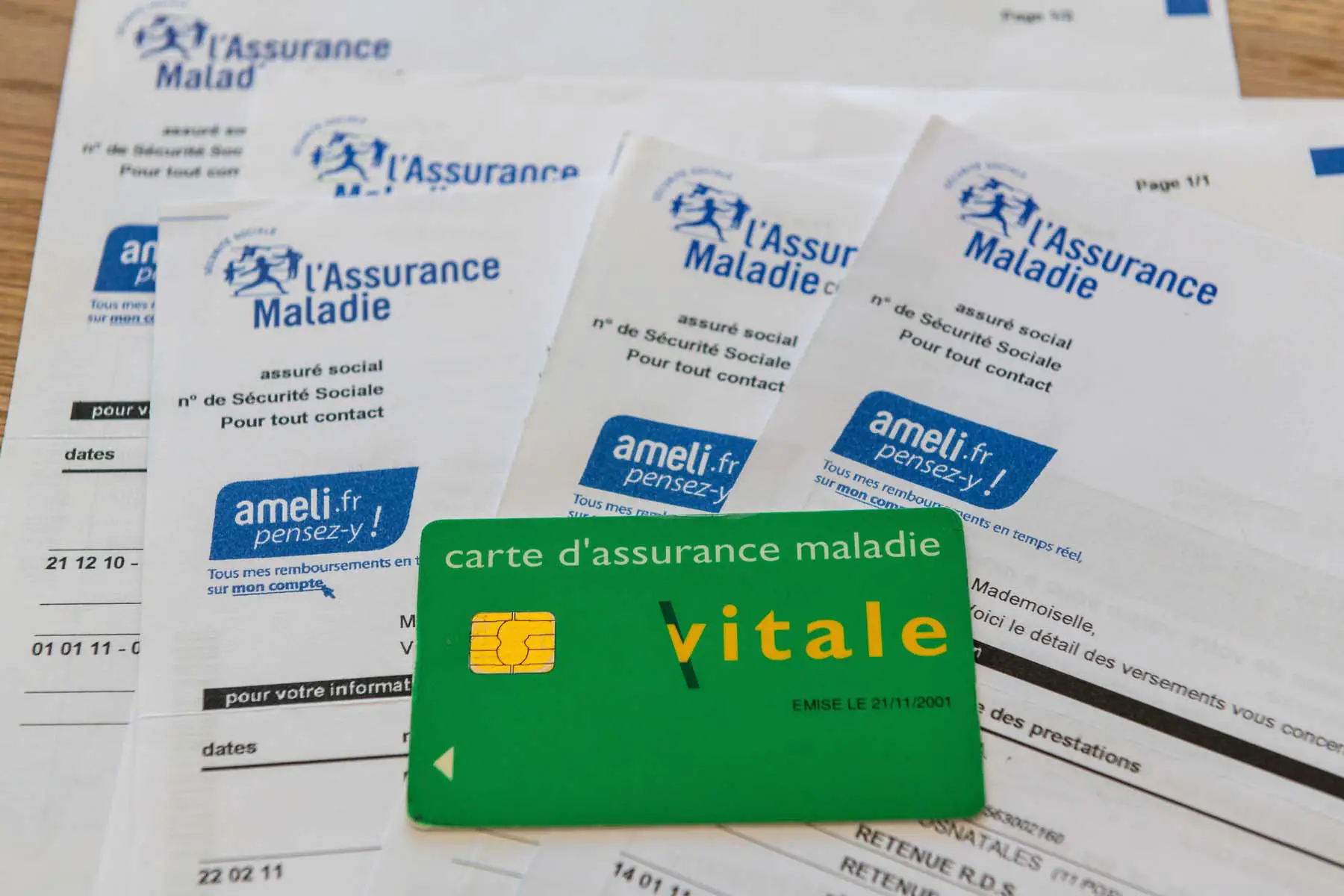
Your carte Vitale is the green health card used once your rights are active. For the bigger picture, see Expatica’s guides to health insurance in France, the French healthcare system, and the carte Vitale.
Keep this checklist in mind:
- validate your VLS-TS on ANEF if your visa requires it
- register with CPAM or the relevant student route when eligible
- keep copies of every submission
- wait for confirmed entitlement, not assumed entitlement
- only then review whether bridge cover can end
How to avoid a coverage gap
A coverage gap is the period when your visa is approved and you are living in France, but your French public healthcare rights are not yet fully live. The risk here is simple, you may still need treatment before CPAM finishes processing your file.
First, keep your private policy active from arrival. Next, submit your French registration as soon as your route allows. Last, cancel bridge cover only when you can prove your French rights are active, not just pending.
Common mistakes that can delay approval or leave you underinsured
The most common errors are paperwork errors, not dramatic legal issues. That is good news, because most of them are preventable.
Avoid these mistakes:
- assuming all long-stay visas accept travel insurance
- relying on GHIC or EHIC without checking route fit and repatriation
- submitting a vague certificate with no clear benefit wording
- buying a policy with dates shorter than your file requires
- cancelling private cover too early after arrival
- assuming public cover starts automatically for everyone after three months
- skipping the consulate’s own checklist because another website said something else
Send larger amounts internationally
Preparing for a long stay in France can mean moving savings, paying insurance premiums, or covering setup costs before arrival. Wise’s international money transfer service lets you send money abroad with fees shown upfront.

French authorities make visa decisions, so no insurer or article can guarantee visa approval. This guide is for general information only and does not constitute legal, medical, or immigration advice.
Sources
- France-Visas: Official guidance on long-stay visa categories, including VLS-T and VLS-TS definitions, checked on 16 June 2026.
- France-Visas: Official guidance on arrival formalities, border insurance wording, and VLS-TS validation through ANEF, checked on 16 June 2026.
- Service-Public: French government page on long-stay visas, durations, and residence permit steps, checked on 16 June 2026.
- Service-Public: French government page on health insurance rights for foreigners settling in France, including worker, student, and S1 pathways, checked on 16 June 2026.
- Ameli: Official foreign student registration guidance for French health coverage, checked on 16 June 2026.
- Cleiss: Official explanation of the S1 form and when it is used for cross-border healthcare rights, checked on 16 June 2026.
- Cigna Global: Provider page used for factual plan positioning, modular options, portability, and direct billing references, checked on 16 June 2026.
- Allianz Care: Provider page used for factual France, Benelux, and Monaco plan positioning, top-up logic, and optional repatriation references, checked on 16 June 2026.



Did you find this guide helpful?