'%20id='ico-down'%20stroke='%23000000'%20stroke-width='1.5'%3e%3cg%20transform='translate(1092.250000,%20254.750000)'%3e%3cpolyline%20id='Path-2-Copy-4'%20transform='translate(5.500000,%202.750000)%20scale(1,%20-1)%20rotate(-180.000000)%20translate(-5.500000,%20-2.750000)%20'%20points='0%200%205.5%205.5%2011%200'%3e%3c/polyline%3e%3c/g%3e%3c/g%3e%3c/g%3e%3c/svg%3e)



'%20fill='%23000000'%3e%3cg%20id='icons'%20transform='translate(56.000000,%20160.000000)'%3e%3cpath%20d='M144,7339%20L140,7339%20L140,7332.001%20C140,7330.081%20139.153,7329.01%20137.634,7329.01%20C135.981,7329.01%20135,7330.126%20135,7332.001%20L135,7339%20L131,7339%20L131,7326%20L135,7326%20L135,7327.462%20C135,7327.462%20136.255,7325.26%20139.083,7325.26%20C141.912,7325.26%20144,7326.986%20144,7330.558%20L144,7339%20L144,7339%20Z%20M126.442,7323.921%20C125.093,7323.921%20124,7322.819%20124,7321.46%20C124,7320.102%20125.093,7319%20126.442,7319%20C127.79,7319%20128.883,7320.102%20128.883,7321.46%20C128.884,7322.819%20127.79,7323.921%20126.442,7323.921%20L126.442,7323.921%20Z%20M124,7339%20L129,7339%20L129,7326%20L124,7326%20L124,7339%20Z'%20id='linkedin-[%23161]'%3e%3c/path%3e%3c/g%3e%3c/g%3e%3c/g%3e%3c/svg%3e)
'%20fill='%23000000'%3e%3cg%20id='icons'%20transform='translate(56.000000,%20160.000000)'%3e%3cpath%20d='M335.821282,7259%20L335.821282,7250%20L338.553693,7250%20L339,7246%20L335.821282,7246%20L335.821282,7244.052%20C335.821282,7243.022%20335.847593,7242%20337.286884,7242%20L338.744689,7242%20L338.744689,7239.14%20C338.744689,7239.097%20337.492497,7239%20336.225687,7239%20C333.580004,7239%20331.923407,7240.657%20331.923407,7243.7%20L331.923407,7246%20L329,7246%20L329,7250%20L331.923407,7250%20L331.923407,7259%20L335.821282,7259%20Z'%20id='facebook-[%23176]'%3e%3c/path%3e%3c/g%3e%3c/g%3e%3c/g%3e%3c/svg%3e)

While German banks offer a range of options for residents, expats and non-residents may find that eligibility rules and in-person appointments shape what’s available. This guide walks through the main account options for expats in Germany, helping you understand what’s possible and how to choose an account that meets your needs.
Wise Account
Living between countries often means managing more than one currency – Wise can help keep things simple. With a Wise multi-currency account, you can hold 40+ currencies and spend in 150+ countries using the Wise debit card, with conversions at the mid-market exchange rate and no hidden markups. The Wise app lets you track spending, withdraw cash from ATMs and manage your money in one place, making it a useful tool while settling into life in Germany or travelling abroad.

Can I open a German bank account as a non-resident?
Yes, it is possible to open a German bank account as a non-resident, but options are limited and acceptance depends heavily on the provider and your circumstances. In most cases, high-street banks require a German address and an in-person appointment, while non-residents are more likely to be accepted by direct banks or specialist providers such as Wise, which can be opened and used without German residency.
Can I open a German bank account online before moving?
Yes, in some cases you can open an account online before moving to Germany, usually through direct banks (Direktbanken) and specialist providers. Many German high-street banks prefer customers to apply in person once they are in the country, but direct banks operate fully online and are often more flexible for applicants living abroad. Providers like Wise also allow you to open and use an account remotely, which can be helpful for managing money before arrival.
Can I open a bank account in Germany without an address?
In most cases, you will need a German address to open a standard bank account, as banks usually require proof of registration (Meldebescheinigung). Without an address, your options are generally limited to direct banks or specialist providers, which may allow you to open an account using foreign documents and remote identity verification methods. These accounts can be useful as a temporary solution until you have registered your address in Germany and can apply for a local bank account.
What is the best German account for expats?
There is no single best German account for every expat, as eligibility and features depend on residency status, documentation and how you plan to use the account. German banks usually require local registration and a German address, which means many expats only open a bank account after arriving. Before that, or alongside a local bank, specialist providers and international accounts are often used to manage everyday finances and move money across borders. Once settled, most people will need a Girokonto, the standard German current account used for salary payments, rent, bills and everyday spending.
- Wise Account: Multi-currency account for holding, sending, exchanging and spending money internationally, commonly used by expats before and after moving to Germany
- Revolut Account: An app-based multi-currency account with 30+ currencies, debit cards and budgeting tools, suited to everyday spending and travel
- HSBC Global Money Account: International banking option for higher-income or globally mobile customers
- Airwallex Account: Business-focused multi-currency account for companies operating internationally
- Deutsche Bank current account: German Girokonto for expats with residency who want a full local bank account with branch access and English-language support
Wise account
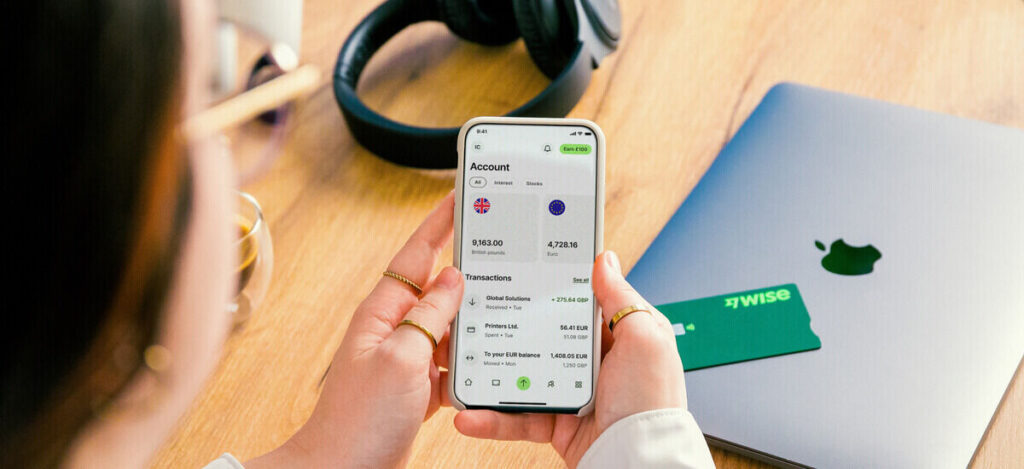
The Wise account is widely used by expats in Germany who need to manage money in more than one country. Opening is fully online and possible before arrival, with no requirement for German residency, making it useful while getting set up locally. Wise is not a bank, but a multi-currency account that works well on its own or alongside a German bank account later. Accounts are free to open and come with no monthly maintenance fees.
With Wise, you can hold and exchange 40+ currencies, including euros, and receive money using local or SWIFT account details for selected currencies. International transfers are available to 140+ countries, with transparent fees shown upfront and currency conversion at the mid-market exchange rate. The Wise debit card works in 150+ countries, including Germany, for everyday spending and ATM withdrawals, with automatic currency conversion when needed.

Revolut account
Revolut offers a digital account used by many expats in Germany who want app-based money management and multi-currency features in one place. Account opening is online, but eligibility generally requires German residency, which makes Revolut more suitable once you have arrived and registered locally. Personal customers can choose between a free Standard plan or paid plans with extra features and monthly fees up to around 60 EUR, depending on your usage needs.
Accounts let you hold and exchange 30+ currencies and include a linked debit card for spending in Germany and abroad. Currency exchange uses Revolut’s own rate, with plan-based limits on fee-free exchanges and additional 0.5% fair usage fees that may apply once allowances are exceeded or when exchanging at weekends.
Customers who are residents of Germany can receive a German IBAN for salary payments, SEPA transfers and direct debits, while other currencies are received using SWIFT details.
HSBC Expat Global Money Account
The HSBC Global Money Account is designed for customers who already bank with HSBC Expat and need to manage money across countries. Access requires holding an HSBC Expat Bank Account and meeting specific eligibility criteria, such as holding £75,000 (or the currency equivalent) in savings or investments, or earning an annual income of £120,000 or more paid into the account. As a result, the account is better suited to globally mobile or higher-income expats rather than everyday banking in Germany. Opening the Global Money Account itself comes with no account opening or monthly maintenance fees, although fees may apply to the underlying HSBC Expat account.
Balances can be held and managed in up to 19 currencies, including euros, within a single account. International transfers made through Global Money are fee-free from HSBC’s side, with exchange rates shown in the app. A linked debit card supports spending in multiple currencies and cash withdrawals worldwide, and English-language customer support is available for expats who prefer banking with a large international provider rather than a locally focused German bank.
Airwallex account
The Airwallex account is designed for businesses operating internationally, including companies registered in Germany that need to manage payments and multiple currencies in one place. Account opening is online, with no opening fee, and eligibility is subject to standard business verification. Airwallex is not intended for personal use, which makes it more suitable for startups, ecommerce businesses and established companies with frequent cross-border activity.
Businesses can hold, send, receive and spend 20+ currencies and open Global Accounts with local bank details to collect customer payments in their preferred currency. Monthly fees depend on the selected plan, ranging from no monthly fee or 19 EUR on entry-level plans (subject to balance or deposit thresholds), to higher-tier plans priced at 49 EUR per month or more for larger or more complex operations. Business features include corporate cards, batch payments and expense management and currency exchange uses interbank rates with transparent conversion fees.
Deutsche Bank current account
Deutsche Bank is one of Germany’s largest and most internationally recognised banks, offering a range of current (Girokonto) accounts to customers who are resident in Germany. Account options include AktivKonto and BestKonto, as well as Das Junge Konto for students, with monthly account fees ranging from 0 EUR to 13.90 EUR depending on the selected option. Accounts include a Deutsche Bank debit card, access to branch support and online and mobile banking.
Deutsche Bank accounts can suit expats who want a full German bank relationship once registered locally, including salary payments, direct debits and everyday spending in euros. Free cash withdrawals are available within the Cash Group network and in selected countries abroad, and debit cards support contactless payments and mobile wallets. While most of the website and application process are in German, Deutsche Bank provides an English-language version of their online banking and website with access to English-speaking customer support by phone, which can help non-German speakers manage their accounts more confidently once set up.
How to open a German bank account as a non-resident?
Opening a German bank account as a non-resident is possible, but the process depends on the type of provider you choose. Banks in Germany usually require you to be resident first, with proof of address and local registration, and may ask you to apply in person. Specialist providers and international accounts often allow online opening from abroad with fewer local requirements, which can be useful while relocating. Many expats start with a non-resident or international account, then open a German current account once they have registered their address.
Typical steps
- Choose between a German bank or a specialist international provider
- Check eligibility for non-residents and whether online opening is available
- Gather required identity, visa and address documents
- Apply online or visit a branch if required
- Complete identity checks and wait for account approval
Required information and documents
Requirements vary by bank and account type, but the following are commonly requested:
- PassportValid photo ID used to confirm your identity.
- Visa or residence permitProof that you are legally allowed to live or work in Germany.
- Proof of address or registration
- Registration certificate – confirms your address in Germany
- Certificate of residence – confirms you are still registered at that addressThese documents are issued by the Bürgeramt.
- Proof of employment or incomeSome banks ask for recent payslips, an employment contract, or bank statements, depending on the account.
- Student status confirmationRequired if you are applying for a student account.
If you’re opening a business account, additional required documents include:
- Company name and legal form
- Commercial register extract, if applicable
- Proof of representation rights, sometimes with apostille or legalisation
Because requirements differ between providers, it’s worth checking the exact list with the bank or account provider before applying, especially if you are opening an account from abroad.
Do you need a local bank account in Germany?
A local bank account is not always legally required, but in practice it often becomes necessary once you live in Germany. Many everyday payments are built around a German current account (Girokonto), and relying only on a foreign or international account can create delays or extra administration.
Salary payments, rent, utilities, health insurance contributions and tax payments are all commonly handled through SEPA transfers and direct debits. Government systems such as ELSTER for taxes and Deutsche Rentenversicherung for pensions also typically require a German or EU IBAN. International accounts can work at first when you’re still getting set up, but opening a local account usually becomes unavoidable once you are settled.
How to move your money to Germany
Moving money to Germany can feel complicated if you are relocating internationally for the first time, but there are a few ways to go about it. The right option depends on how much you are moving, how often you need to transfer funds, and whether you want to keep money in more than one currency. Some people move funds in one large transfer, while others prefer a more flexible setup that lets them manage money across countries as they settle in.
Common ways to move your money
- Bank or wire transfer: Money can be sent directly from your existing bank to a German bank account using an international wire or SEPA transfer. Banks such as Deutsche Bank support this once your account is open, but international transfers through banks can be slower and may involve higher fees or less favourable exchange rates.
- Money transfer with a specialist provider: Specialist providers such as Wise focus on international transfers, often with clearer pricing and exchange rate as well as faster delivery times. This option is commonly used to pay initial living costs or send money to Germany before a local bank account is fully set up.
- Multi-currency account: Multi-currency accounts let you hold, convert and spend money in different currencies from one place. Accounts from providers like Wise or Revolut allow you to keep funds in your home currency, convert to euros when needed, and spend or withdraw money in Germany using a debit card. Helpful during the transition period, it avoids repeated transfers while you are still managing finances across borders.
Useful resources
- Wise account: Multi-currency account features, pricing, and supported countries
- Revolut personal pricing plans: Germany-specific personal plans, fees, and feature limits
- HSBC Expat Global Money Account: Account features, eligibility criteria, and supported currencies
- Airwallex pricing: EU business account plans, fees, and exchange costs
- Deutsche Bank current accounts: Overview of Girokonto options, monthly fees, and account features in Germany