
'%20id='ico-down'%20stroke='%23000000'%20stroke-width='1.5'%3e%3cg%20transform='translate(1092.250000,%20254.750000)'%3e%3cpolyline%20id='Path-2-Copy-4'%20transform='translate(5.500000,%202.750000)%20scale(1,%20-1)%20rotate(-180.000000)%20translate(-5.500000,%20-2.750000)%20'%20points='0%200%205.5%205.5%2011%200'%3e%3c/polyline%3e%3c/g%3e%3c/g%3e%3c/g%3e%3c/svg%3e)


Finance
Taxes
The tax system in Switzerland
How does tax work in Switzerland? Learn all about who pays taxes in the country, what the rates are, and what happens if you fail to pay them on time.

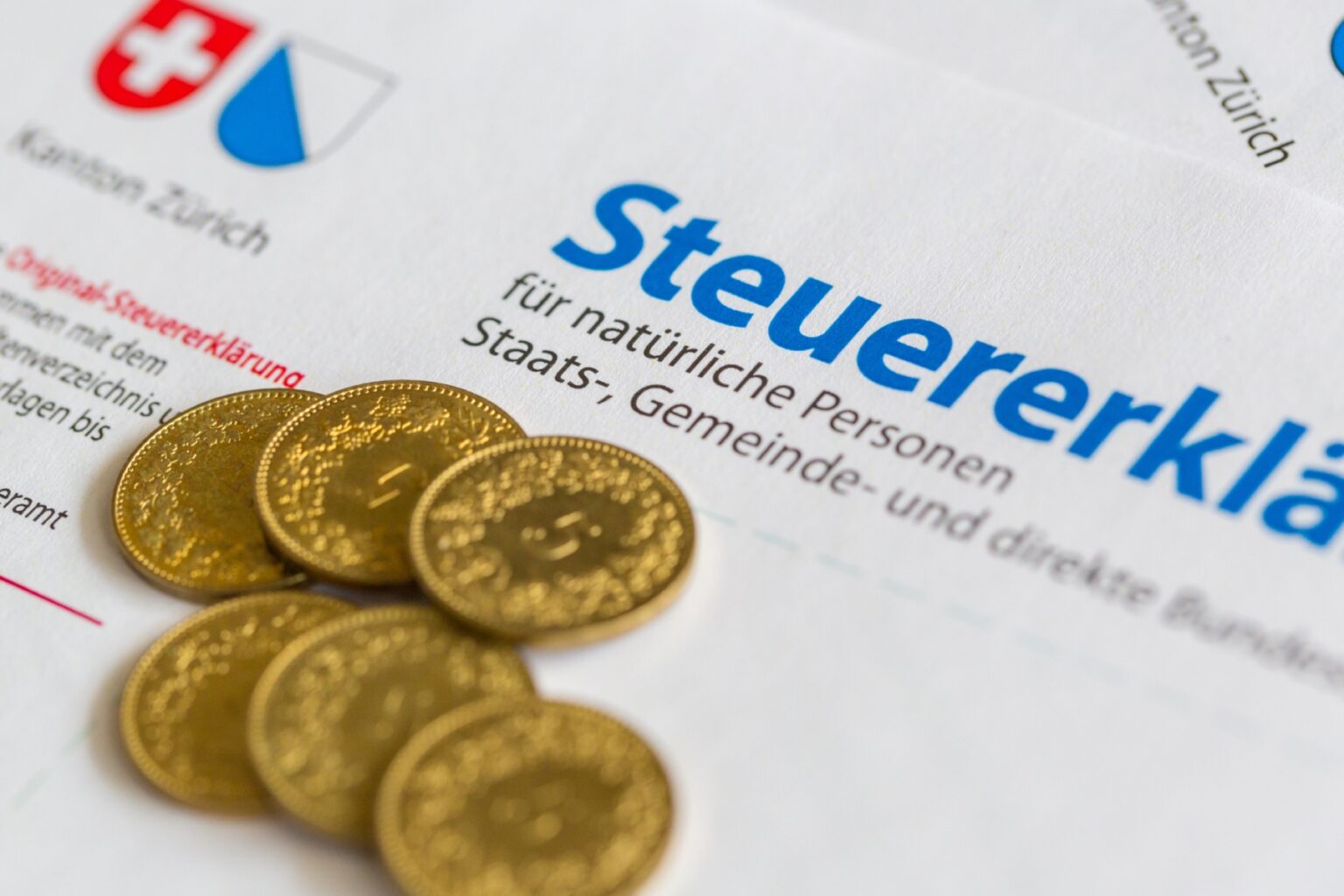
Taxes come for us all, even when you live in Switzerland. But figuring out how much you’ll need to pay can be tricky; not only are taxes levied from three different sources, but rates also vary depending on where you live in the country.
As an expat living in Switzerland, you might need an account to manage your finances in your home currency alongside Swiss francs. Wise offers multi-currency accounts with linked debit card to hold, and exchange CHF, and spend conveniently in Switzerland. More on that later.
Here’s a breakdown of what you need to know:
The tax system in Switzerland
With its reputation as a tax haven, Switzerland is renowned for its attractive rates, particularly for large-scale corporations. The country operates with a federalist tax structure, with duties levied from three distinct sources:
- The federal government: Headed by the Federal Department of Finance (FDF), the government directly taxes the money when you earn it
- The cantons: The country’s 26 cantons offer different tax rates and laws from each other
- The municipalities: Otherwise known as communes, these follow the laws set by their corresponding cantons, but oftentimes offer their own tax rates
The tax year runs in tandem with the calendar year, from 1 January to 31 December.

Who pays tax in Switzerland?
Anyone who is a Swiss resident or has lived in Switzerland for a minimum of 30 days must pay taxes. According to Swiss domestic tax law, a tax resident is someone who:
- Moves permanently to Switzerland and registers with their municipality OR
- Plans to work in the country for at least 30 days OR
- Lives in the country without working for at least 90 days
This does not mean, however, that every tax resident will need to file a tax return for their income.

Tax residents who have lived in the country for less than five years will be taxed directly on the monthly salary they earn in Switzerland. This is known as the withholding tax (WHT).
Permanent residents and self-employed people, on the other hand, will need to fill out a tax return once a year to account for their worldwide income. This is arranged through their canton.
If you’re married, the tax system treats you and your spouse as a single financial entity. This also extends to any children you have who are under 18 years old. As a result, you’ll only need to complete and submit one tax form for the entire family.
Managing international finances with Wise
Navigating Switzerland’s financial landscape as an expat might come with unique challenges. With Wise, expats can hold and convert money in 40+ currencies at the mid-market exchange rate, saving significantly on conversion costs. Their transparent fee structure ensures you always know exactly what you’re paying, with no hidden charges. Whether you’re settling in Switzerland or maintaining connections to your home country, Wise simplifies cross-border finance management.

How does Swiss tax work for expats?
Expats living in Switzerland for less than five years are taxed directly on their earnings in the country. This money is then split between the government, the canton, and the municipality.
Only expats who are permanent residents (living in the country for at least five years) will need to file a tax return. This will cover both their Swiss and worldwide income.

Luckily, Switzerland has over 100 tax treaties in place to help expats avoid double taxation. Check out the Swiss Federal Council’s website for a full list of countries that qualify.
The country also offers tax treaties to cover estate and inheritance taxes in the following countries:
- Austria
- Denmark
- Finland
- Germany
- Netherlands
- Norway
- Sweden
- The United Kingdom
- The United States
Internationals living in the country for a temporary assignment of less than five years can also claim certain income tax deductions. This includes expenses such as relocation costs, school fees, and housing.
Switzerland is also an active participant in the automatic exchange of information on financial accounts (AEOI). This system is made up of over 100 countries that automatically share information about financial accounts and investments to combat tax evasion.

For expats who need to transfer money to Switzerland to pay taxes or vice versa, Wise offers a convenient way to move money internationally with the mid-market exchange rate and a small, transparent fee. Wise also has automatic fee discounts on large transfer over the amount of 20k GBP (or equivalent in other currencies). This is particularly valuable when making larger tax payments or transferring funds for wealth tax calculations.
Do I need a tax number in Switzerland?
If you live and work in Switzerland, you should have an OASI (Old Age and Survivors’ Insurance) number (French: numéro AVS, German: AHV-Nummer, Italian: numero AVS). This is primarily a social security number, but it’s also used for tax matters and automatic deductions for contributions. You’ll usually receive an OASI number from your employer, but if you’re unsure, contact your local social insurance office.
Companies need an Enterprise Identification number (UID). They receive it when they enter into one of several commercial registers listed on the Federal Statistical Office website. This number is used as an identifier for corporate taxes, VAT, managing social security contributions, and other business activities.
Types of tax in Switzerland
Income tax
All permanent residents will need to pay income tax in Switzerland (Einkommensteuer/L’impôt sur le revenu) on their worldwide earnings and wealth. Non-permanent residents, on the other hand, will only be taxed on their earnings in the country.
Taxable income in the country includes (but is not restricted to) the following:
- Business income
- Employed income
- Pension income
- Self-employed income
- Rental income
Income tax rates vary by cantons and municipalities, so make sure to check your canton’s website to confirm what the amounts are.
The deadline for income tax returns is usually 31 March, although this may differ between municipalities.
Income tax for self-employed workers
Since self-employed workers are not subject to withholding tax, they must fill in a tax return every year in Switzerland. This also applies if they have been living in the country for less than five years.
Self-employed workers in Switzerland who receive payments from international clients can benefit from Wise Business accounts, which allow you to receive payments in multiple currencies without the high conversion fees or unfavorable exchange rates. This can be especially advantageous when billing clients in euros, dollars, or pounds while managing your tax obligations in Swiss francs.

Cantonal and municipal tax
Your cantonal and municipal taxes (French: Impôts cantonaux et communaux, German: Kantons- und Gemeindesteuern, Italian: Imposte cantonali e comunali) in Switzerland are levied as part of your income tax or your withdrawal tax (directly from the source).
Among its uses, these taxes will go towards supporting your local education system, public transportation, and utilities in your area.
Since cantons have the autonomy to set their own laws, rates can vary greatly between them, so make sure to check your local authority’s website for more information.
Corporate tax
All businesses registered in Switzerland must pay Swiss corporate income tax (CIT –French: L’impôt sur les sociétés, German: Körperschaftsteuer, Italian: Imposta sulle società) on their taxable earnings. Companies that gain profits outside of the country or have real estate established in foreign territory do not need to pay for this.

The government levies a federal CIT base rate of 8.5% on profit after tax or 7.83% before tax. Cantons and municipalities, on the other hand, impose their own rates.
As is the case with income tax, the amount of CIT due will depend on which canton and commune your business is based in, with some cantons levying progressive rates. However, in a general sense, companies can be expected to be charged a maximum rate of between 11.9% and 21% before tax.
VAT in Switzerland
Value-added tax (VAT) is 8.1% in Switzerland, though it will rise to 8.8% in 2026. It is also called Taxe sur la valeur ajoutée (TVA) in French, Mehrwertsteuer (MWST) in German, and Imposta sul Valore Aggiunto (IVA) in Italian.
Certain products and services qualify for a reduced VAT rate. Most notably, these are:
| Purchase item | VAT |
| Certain categories of goods and services | 2.6% |
| A stay in a hotel that includes breakfast | 3.8% |
Other services are excluded from VAT altogether, including:
- Cultural events
- Education
- Healthcare
- Rent on property
Can you get a refund on VAT?
If you are visiting Switzerland as a tourist, you can claim VAT on certain purchases if:
- The purchase is over CHF 300 (including VAT)
- The purchase is for you or is a gift
- You export the goods within 90 days
To claim the refund, you must fill out the export document in tourist traffic form and have it stamped at a Swiss customs office.
VAT for businesses
Although customers must pay VAT on products and services, only businesses making over CHF 100,000 annually will be levied for it.
If you are liable for VAT, you must register with the Federal Tax Administration to submit your annual accounts and receive your VAT number. Businesses that do not need to pay VAT (such as small businesses and event organizers) can adopt a simplified tax rate to track their finances instead.
Property tax
Whether you buy, own, or sell your property in Switzerland, you will need to pay taxes on it.

If you are purchasing property, you will need to pay a property transfer tax to register your new accommodation in the local land registry. This costs 1–3% of the purchase price.
You will need to account for various taxes if you own property in the country. Most notably, you will be levied for the following:
- Imputed rental value (Eigenmietwert/valeur locative): A form of income tax that amounts to 60–70% of the property’s rental value, if it were to be put on the market. On the bright side, you can then deduct the interest on your mortgage and any home maintenance costs from your tax return.
- Property tax (Liegenschaftssteuer/impôt foncier): Applicable to about half of the cantons, this is a tax of around 0.01–0.03% of the property’s value.
- Wealth tax (Vermögenssteuer/impôt sur la fortune): If you own property or land, you must pay taxes on it as an asset. However, you can offset this by deducting any associated mortgages from your tax return.
You will also need to pay the above taxes if you own a second home in Switzerland.

When purchasing property in Switzerland as a foreigner, you may need to transfer large sums from your home country.
Wise has high international transfer limits – often equivalent of 1 million GBP in most currencies, with automatic and progressive fee discounts. Wise transfer fee discounts apply to transfers over the amount of 20k GBP (or equivalent in other currencies), either in one transfer or across multiple transfers within a month.
You can use Wise international money transfers when moving funds for property purchases, renovations, or mortgage payments. Their service is particularly valuable for down payments or when paying contractors in Switzerland while your primary accounts remain abroad.
Inheritance tax
Anyone who inherits their deceased heir’s money and/or property is liable for inheritance tax in Switzerland (Erbschaftssteuer/Impôt de succession). This applies to every canton in the country besides Obwalden and Schwyz. Spouses, registered partners, children, and grandchildren are exempt from it.
Inheritance tax is calculated on how much the inheritance is worth, as well as the degree of relationship held between the deceased and the inheritor.
Gift tax
Gift tax is levied on anyone who receives certain types of gifts in Switzerland. It is not the same as inheritance tax because it concerns donated assets, rather than inherited assets.
Taxable gifts include the following:
- Advances on inheritances
- Gifts of money over a certain value
- Real estate gifts
- Works of art
As is the case with inheritance tax, the amount of the gift tax depends on the value of the gift and the degree of relationship between the donor and the receiver.
Vehicle tax
The Swiss government charges a 4% tax on the value of cars and small commercial vehicles that weigh up to 1,600 kg. This tax applies when these vehicles are brought into Switzerland, as well as when they are sold within the country.

Electric vehicles are subject to this tax only in certain cantons and, as usual, each canton levies its own rates.
CO2 tax
Established in 2008 to minimize carbon emissions, the CO2 tax (French: taxe carbon, German: CO2-Abgabe, Italian: tassa sul carbonio) is levied on individuals or businesses who use fossil fuels (mainly coal, natural gas, and heating oil) to generate heat and power thermal plants.
As of 2025, you must pay a surplus of CHF 120 for every tonne of CO2 consumed.
Companies can contact the Federal Department of Finance for an exemption from the tax if they are committed to reducing their carbon emissions.
Tax avoidance and evasion in Switzerland
With its reputation for low tax rates, Switzerland has had its fair share of tax avoidance in the past. It is one of the top-ranking countries in the Corporate Tax Haven Index, which says it has inflicted $18 billion worth of tax losses on other countries by facilitating tax abuse.
Swiss authorities have increased the frequency of tax audits and have participated in international agreements, such as the Convention on Mutual Administrative Assistance in Tax Matters, to encourage financial transparency.
What’s more, the OECD/G20 tax reform will ensure that large-scale businesses in Switzerland raise their rates to match the global minimum.
Tax fines and penalties
If you do not file your tax return by 31 March (or by your canton’s alternative deadline), you will need to pay interest on your late payment. Corporations are subject to similar obligations and will also face interest on late payments. This amount varies by canton but can be as high as interest rates on personal loans.
Where can I find tax advice in Switzerland?
Taxes in Switzerland can be complex for locals, let alone for someone who is new to the country and is still learning the local language.
Although this article gives you a general overview of the tax system in Switzerland, you should still consult a financial expert to advise you on your unique situation.
You can consult an expat-friendly tax service to help you figure out how to handle your taxes. Alternatively, check out our business directory to find other advisors in your area.
Useful resources
- ch.ch – More information on paying your taxes
- Federal Tax Administration – the government body that regulates taxes in Switzerland, with information on federal taxes, withholding tax, and more
- Swiss Tax calculator – government-approved calculator to calculate your taxes


Did you find this guide helpful?