'%20id='ico-down'%20stroke='%23000000'%20stroke-width='1.5'%3e%3cg%20transform='translate(1092.250000,%20254.750000)'%3e%3cpolyline%20id='Path-2-Copy-4'%20transform='translate(5.500000,%202.750000)%20scale(1,%20-1)%20rotate(-180.000000)%20translate(-5.500000,%20-2.750000)%20'%20points='0%200%205.5%205.5%2011%200'%3e%3c/polyline%3e%3c/g%3e%3c/g%3e%3c/g%3e%3c/svg%3e)



'%20fill='%23000000'%3e%3cg%20id='icons'%20transform='translate(56.000000,%20160.000000)'%3e%3cpath%20d='M144,7339%20L140,7339%20L140,7332.001%20C140,7330.081%20139.153,7329.01%20137.634,7329.01%20C135.981,7329.01%20135,7330.126%20135,7332.001%20L135,7339%20L131,7339%20L131,7326%20L135,7326%20L135,7327.462%20C135,7327.462%20136.255,7325.26%20139.083,7325.26%20C141.912,7325.26%20144,7326.986%20144,7330.558%20L144,7339%20L144,7339%20Z%20M126.442,7323.921%20C125.093,7323.921%20124,7322.819%20124,7321.46%20C124,7320.102%20125.093,7319%20126.442,7319%20C127.79,7319%20128.883,7320.102%20128.883,7321.46%20C128.884,7322.819%20127.79,7323.921%20126.442,7323.921%20L126.442,7323.921%20Z%20M124,7339%20L129,7339%20L129,7326%20L124,7326%20L124,7339%20Z'%20id='linkedin-[%23161]'%3e%3c/path%3e%3c/g%3e%3c/g%3e%3c/g%3e%3c/svg%3e)
'%20fill='%23000000'%3e%3cg%20id='icons'%20transform='translate(56.000000,%20160.000000)'%3e%3cpath%20d='M335.821282,7259%20L335.821282,7250%20L338.553693,7250%20L339,7246%20L335.821282,7246%20L335.821282,7244.052%20C335.821282,7243.022%20335.847593,7242%20337.286884,7242%20L338.744689,7242%20L338.744689,7239.14%20C338.744689,7239.097%20337.492497,7239%20336.225687,7239%20C333.580004,7239%20331.923407,7240.657%20331.923407,7243.7%20L331.923407,7246%20L329,7246%20L329,7250%20L331.923407,7250%20L331.923407,7259%20L335.821282,7259%20Z'%20id='facebook-[%23176]'%3e%3c/path%3e%3c/g%3e%3c/g%3e%3c/g%3e%3c/svg%3e)

Is Amsterdam safe to travel? Yes, Amsterdam is a safe city to visit. In the last Safe City Index (2019), Amsterdam ranked fourth position in the list of safest cities in the world.
Though you can buy marihuana freely in coffee shops, smart drugs in smart shops and prostitution is legal, Amsterdam is not a dangerous city.
The city does especially well in regards to traffic. Because everyone travels by bike there are not many traffic accidents and the air in Amsterdam is not (very) polluted.
For crime, Amsterdam is also safe. The risk of violent assault in Amsterdam is pretty much absent, in all parts of the city. Also, crime rates in general in Amsterdam are going down every year.
Still, most of the crimes such as robbing and pickpocketing in Amsterdam happen to tourists. Tourists are targeted more often than Amsterdam residents because they are easily distracted. As you prepare for your visit or move to Amsterdam, consider practical steps like managing your finances safely—using digital payment options can help you reduce the amount of cash you need to carry. Tourists still need to be careful of petty thieves, such as pickpockets, and getting your bag, jacket or things from your car stolen.
Here’s a list of tips for keeping safe in Amsterdam.
- Getting your bike stolen in Amsterdam
- Theft from parked cars in Amsterdam
- Pickpockets in Amsterdam
- Getting robbed or mugged in Amsterdam
- Chances of assault and armed robbery in Amsterdam
- Rates of violence and murder in Amsterdam
- Is Amsterdam’s Red Light District safe?
- Are there unsafe areas in Amsterdam?
- Is it safe for a woman to travel to Amsterdam?
Huurwoningen
Huurwoningen offers an extensive selection of rental properties across the Netherlands. With a user-friendly interface, direct communication with landlords, and valuable resources, finding the perfect home is effortless. Start your search today and discover your ideal rental property with Huurwoningen.

Getting your bike stolen in Amsterdam
Unsurprisingly, in a city with more than 800,000 bikes, bike theft is the biggest crime in Amsterdam. Most Amsterdam residents lose on average two bikes a year.
8 tips to avoid a stolen bike in Amsterdam
- Always use two different locks.
- Get at least one really good bike lock. A good bike lock should have a steel chain and will cost at least €30.
- Don’t use U-shaped locks.
- Always attach the frame to a bike rack or pole.
- If you have two bikes, don’t attach them to each other, unless you really want to help out the thief.
- There are many bike parks in the city where your bike is safe and dry (and many with the first 24 hours free).
- The thief follows the market: popular bikes (like ‘grandpa style’ bikes, shiny new bikes, or bikes with accessories) are easy to sell and so more popular among thieves.
- And, oh yeah, try to remember what your bike looks like to describe to the police or get a frame number.
Theft from parked cars in Amsterdam
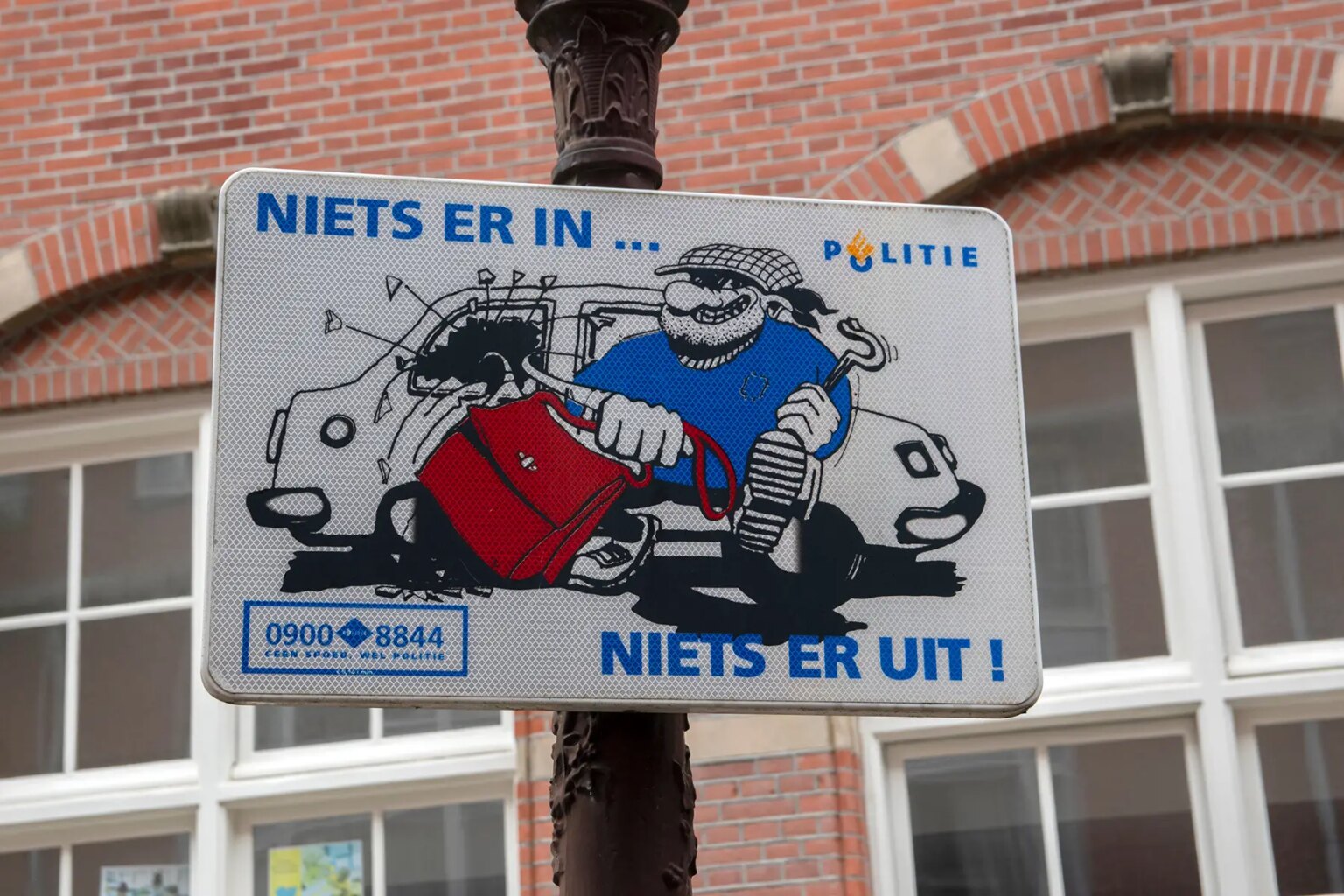
Leaving your car in Amsterdam is already expensive, but if you do please empty out the car completely. Any visible objects in the car (especially if it’s rental or a foreign number plate) will let a thief know there’s something worthwhile inside. Any car is very easy to open. Even secure park&ride car parks will not guarantee that your car is safe.
Pickpockets in Amsterdam
In any city where there are tourists, pickpockets try their luck. Though Amsterdam is no Barcelona or Rome (true pickpocket havens), Amsterdam, with its high density of tourism, does attract thieves and so pickpocketing happens a lot, especially in summer.
That’s because thieves know tourists carry a lot of cash with them and are easily distracted.
6 tips to avoid pickpockets in Amsterdam
- Always keep your bag close to your body and closed.
- Don’t use a big wallet or carry more money than you need.
- Don’t leave your bag or jacket with a wallet unattended in the dressing room of a shop, a fast-food restaurant, bar, or club (all clubs offer paid cloakrooms) or hanging from a baby stroller.
- Places with high pickpocketing rates in Amsterdam: Central Station, Damrak (between Central Station and Dam Square), Kalverstraat shopping street, (getting in and out of) trams, buses and metros, hotel lobbies, restaurants, and bars.
- Pickpockets either try to get into your bag or pocket when you are distracted or they try to distract you. Be very careful when someone asks you direction at Central Station – you probably look like a tourist and information stands are everywhere, so why would anyone approach you to ask directions? Or they point out a spot on your clothing. Or when they exit the tram, they fall and, while you help out, they take your wallet out of your bag. Usually, they work in teams, so if one person is talking to you, the other has probably already robbed you.
- Reduce your need to carry cash by using a payment card for daily expenses. Services like Wise offer a debit card that uses the mid-market exchange rate when you spend in euros or other currencies, which can help you avoid carrying large amounts of cash. Wise charges a small fee for currency conversion, but you can see all costs upfront before making transactions.
Getting robbed or mugged in Amsterdam
How big is the chance you will be robbed or mugged in Amsterdam? Not very big. On average, there are five robbings in the streets of Amsterdam per day (by comparison: just in Paris Nord station, there are 30–40 suitcases stolen every day).
In almost all of these cases, people were robbed of their mobile phone. Basically, it was just taken out of their hands while talking on the phone. In most of the cases, the victims were teenagers and not tourists.
If anyone confronts you violently, just give away your belongings without hesitation. Please remember: it’s only stuff that can be replaced. Your health is more valuable.
Chances of assault and armed robbery in Amsterdam
In Amsterdam, most of the assault, with violence or arms, happen to people at their business, such as shops and at their homes. So that’s one area where tourists are safer.
Rates of violence and murder in Amsterdam
There are not a lot of murders in Amsterdam and, if they happen, they are usually carried out between criminal groups operating in organized crime. In 2014, 25 people were murdered. In 10 cases the victims were known by the police and active as criminals themselves. The famous year is 2003, when criminal groups started murdering each other, resulting in 15 deaths.
In the Netherlands, homicide is not very common. In the United States, every year 5.27 in 100,000 people are murdered. With 0.9 murders per 100,000 people, the Netherlands is surely one of the safest countries in the world.
Is Amsterdam’s Red Light District safe?
Amsterdam’s Red Light District is full of crime, but you will never notice! Organized crime is high here, with women trafficking, prostitutes working for pimps (which is illegal), whitewashing of money in shady snackbars, dirty sex clubs, and dodgy coffee shops.
But, for people just walking around, the red light area is not dangerous at all. There is not much street crime in the Amsterdam Red Light District, probably because it’s always so busy and there are a lot of police cameras.
Still, naming the red light district as the safest area of Amsterdam is taking things too far. The center of Amsterdam is still the unsafest area for tourists, mostly due to all the pickpocketing.
Are there unsafe areas in Amsterdam?
As always, the poorest neighborhoods in a city are usually the most unsafe. This is also true in Amsterdam. Most crimes are recorded in the West: Bos & Lommer and Nieuw-West. These are areas with a lot of social housing, low-income families, immigrants, poverty, and social problems. Still, it’s not necessarily dangerous to be around there – most of the crime comes from burglaries.
Amsterdam Zuidoost
The only famously (supposedly) dangerous area in Amsterdam is Zuidoost, an area rather separated with some distance from the city. No chance you will wander around here by accident!
Zuidoost, also called Bijlmer, was built in the 1960s as a new haven for young families. Since the 1980s, the area is home to a huge number of immigrants from all over the world. The Bijlmer is a poverty-stricken area. It suffers from more crime than any other part of the city, though things are looking much better since a huge renovation operation of the area.
Still, the Bijlmer is safe and a lot of fun to visit during day time (it’s not like somewhere with gangs like Los Angeles).
The Amsterdam council has made an interactive map that shows the safety of different neighborhoods in Amsterdam.
Is it safe for a woman to travel to Amsterdam?
Amsterdam is safe for all people but as a woman traveling on your own, I advise you to take the normal precautions: don’t wander alone in deserted areas such as parks after dark and don’t trust just any stranger! Other than that: Amsterdam is safe, also for women traveling alone.
Reprinted with permission of What’s up with Amsterdam.
What’s up with Amsterdam guides tourists and expats towards the hidden gems of Amsterdam. Find budget friendly things to do and see, check up on upcoming events or get closer to the underground scene of Amsterdam: What’s up with Amsterdam keeps you posted.
Frequently Asked Questions
Is Amsterdam safe at night for tourists?
Yes, Amsterdam is generally safe at night, especially in the city center and well-populated areas. The main tourist areas remain busy until late, and the extensive tram and night bus network makes getting around safe and convenient. However, as in any major city, it’s wise to stay aware of your surroundings, stick to well-lit areas, and avoid walking alone in parks or deserted neighborhoods late at night. The Red Light District can get crowded and occasionally rowdy on weekend nights, but it’s heavily monitored by police cameras and officers.
How can I safely carry money while visiting Amsterdam?
The safest approach is to minimize the amount of cash you carry. Amsterdam is highly digital, and cards are accepted almost everywhere, from cafés to street markets. Consider using a payment card that offers transparent exchange rates—for example, Wise provides a debit card that uses the mid-market exchange rate for spending in euros, with fees shown upfront before you spend. This can help you reduce reliance on currency exchange services.
Keep any cash you do carry in a secure, inside pocket rather than an easily accessible wallet. Split your money between different locations (some in your accommodation safe, some on your person) so you’re not carrying everything at once. For added security, keep digital copies of your important cards and documents stored securely online.
What’s the best way to manage finances as an expat in Amsterdam?
As an expat settling in the Netherlands, you’ll want to set up practical financial systems early. While opening a local Dutch bank account is essential for receiving salary and paying rent, you might also consider an international money transfer service like Wise for managing multiple currencies. This can be particularly helpful if you’re receiving income from abroad, supporting family in your home country, or maintaining financial connections outside the Netherlands. With Wise, you can hold euros alongside other currencies and send money internationally using the mid-market exchange rate with transparent fees shown before you transfer.
What should I do if my bike is stolen in Amsterdam?
First, report the theft to the police—you can do this online at Politie.nl or at a police station. You’ll need your bike’s frame number for the report, which is why it’s crucial to record this when you first get your bike. Check Amsterdam’s official bike recovery depots (fietsdepots) where found and confiscated bikes are stored—sometimes stolen bikes turn up there. You can search their online databases with your frame number.
Also look at online marketplaces like Marktplaats, where stolen bikes are sometimes sold. If your bike was insured (either through home contents insurance or separate bike insurance), file a claim with your insurance company using the police report. Unfortunately, with over 80,000 bikes stolen annually in Amsterdam, recovery rates are low, so investing in proper locks and following prevention tips is your best defense.