
'%20id='ico-down'%20stroke='%23000000'%20stroke-width='1.5'%3e%3cg%20transform='translate(1092.250000,%20254.750000)'%3e%3cpolyline%20id='Path-2-Copy-4'%20transform='translate(5.500000,%202.750000)%20scale(1,%20-1)%20rotate(-180.000000)%20translate(-5.500000,%20-2.750000)%20'%20points='0%200%205.5%205.5%2011%200'%3e%3c/polyline%3e%3c/g%3e%3c/g%3e%3c/g%3e%3c/svg%3e)


Moving
Visas & Immigration
Getting a work visa in the United Arab Emirates in 2026
We explain the rules around getting a work visa in the UAE, including eligibility, costs, and how the golden visa system works.

Expats moving to the likes of Dubai and Abu Dhabi must secure a work permit; this ultimately forms part of the Emirati residency visa. This guide includes the following information:
What’s the difference between a work visa and a work permit in the UAE?
In the UAE, the terms ‘visa’ and ‘permit’ are often used interchangeably. Generally, you’ll require a visa (or entry permit) to enter the country, a work permit (or labor card) to work, and a residency visa (or permit) to stay in the country.
Employers generally apply for entry permits, Labor Cards, and residency visas on behalf of their employees. Self-employed people apply for their own.

The residency visa and Emirates ID application are handled by the Federal Authority for Identity and Citizenship, Customs and Ports Security (ICP) or the General Directorate of Foreigners Affairs (GDRFA), while the Ministry of Human Resources and Emiratisation (MOHRE) issues work permits.
Who needs a visa and/or work permit in the UAE?
Whether you need an entry visa for the UAE depends on your nationality. However, all foreign nationals who intend to work in the UAE require a labor card and residency visa.

How easy is it to get a work visa for the UAE?
It’s quite easy to get a work visa for the UAE if you already have a job offer from an employer based in the country. That’s because they handle the application. Furthermore, there is no labor market test – employers do not have to prove there was no qualified worker locally.
However, there are several important considerations:
- Emiratisation: The UAE government has several policies to increase the number of Emirati workers in the labor force.
- Quotas: There are limits on the number of visas available for businesses to employ foreign workers.
- Complex processes: You will likely need to undergo medical tests to receive your visa and permit.
- Salary requirements: Some visas require a certain income.
Generally, the process is easier for skilled workers in high-demand industries.
It is possible to move to the UAE without a job lined up – the country offers Jobseeker visit visas for candidates looking for work in certain professions. Furthermore, Green and Gold Visas offer different routes to residency, including self-employment and investment.
Types of UAE work visa
In the UAE, work visas offer entry, residency, or both.
| Visa type | Does it provide entry? | Does it provide residency? | Notes |
| Standard Work Visa | Yes | No | You also require a work permit and residency visa. |
| Green Visa | Yes | Yes | If you are employed, your employer must apply for a work permit. |
| Golden Visa | Yes | Yes | If you are employed, your employer must apply for a work permit. |
| Jobseeker Visit Visa | Yes | No | You can only get a residency visa after finding work – your employer will handle the process. |
| Blue Visa | Yes | Yes | If you are employed, your employer must apply for a work permit. |
| Virtual Work Residence Visa | Yes | Yes |
Not all visas are available for every Emirate, and requirements vary, so it’s worth checking with the GDRFA website of the state where you will be living:
UAE Standard Work Visa
A Standard Work Visa is for foreign nationals with a job offer from an employer in the UAE. This visa is valid for 60 days, during which time you must obtain a work permit and residency visa to stay longer.
Employers apply for the Standard Work Visa – in Dubai, it costs AED 200 plus 5% value-added tax (VAT). There are additional charges for sponsored workers already in the country.
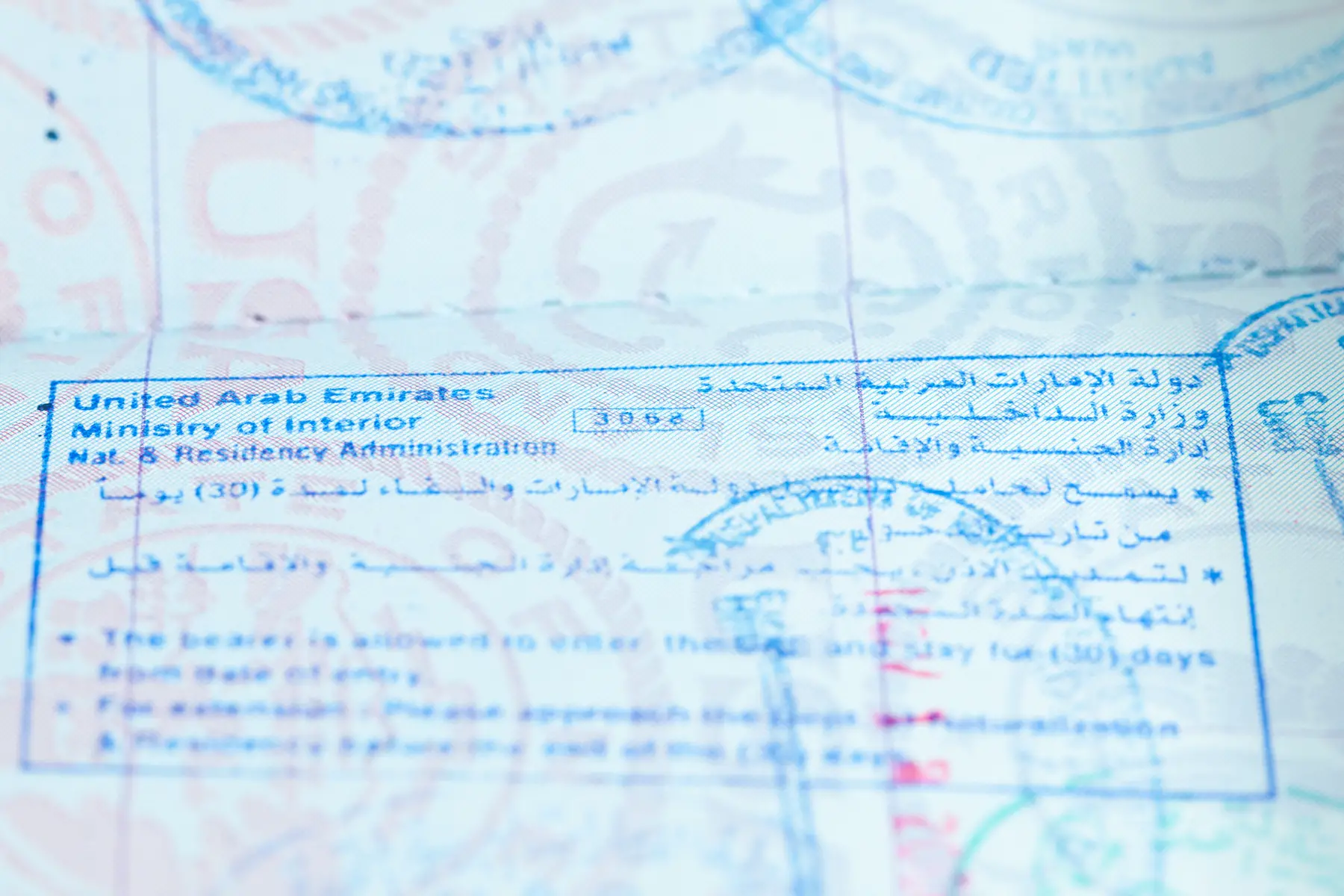
The Standard Work Visa allows you to stay in the country while you organize your documents. It does not allow you to work until you have the Labor Card and Residency Visa.
Green Visa
The UAE’s Green Visa is for the following workers:
- Freelancers and self-employed people
- Skilled employees
It’s valid for five years, renewable, and allows you to live and work in the UAE without employer sponsorship. You can also bring your family members to the UAE with you.
UAE Golden Visa
Golden Visas in the UAE allow foreigners to live, work, and study in the country without a sponsor. This permit includes a residence visa valid for five or 10 years. Furthermore, you can stay outside the UAE for longer than six months and still retain your right to residency.
It also allows you to sponsor both family members and domestic helpers.
This visa is for the following people:
| Golden visa type | Requirements |
| Investors in public investments | A deposit of at least AED 2 million in an accredited UAE investment fund OR A commercial or industrial license and no less than AED 2 million in capital |
| Real estate investors | Ownership of properties valued at more than AED 2 million |
| Entrepreneurs | Ownership of an economic project of a ‘technical or future nature based on risk and innovation’ with a value of more than AED 500,000 |
| Outstanding specialised talents | People working in several highly qualified positions, including doctors, engineers, inventors, creatives, and athletes |
| Outstanding students | High school or university students with excellent grades |
| Pioneers of humanitarian work | Five years working for an international or regional organization OR Five years’ employment in a civil association or institution of public interest OR An appreciation award from a local, regional, or international organization focusing on humanitarian work OR Have provided at least AED 2 million in funding for humanitarian work |
| Frontline heroes | Workers such as nurses, medical assistants, and other medical workers who have made extraordinary efforts during crises such as the COVID-19 pandemic |
Jobseeker visit visa for the UAE
The UAE offers visas to highly skilled professionals who want to find work in the country. The jobseeker visa provides a single entry to the country to explore job opportunities for 60, 90, or 120 days.
The costs are as follows:
- 60 days: AED 200
- 90 days: AED 300
- 120 days: AED 400
You’ll also need to pay 5% VAT, and the ICP may charge additional fees and security deposits.
Once you find a job in the UAE, your employer will apply for a work visa and residence visa on your behalf so that you can remain in the country.

Requirements for the jobseeker visit visa
The following professionals can apply for the jobseeker visit visa in the UAE:
- Legislators, managers, and business executives
- Professionals in scientific, technical, and human fields
- Technicians in scientific, technical, and humanitarian fields
- Graduates from one of the MOHRE’s top 500 universities (must have graduated within the past two years)
The minimum qualification requirement is a bachelor’s degree.
UAE Blue visa
In 2024, the UAE announced a new visa for people who have made substantial contributions to environmental and sustainability-related causes inside or outside the UAE.
This Blue Visa provides 10 years of residence.
Blue visa requirements
The following people can apply for the Blue visa:
- Members of international organizations
- International companies
- Associations and NGOs
- Global award winners
- Distinguished activists and researchers in environmental work
Virtual work residence visa in the UAE
The UAE also offers a one-year, renewable work visa for digital nomads: the Virtual Work residence visa. It has a minimum income of $3,500 per month ($5,000 per month in Dubai). Employees of foreign companies and self-employed people can apply for it. It costs $287, and you can bring family members on a dependent family member visa.

Gaining residency in the UAE for work
Holders of Golden, Green, Blue, and Virtual Work Residence Visas have residency included. On the other hand, if you come to the UAE with a Standard Work Visa, you’ll need a residence visa.
A residence visa allows you to stay in the UAE for two years, and is renewable. Your employer should apply for it for you.
Do student visas and family visas allow you to work in the UAE?
It is possible to work in the UAE on a student or family visa, but you’ll require a work permit. You can read more about the different types below.
Types of work permit in the UAE
The UAE has a large number of work permits. Employers apply for these through the Ministry of Human Resources & Emiratisation (MOHRE) online platform.
Please note: fees can vary according to the profession and company, and there may be additional fees involved in the application and issue of permits.

Work permit – Overseas
- Who it’s for: Employers recruiting workers from outside the UAE
- Requirements:
- Employee must be over 18.
- They must not already hold an active permit.
- Valid for: Two years
- Cost:
- Application fee: AED 50
- Issuance fee: AED 250 for category 1 companies, AED 1,200 for category 2 companies, and AED 3,450 for category 3 companies.
You can read more about the different classifications for companies on the MOHRE website.
Work permit – Dependents sponsored by family members
- Who it’s for: Workers already residing in the UAE on a family-sponsored residence visa working in any profession at any skill level.
- Requirements:
- The worker must be over 18.
- They must not already have an active work permit.
- They must already be living in the UAE through family member sponsorship.
- Valid for: Two years
- Cost:
- Application: AED 50
- Issue: AED 250
UAE temporary work permit
- Who it’s for: employees working for a specific, short-term duration
- Requirements:
- The worker must be over 18.
- They must have a residence visa that lasts longer than the temporary work permit (if not a UAE or GCC citizen).
- Valid for: Six months
- Cost:
- Application: AED 50
- Issue: Varies according to the company classification and worker’s skill level
Training and work permit for students in the UAE
- Who it’s for: students engaging in training or part-time work
- Requirements:
- The worker must be over 15.
- The job must not be prohibited for juvenile students.
- The student must not already have a work permit.
- Valid for: Three months
- Cost:
- Application: AED 50
- Issuance fee: AED 50
Work permit – Domestic Workers
- Who it’s for: domestic workers in household and personal service roles
- Requirements:
- The worker must be 18–60 years old.
- The employer must have a valid insurance policy.
- Valid for: Up to two years if the employer is a UAE/GCC citizen or diplomat, up to one year for other employers.
- Cost:
- Depends on the employer’s nationality, location, and length of permit. Check the MOHRE website for details.
Private tutor licensing
- Who it’s for: People who plan to offer private tutoring service, such as registered teachers, unemployed people, university students, and high school students
- Requirements:
- Valid residence visa.
- High school students must be aged 15–18.
- Valid for: up to two years
- Cost: Free of charge
Work permit for UAE Golden Visa holders
- Who it’s for: Workers with UAE golden visas
- Requirements:
- The worker must be over 18.
- The worker must already have a Golden Visa.
- Valid for: two years
- Cost:
- Application: AED 50
- Issuance fee: AED 250
How to apply for UAE work permits and visas
As discussed above, you require the following to work in the UAE:
- Entry (employment) visa
- Residency visa
- Work permit (Labor card)
Here is the application process in more detail. Bear in mind that the process is different if you are moving to the UAE as a jobseeker.
Before starting the process, double-check with your employer which documents are necessary for your application.
Quota approval: Employer
- Quota approval: the employer contacts the Ministry of Labor for approval to hire a foreign employee.
- Job offer and contract: The employer sends a formal job offer, and they and the employee sign an employment contract detailing the terms and conditions.
Work permit application: Employer
The employer applies for a work permit (Labor Card) from the MOHRE.
Documents required:
- Employer’s trade license
- Employee passport copy, valid for at least six months
- A recent color photograph of the worker
- Evidence of relevant qualifications
- A letter of approval from regulatory authorities (if required)
Entry permit issuance: MOHRE or GDRFA
Once the work permit has been approved, the MOHRE issues an entry permit (sometimes known as a “pink visa”), which is usually valid for 60 days. This allows the employee to enter the UAE for work purposes.
Documents required:
- Work permit approval
- Passport copy valid for at least six months
- Passport-sized photograph
- Employment contract signed by both employer and employee
- Visa application fee
Enter the UAE: Employee
The employee uses the entry permit to come into the country.
Required documents:
- Entry permit
- Passport valid for at least six months
Medical fitness test: Employee
The employee undertakes a medical fitness test at an approved health center within 14 days of arrival. This shows they are free from communicable diseases.
Required documents:
- Registration form for the medical center
- Passport photo
- Copies of the first and second pages of the employee’s passport
- Company’s trade license
- Copy of residence or entry permit
- Emirates ID or application form (if renewing a residence permit)
Emirates ID application: Employer and employee
The employer applies for the Emirates ID, and the employee attends an ICP service center in person.
Required documents:
- Entry permit
- Passport
- Passport-sized photograph
- Proof of residence
- Company’s trade license
- Medical fitness certificate
- Employment contract
Health insurance: Employer
The employer arranges the employee’s health insurance. It is mandatory for all UAE residents to have at least basic coverage.
- Passport copy
- Emirates ID application receipt
- Passport-sized photograph
- Proof of employment
- Medical history records
- Proof of payment
Residence visa processing: GDRFA
The GDRFA processes the application and issues the residence visa digitally. The employee’s Emirates ID is proof of residency.
Required documents:
- Emirates ID application
- Medical fitness certificate
- Proof of health insurance
- Employment contract
- Passport copy
The employee can start work.
Appeals and complaints for UAE work visas and permits
If you experience difficulties during the work permit or visa application process, you can file an appeal or complaint with the relevant authority:
- MOHRE – handles complaints to do with work permits and employment
- GDRFA (Dubai only) – for issues relating to entry permits and visas
- ICP – for problems with residency visas and the Emirates ID
You can usually file a complaint online through the portals. Keep your details on hand, such as passport copy, visa details with application number/reference, and supporting documents.
Some platforms allow you to track the status, so make a note of any reference numbers they send you. Typically, it takes one week to a month to review complaints.
Should you need to escalate the issue or are unhappy with the outcome, it’s a good idea to contact a registered immigration lawyer or legal advisor.



Did you find this guide helpful?