'%20id='ico-down'%20stroke='%23000000'%20stroke-width='1.5'%3e%3cg%20transform='translate(1092.250000,%20254.750000)'%3e%3cpolyline%20id='Path-2-Copy-4'%20transform='translate(5.500000,%202.750000)%20scale(1,%20-1)%20rotate(-180.000000)%20translate(-5.500000,%20-2.750000)%20'%20points='0%200%205.5%205.5%2011%200'%3e%3c/polyline%3e%3c/g%3e%3c/g%3e%3c/g%3e%3c/svg%3e)




'%20fill='%23000000'%3e%3cg%20id='icons'%20transform='translate(56.000000,%20160.000000)'%3e%3cpath%20d='M144,7339%20L140,7339%20L140,7332.001%20C140,7330.081%20139.153,7329.01%20137.634,7329.01%20C135.981,7329.01%20135,7330.126%20135,7332.001%20L135,7339%20L131,7339%20L131,7326%20L135,7326%20L135,7327.462%20C135,7327.462%20136.255,7325.26%20139.083,7325.26%20C141.912,7325.26%20144,7326.986%20144,7330.558%20L144,7339%20L144,7339%20Z%20M126.442,7323.921%20C125.093,7323.921%20124,7322.819%20124,7321.46%20C124,7320.102%20125.093,7319%20126.442,7319%20C127.79,7319%20128.883,7320.102%20128.883,7321.46%20C128.884,7322.819%20127.79,7323.921%20126.442,7323.921%20L126.442,7323.921%20Z%20M124,7339%20L129,7339%20L129,7326%20L124,7326%20L124,7339%20Z'%20id='linkedin-[%23161]'%3e%3c/path%3e%3c/g%3e%3c/g%3e%3c/g%3e%3c/svg%3e)
'%20fill='%23000000'%3e%3cg%20id='icons'%20transform='translate(56.000000,%20160.000000)'%3e%3cpath%20d='M335.821282,7259%20L335.821282,7250%20L338.553693,7250%20L339,7246%20L335.821282,7246%20L335.821282,7244.052%20C335.821282,7243.022%20335.847593,7242%20337.286884,7242%20L338.744689,7242%20L338.744689,7239.14%20C338.744689,7239.097%20337.492497,7239%20336.225687,7239%20C333.580004,7239%20331.923407,7240.657%20331.923407,7243.7%20L331.923407,7246%20L329,7246%20L329,7250%20L331.923407,7250%20L331.923407,7259%20L335.821282,7259%20Z'%20id='facebook-[%23176]'%3e%3c/path%3e%3c/g%3e%3c/g%3e%3c/g%3e%3c/svg%3e)

While France has a reputation for high taxes, property-related levies are generally comparable to other European nations, provided you account for all transaction and ownership costs.
If you are buying a home, the figure to keep in mind is roughly 7% to 8% of the purchase price for existing properties and 2% to 3% for new builds.
This amount primarily covers taxes and legal fees collected by your notary (notaire).
- What are the main property taxes in France?
- Taxes on buyers
- Taxes on sellers
- Taxes on homeowners: recurring payments
- Is rental income taxed?
- First vs second home: tax implications
- Wealth taxes in France
- How to save money on your property purchase
- How to pay your taxes
- When to speak to a tax professional
- Useful resources
Use Wise to save money on your property purchase
Buying a property abroad is a big step and involves important financial decisions. Wise, an international money transfer company, provides specialist support to help you navigate large international transfers and save on exchange fees. Fill out Wise’s online form today to find out how they can assist you.

What are the main property taxes in France?
Property owners and buyers in France encounter several types of taxes depending on their status and how they use the property.
These include one-off transaction duties when you buy or sell, and recurring annual taxes for as long as you hold the asset.
The primary taxes include:
- Transfer duties (Droits de mutation): Paid by the buyer during the purchase process.
- Capital gains tax (Taxe sur les plus-values): Paid by the seller on any profit made from the sale.
- Ownership tax (Taxe foncière): An annual tax paid by all property owners.
- Housing tax (Taxe d’habitation): An annual tax now strictly limited to second homes and vacant properties.
- Wealth tax (IFI): A specific tax on high-value real estate portfolios.
Who is subject to these taxes?
Both residents and non-residents are subject to property taxes in France if they own real estate on French soil.
- Residents: Pay all local taxes and are subject to capital gains and wealth taxes on their global assets (subject to tax treaties).
- Non-residents: Must pay local taxes (Taxe foncière and Taxe d’habitation) and are subject to French tax on rental income and capital gains from French property.
- Corporations: Entities owning French property may be subject to corporate tax on income and a specific 3% annual tax on the property’s market value unless they meet disclosure exemptions.
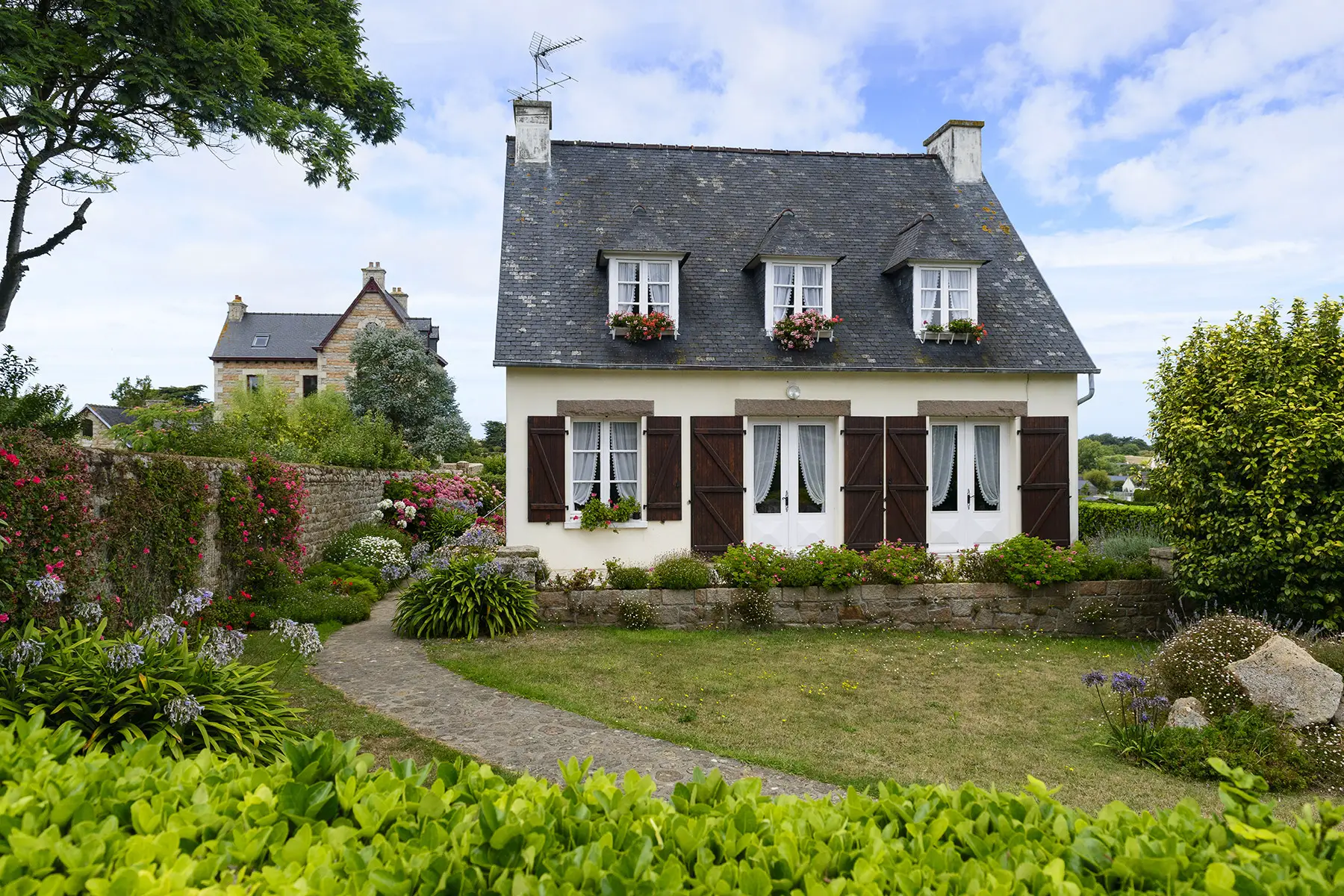
Taxes on buyers
When you buy a property in France, most of your “closing costs” are taxes. These are often collectively called frais de notaire because the notary collects them for the state.
Transfer Tax (Droits de Mutation – DMTO)
This is the largest component of your purchase costs. As of April 2025, departments have the authority to raise this rate to 5% for a temporary three-year period (previously capped at 4.5%). Most departments in France apply the maximum rate.
Registration and Security Contribution (Contribution de sécurité immobilière – CSI
A flat rate of 0.10% of the property price is charged for the formal registration of the change in ownership.
Value Added Tax (VAT/TVA)
New-build properties (less than five years old) are typically subject to 20% VAT. This is usually included in the advertised price from the developer. If you pay VAT, your other transfer duties are significantly reduced to around 0.715%.
Exemptions:
- First-time buyers may occasionally benefit from local departmental reliefs, though these are rare.
- Purchases of new-build homes significantly reduce the transfer tax portion of the notary fees.
Taxes on sellers
If you sell a French property at a profit, you may be liable for capital gains tax. The notary calculates and deducts this tax directly from the sale proceeds.
Capital Gains Tax (CGT)
The standard base rate is 19% on the profit. For high-value gains exceeding €50,000, a progressive surtax of 2% to 6% may also apply.
Social Security Charges
In addition to the base 19%, social charges are applied. For most residents, the rate is 17.2%. Non-residents affiliated with a social security system in the EU, EEA, UK, or Switzerland pay a reduced solidarity levy of 7.5%.
Exemptions:
- Primary Residence: The sale of your main home is entirely exempt from capital gains tax.
- Duration of Ownership: You receive tapering relief based on how long you have owned the property. You are fully exempt from the 19% base tax after 22 years and fully exempt from social charges after 30 years.
- Low Value: Sales where the property price is under €15,000 are generally exempt.

Taxes on homeowners: recurring payments
Once you own a home, you must pay annual local taxes. These are determined by the cadastral rental value of the property and rates set by your local municipality.
Taxe Foncière
This is the main ownership tax. It is payable by whoever owns the property on January 1st each year. Even if you sell the house mid-year, the person who owned it on New Year’s Day is technically responsible for the bill, though buyers and sellers often split this pro-rata in the sales contract.
Taxe d’Habitation
This tax was abolished for primary residences in 2023. However, it remains in place for second homes and holiday homes. In high-demand areas (zones tendues), municipalities can apply a surtax of between 5% and 60% on top of the base bill.
Exemptions:
- New Builds: You may receive a full or partial exemption from taxe foncière for the first two years after a new home is constructed.
- Energy Efficiency: Some communes offer tax breaks of 50% to 100% for five years for properties that have undergone significant energy-efficiency improvements.
- Low Income/Age: Low-income earners over the age of 75 or those with certain disabilities may be exempt from taxe foncière on their main home.

Is rental income taxed?
Yes, rental income from French property is always taxable in France, regardless of where you live. You must file an annual French tax return (Déclaration des Revenus) every spring.
The tax depends on your chosen regime:
- Micro Regime: For annual income below certain limits (e.g., €15,000 for unfurnished), you get a flat-rate deduction (30% to 50%) and pay tax on the remainder.
- Réel Regime: You deduct actual expenses like maintenance, insurance, and mortgage interest. This is often more beneficial for furnished rentals (LMNP) where you can also deduct depreciation.
Exemptions:
- New rules introduced in 2025 significantly reduced the tax advantages for short-term tourist rentals (like Airbnb) to encourage long-term letting.
- Occasional letting of a room in your primary residence may be exempt if the rent is below certain modest thresholds.
First vs second home: tax implications
The tax burden in France is significantly lighter for your main residence compared to a holiday home or investment property.
- Primary Residence: Exempt from taxe d’habitation and capital gains tax. It also receives a 30% valuation reduction for wealth tax (IFI) calculations if owned directly.
- Second Home: Subject to taxe d’habitation (often with a surtax) and standard capital gains tax upon sale. There are no valuation reductions for second homes when calculating wealth tax.
Wealth taxes in France
France applies a specific real estate wealth tax called Impôt sur la Fortune Immobilière (IFI). This tax applies if the total net value of your real estate assets (minus deductible debts like mortgages) exceeds €1.3 million.
If you are over the threshold, the tax is calculated on a progressive scale starting from €800,000. Rates range from 0.5% to 1.5%.
Non-residents are only taxed on their assets physically located in France, while residents are theoretically taxed on their global property holdings.
How to save money on your property purchase
Buying property abroad involves moving large sums of money across borders, which can be expensive if you rely on banks for currency conversion.
You can use Wise to move money for your French property purchase and save on currency conversion costs.
Wise uses the mid-market exchange rate (the one you see on Google) and charges a transparent, low fee:
- You can use Wise to pay the seller or notary directly.
- Alternatively, if you have already set up a French bank account, you can use Wise to move money between your home country and France at a lower cost than most traditional banks.

How to pay your taxes
The main tax authority in France is the Direction Générale des Finances Publiques (DGFiP). Most property-related taxes are managed through their official portal, impots.gouv.fr.
- Payment Dates: Taxe foncière bills are usually issued in the fall and are due in October. Taxe d’habitation is typically due by mid-December.
- Declarations: All owners must complete a mandatory Occupancy Declaration (Déclaration d’occupation) via the portal. This identifies your primary residence so you aren’t incorrectly billed for second-home taxes.
When to speak to a tax professional
French tax law is complex and subject to frequent changes, such as the 2025 updates to transfer tax rates and tourist rental rules.
It is usually a good idea to speak to a tax professional or a specialist French accountant before buying or selling a house. They can help you structure your ownership (for example, through an SCI) to minimize your IFI liability or inheritance tax exposure.
Useful resources
Notaires de France – The official portal for the French notary profession with information on buying costs.
impots.gouv.fr – Official website of the French national tax office.
Service-Public.fr – Official government guide to French taxes and property ownership.