'%20id='ico-down'%20stroke='%23000000'%20stroke-width='1.5'%3e%3cg%20transform='translate(1092.250000,%20254.750000)'%3e%3cpolyline%20id='Path-2-Copy-4'%20transform='translate(5.500000,%202.750000)%20scale(1,%20-1)%20rotate(-180.000000)%20translate(-5.500000,%20-2.750000)%20'%20points='0%200%205.5%205.5%2011%200'%3e%3c/polyline%3e%3c/g%3e%3c/g%3e%3c/g%3e%3c/svg%3e)


About Thailand
Basics
Introduction to Thai: the official language of Thailand
Ready to expand your knowledge databank? Learn more about the Thai language, including its origins, pronunciation, grammar, and dialects.

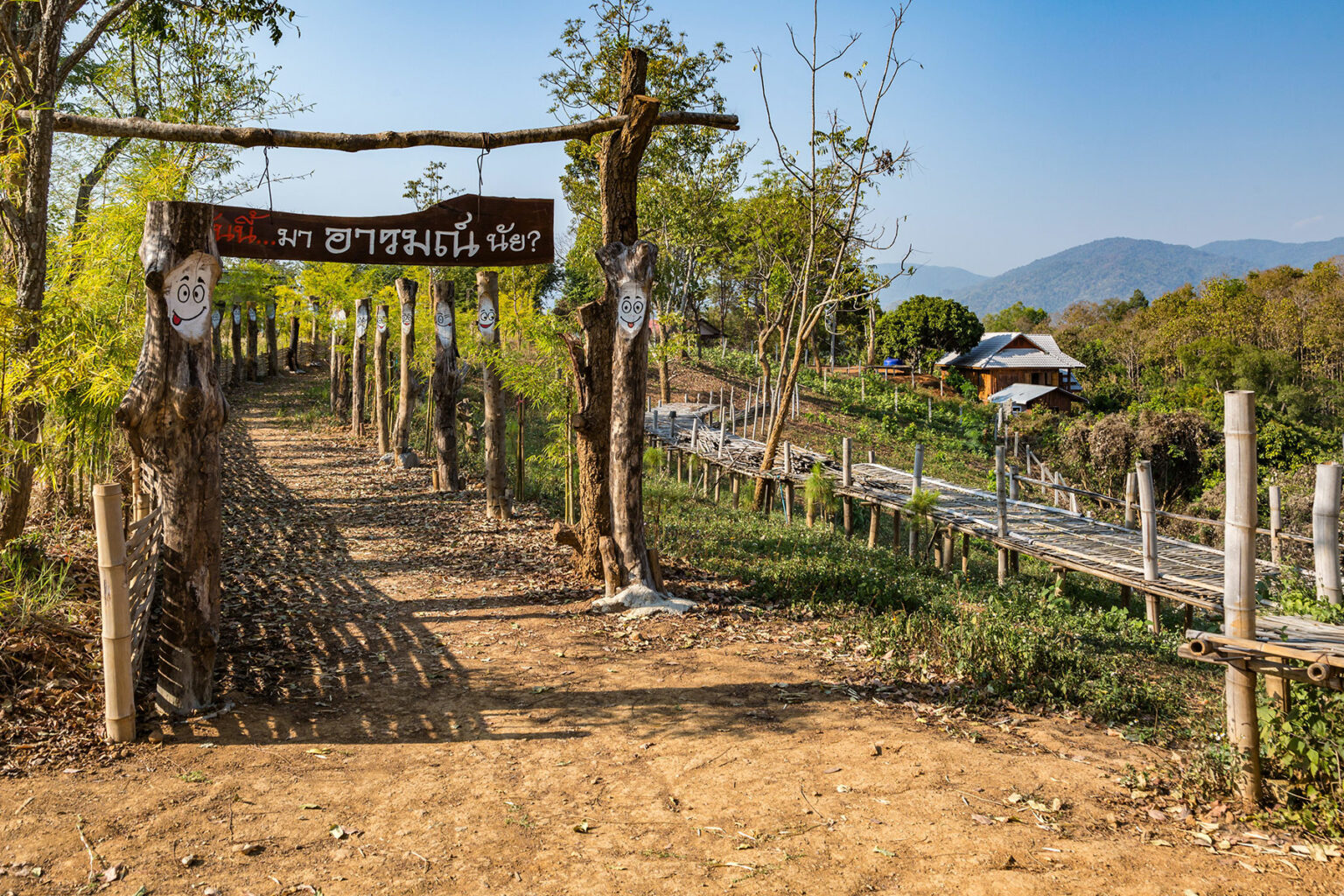
Thai is the official language in Thailand, and almost all of its 70 million citizens speak it as either a first or second language. While Thai is not widely used in other parts of the world, it’s still useful to learn if you plan to live in the country for any time. For expats in Thailand, learning Thai opens doors, starts conversations, solves mysteries, and brings smiles.
As it has roots in Sanskrit, Pali, and Khmer, it can be difficult for speakers of unrelated languages to learn it fluently. However, the simple grammar and relaxed, friendly native speakers mean it’s straightforward to use at a conversational level.
Read on to learn more about:
What languages are spoken in Thailand?
The main language of Thailand is Standard Thai, the country’s official language. According to UN data from 2010, around 90.7% of the population speaks Thai as one of their primary languages. Of the remainder, 1.3% speak Burmese, 1.2% speak Ti, 0.7% speak Karen, and 6.1% speak something else.
In certain areas of the country, people have dialects as their first language at home. However, almost everyone also speaks standard Thai, also referred to as ‘central language’ or phasa glang (ภาษากลาง).

As well as regional dialects, Thailand also recognizes about 51 living indigenous languages, mostly spoken by people living in the border regions. These languages include Burmese, Karen, and Malay.
Is Thai spoken anywhere else outside of Thailand?
Thai is not very widespread internationally, but some people speak it in border areas of neighboring countries, including Laos, Myanmar, and Malaysia. There are also pockets of Thai speakers in China, the US, the UK, and many other countries.
However, all these Thai speakers only account for about 0.5% of the total global number of Thai speakers, or approximately 350,000 people, worldwide. According to some estimates, this makes Thai the 28th most-spoken language in the world.
Most speakers of the language outside Thailand are Thai expats who have moved to other countries. Indeed, only universities with Southeast Asian Studies programs generally teach Thai.
Origins and history of the Thai language
Thai is part of the Tai Kadai family, which includes various languages spoken in China, Vietnam, Laos, Myanmar, and India. It has its roots in Sanskrit, Pali, and Khmer, with many words coming from these languages. However, in modern times, Thai has started borrowing words from languages such as English, Dutch, and Arabic.
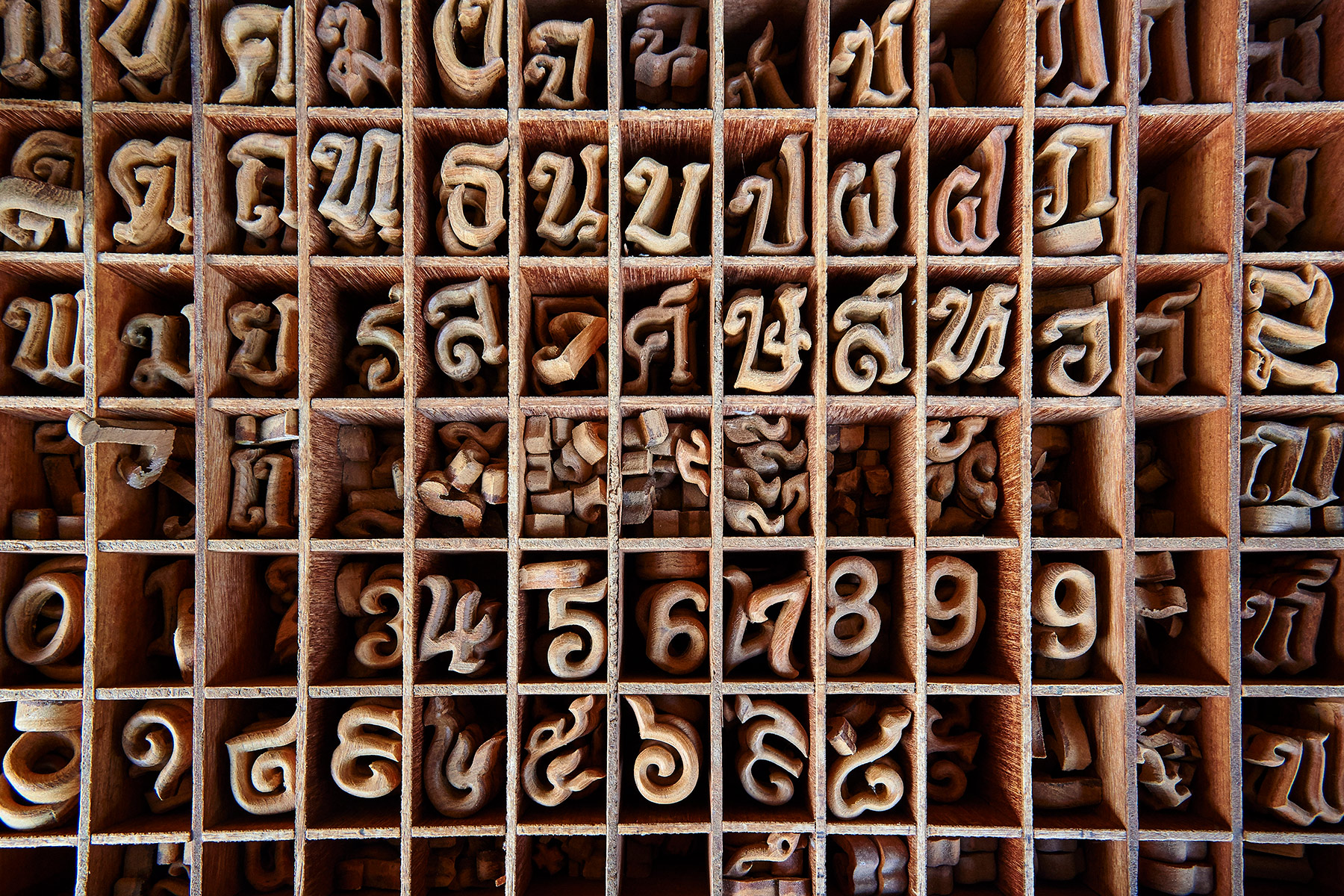
The Thai alphabet was formalized during the Sukhothai era in the 13th–15th centuries and is based on the Khmer script. All dialects around the country use the same alphabet – though no languages outside of Thailand use it, it bears some similarities to the Laotian alphabet.
The Thai alphabet has 44 consonants and 21 consonant sounds, but two of the consonant letters are no longer in use. Additionally, the alphabet has 28 vowel sounds and four tone markers
Thai dialects
In Thailand, there are four main dialects. In addition to Central or Standard Thai, these dialects are:
- Northeastern Thai or Isan language – those living in the Isan region speak this dialect, and it has quite a few similarities to the Laotian language.
- Northern Thai – this variety of Thai is spoken in Northern Thailand, in the former Lanna Kingdom. While most of the language bears a substantial similarity to Standard Thai, there are some significant differences.
- Southern Thai – this dialect is native to the south of Thailand, and it has some similarities to Malay.
Besides these dialects, there are over 50 indigenous languages across the country. People who speak these are usually members of smaller ethnic groups often referred to as ‘hill tribes’ (ชาวเขา). Many of these dialects are not related to Thai and are not usually taught in schools. However, Thailand has signed the UNESCO Convention for the Safeguarding of the Intangible Cultural Heritage, which references language.
Sign language in Thailand
The official sign language in Thailand is Thai Sign Language (TSL – ภาษามือไทย) or Modern Standard Thai Sign Language (MSTSL). TSL is closely related to American Sign Language (ASL), although some differences come from two older forms of sign language used in Thailand. ASL was introduced to Thailand in the 1950s, replacing Old Bangkok Sign Language and Chiangmai Sign Language.

Thai residential schools for deaf children teach TSL to their students. Since 1999, the government has officially recognized it as the “national language of deaf people in Thailand.” Approximately 11,000 people speak TSL.
Thai language pronunciation and phonology
Thai pronunciation is often one of the more challenging aspects of learning the language, as it is a tonal language. The script has 42 currently in-use consonants and 28 vowels and diphthongs. However, the language only has 21 consonant sounds, meaning some letters represent the same sound in English. It also uses five tones, which can be challenging for native speakers of non-tonal languages.
Thai tones
The five tones are:
- mid tone
- high tone
- low tone
- rising tone
- falling tone
Depending on the tone used, words can have multiple meanings. For example, kao can have five different meanings: The Thai tones mean that what sounds like kao to an expat could mean five or more different things: fishy, news, rice, white, him/her/they/them, or mountain.
- คาว with a mid-tone means ‘fishy’
- ข่าว with a low tone means ‘news’
- ข้าว with a falling tone means ‘rice’
- ขาว with a rising tone means ‘white’
- เขา with a rising tone means ‘he/she/they/them’
- เขา with a rising tone means ‘mountain/hill’
Thai vowels
Technically, Thai script is an abugida rather than an alphabet, meaning vowels are represented as additions to consonants instead of separate letters. They wrap around the consonant and appear above, below, or on either side. In the following table, the letter อ acts as a placeholder to show what these diacritics look like, but it is also a vowel in its own right.
| Sound | Letter | Sound | Letter | Sound | Letter |
|---|---|---|---|---|---|
| short a | อะ | long e | เอ | long ia | เอีย |
| long a | อา | short eh | แอะ | short uea | เอือะ |
| short i | อิ | long eh | แอ | long uea | เอือ |
| long i | อี | long o | โอ | short ua | อัวะ |
| short ue | อึ | short aw | เอาะ | long ua | อัว |
| long ue | อือ | long aw | ออ | am | อำ |
| short u | อุ | short uh | เออะ | ai | ไอ |
| long u | อู | long uh | เออ | ao | เอา |
| short e | เอะ | short ia | เอียะ |
Thai consonants
Unlike Thai vowels, Thai consonants consist of single characters. These are:
| Sound | Letter | Sound | Letter |
| g | ก | ch | ฌ |
| k | ข | y | ญ |
| k | ฃ | d | ฎ |
| k | ค | dt | ฏ |
| k | ฅ | t | ฐ |
| k | ฆ | t | ฑ |
| ng | ง | t | ฒ |
| j | จ | n | ณ |
| ch | ฉ | d | ด |
| ch | ช | dt | ต |
| s | ซ | t | ถ |
| Sound | Letter | Sound | Letter |
| t | ท | y | ย |
| t | ธ | r | ร |
| n | น | l | ล |
| b | บ | w | ว |
| bp | ป | s | ศ |
| p | ผ | s | ษ |
| f | ฝ | s | ส |
| p | พ | h | ห |
| f | ฟ | l | ฬ |
| p | ภ | or | อ |
| m | ม | h | ฮ |
One thing to note about Thai consonants is that they can change sound if they are the last consonant in the word. For example, when an ‘L’ or ‘R’ sound comes at the end of a word, it turns into an ‘N’ sound. Also, final consonant sounds are more suggested than pronounced clearly, making them difficult to discern. All the sounds shown above are the letters as initial consonants.
Thai grammar
Compared to Thai pronunciation, some aspects of Thai grammar are straightforward. Some key points include:
- Thai sentence structure follows a subject, verb, and object order – e.g., ‘You like cake’ or คุณชอบเค้ก (khun chop keik).
- There are no genders for nouns in the Thai language
- To ask a question, you add the specific question word: who, what, where, why, how, or when. Alternatively, for yes/no questions, you can simply add mai (ไหม – rising tone). So, ‘Do you like cake?’ is คุณชอบเค้กไหม (khun chob keik mai)
- Mai (ไม่ – falling tone) turns a positive sentence into a negative one. So ‘You don’t like cake’ is คุณไม่ชอบเค้ก (khun mai chob keik).
- To answer yes/no questions, repeat the verb for a positive (ชอบ, chob: like) and put mai (ไม่ – falling tone) in front of the verb for a negative response (ไม่ชอบ, mai chob: don’t like)

Tenses and time
Talking about tenses and time is also relatively simple in Thai:
- You don’t need to conjugate Thai verbs. The language uses additional words to show when something happened. So, to indicate the past, you could say, ‘Yesterday morning you ate cake’ or meu wan don chaw khun kin keik (เมื่อวานตอนเช้าคุณกินเค้ก).
- When you want to talk about the present, you can use words like ‘now’ (ตอนนี้, dton nii), ‘at the moment’ (เดี๋ยวนี้, deeyow nii) or ‘this time’ (เวลานี้, welaa nii).
- Thai also uses auxiliary verbs to indicate time.
- กำลัง (kamlang) + verb refers to something that is currently ongoing.
- เคย (kuey) + verb can be used when you’re talking about something you used to do or to ask if someone has ever done something. Lengthen the vowel sound to avoid inadvertently uttering an offensive swear word.
- จะ (ja) + verb translates to ‘will,’ so you can use it to discuss the future. This is also sometimes used to talk about things done habitually.
- If you want to say ‘since,’ you can use the word ตั้งแต่ – dtang dtae.
While this is only some of what you’ll learn about Thai grammar, these basics show that it’s fairly straightforward.
Interesting facts about the Thai language
Thai is a fascinating language, with several peculiarities that can make it tricky for non-Thai foreigners to learn:
- There are no spaces between words in written Thai, which can be very confusing at first. Vowels are good markers.
- While there are four tone markers, they do not always equate to a specific tone. They vary depending on the class of consonants, of which Thai has three.
- In written Thai, the vowels appear in different places. Some vowels come before the consonant, even though you pronounce them afterward. Certain vowel sounds are made up of multiple letters that can appear in front, after, above, and below the consonant.
- Although you’ll find Thai place names written in English around the country, there is no standard transliteration for the Roman alphabet, so you might see place names spelled in multiple different ways, e.g., บำรุงราษฎร์ can be written as Bumrungrat or Bamrungraj.
Learning the Thai language in Thailand
The best place to learn Thai is in Thailand. Luckily, there are many opportunities to do so once you are there.
If you are living in a popular location for expats, there are sure to be several Thai language schools (โรงเรียนสอนภาษา) in your city. However, it is always a good idea to ask for recommendations for the best local schools, as some schools focus more on providing education visas than high-quality language classes.
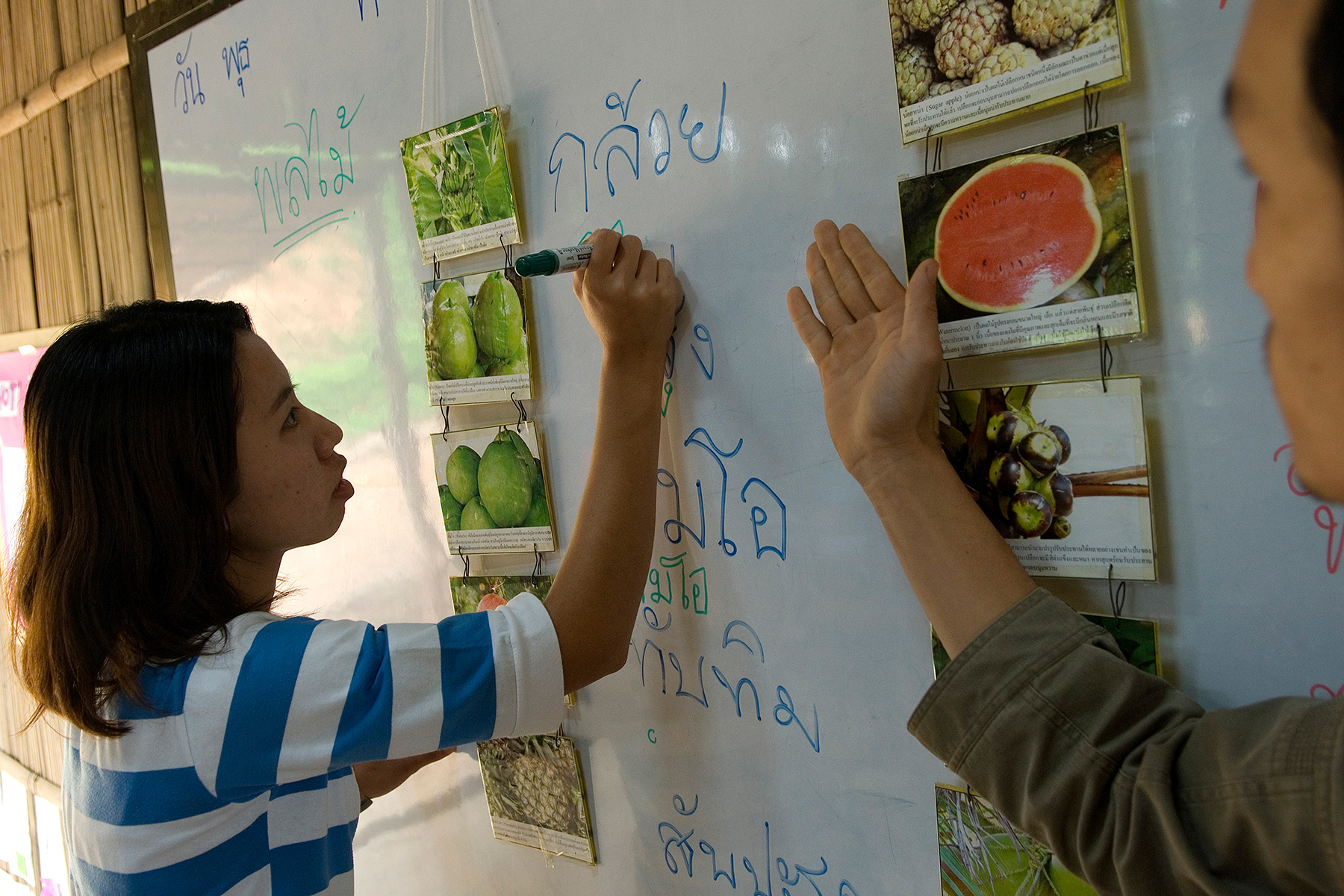
As well as language schools, there are some great apps and websites that can help you improve your Thai language skills. Some of the more popular ones include:
- Thailand Foundation has free online courses to study at your own pace.
- ThaiPod 101 has a huge library of video lessons, flashcards, and word lists to help you learn Thai.
- Ling is a smartphone app that focuses on teaching speaking and listening, although it also uses the Thai alphabet if you want to practice your reading, too.
While it’s not essential to learn Thai when living in Thailand, it has many practical, social, and cultural benefits. Unfortunately, this doesn’t stop many expats from relying purely on English, even after living there for many years.
The Thai people are very appreciative of foreigners who make the effort to learn their language. Speaking some functional Thai is very helpful for building relationships and traveling outside the most popular tourist areas. In smaller villages and rural areas, not many people speak English, and reading the menu helps if you want to order food in local restaurants.
Useful resources
- Thai-language.com – free online resources and a dictionary with clear examples and tones.
- Thailand.go.th – introduction to the Thai language
- ThaiPod 101 – articles that clearly describe language points and video lessons.


Did you find this guide helpful?