
'%20id='ico-down'%20stroke='%23000000'%20stroke-width='1.5'%3e%3cg%20transform='translate(1092.250000,%20254.750000)'%3e%3cpolyline%20id='Path-2-Copy-4'%20transform='translate(5.500000,%202.750000)%20scale(1,%20-1)%20rotate(-180.000000)%20translate(-5.500000,%20-2.750000)%20'%20points='0%200%205.5%205.5%2011%200'%3e%3c/polyline%3e%3c/g%3e%3c/g%3e%3c/g%3e%3c/svg%3e)


Education
Children's Education
International schools in Saudi Arabia
From British to IB education, discover warm and welcoming international schools in Saudi Arabia that help your child feel right at home.


Moving to Saudi Arabia with kids? You’ll find plenty of welcoming international schools that offer familiar teaching styles and a smooth transition. Whether you’re after British, American, or IB programs, there’s a great fit out there – complete with caring teachers, supportive communities, and fun extras to help your child thrive.
Continue reading for the following:
The education system in Saudi Arabia
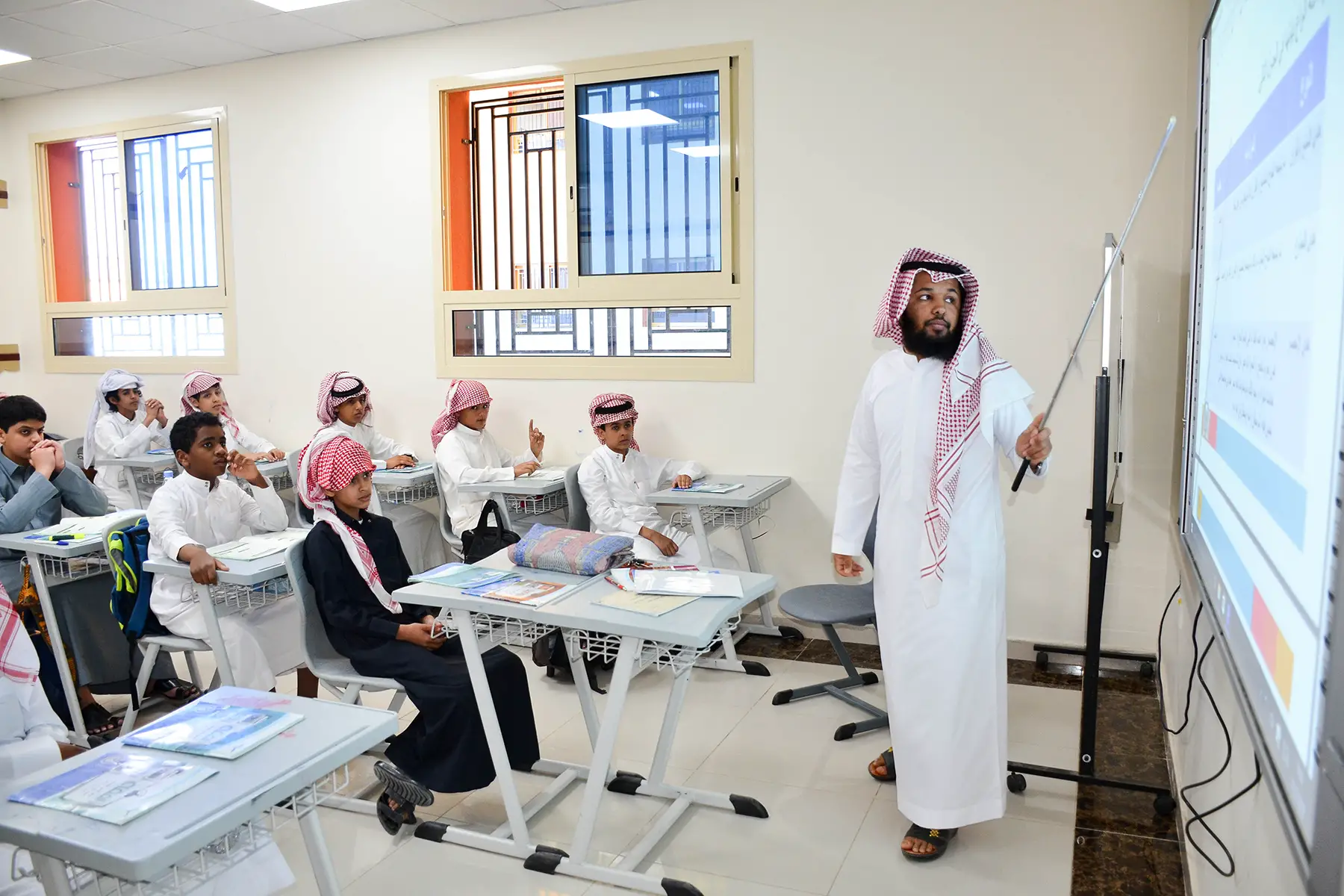
The Saudi educational system is structured to provide expat children with just a few avenues to pursue. Saudi public schools are taught exclusively in Arabic and are segregated by gender; these schools accept expat children, but only Muslim ones.
The second option is Saudi private schools, many of which follow the national curriculum and teach in Arabic; few of these would appeal to expats, though there are several nationality-based institutions – for example, Filipino schools – that appeal to certain expats.
Most expats will send their children to the final option, international schools, which will generally meet British, American, or other international academic standards. This article will focus on international schools in the Kingdom.
International schools in Saudi Arabia
International schools are very popular for Western expats because they keep students on the same academic track as their peers back home. This is very convenient with certain international accreditations, like International Baccalaureate or Advanced Placement courses, because when applying to universities, the diplomas are widely recognized.
In Jeddah and Riyadh alone, there are more than 30 international schools. International school structures vary depending on the type of school, however, most schools offer K-12 education, even as they might have different divisions between primary and secondary, or elementary, middle, or high school. Most expats find this academic continuity convenient.

International school curricula and certificates in Saudi Arabia
International Baccalaureate (IB)
The International Baccalaureate program is an academic structure that emphasizes writing, critical thinking, creativity, and extracurricular service. The IB diploma is widely accepted in university applications the world over and is recognized to be rigorous and well-rounded.

Students study language and literature, math, science, and the arts; at the end of secondary school, they take a challenging exam to qualify for their diploma. In Saudi Arabia, 19 schools offer the IB program.
International GCSE (IGCSE)
The International General Certificate of Secondary School follows the British curriculum model. Structured in three stages, once a student completes them, they receive an A-level qualification, which allows them to apply to university in their given field. Students study English language and literature, math, science, and a foreign language.
Usually, students will take the IGCSE in the first two years of secondary school, through the Cambridge International Examinations Board. Students will then take their A levels in their final two years of secondary school and use these scores to apply to British universities.
Many expat parents who want their students to study in British schools choose to enroll their students in IGCSE schools to facilitate a smoother university transition.
American High School Diploma and Advanced Placement
The American academic structure divides students into elementary, middle, and high school but is generally less structured than other models. In order to graduate, students must be in good academic standing and must pass their required exams. Subjects vary but generally include science, math, social studies, English, and a foreign language.
American schools are convenient because they usually offer students Advanced Placement courses and exams, which can count as college credit in the US, and SAT preparation classes; some even offer US university application counseling within the school!
Should you send your child to an international school?
Choosing between private and international schools
Unless your family is Muslim and your child speaks – or wants to learn – Arabic, you will likely not be sending them to a Saudi public school. Furthermore, the decision between a private and an international school depends on your family preferences.
A private school might make sense if there is one that caters specifically to your home country and you want your child to be exposed to that culture; for example, a Pakistani or Filipino school. However, if your child will likely attend university in an American, British, or other academic model offered, it might be a good idea to enroll them in an international school.
Benefits of international schools
International schools are helpful because of their certifications, because of the multicultural student body, and because they are simply used to meeting expat needs.
Despite these advantages, finding an international school to meet your needs and your budget – and one that is accepting students – is increasingly difficult. You would also be confining your child to an expat bubble. Therefore, there are several important considerations to discuss as a family.
How to choose an international school in Saudi Arabia
Because Saudi Arabia has a large local population, there aren’t as many international and private schools as you might find in its more expat-heavy neighbors. As a result, narrowing down your options is a little simpler.
What language does your child speak?
The first question should revolve around the language of instruction; what language(s) does your child speak or want to learn? Furthermore, how does this relate to where they are likely to attend university? Furthermore, you will want to consider which curriculum and teaching style would suit your child best.
Which curriculum do you want them to learn?
If they are planning to continue their studies in the UK or a Commonwealth country, you might want to strongly consider a British curriculum school. With these two questions, you will likely narrow your options to a small number of schools that you should visit.
Keep in mind that horror stories abound of English language instruction schools that do not deliver on promises of rigor. Furthermore, there are those teachers who aren’t proficient in English. Therefore, it is important to do your homework and bring up these concerns in school visits.
Types of international schools in Saudi Arabia
International Baccalaureate schools
IB schools in the Kingdom generally teach in English but may also offer Arabic or a different foreign language. They are very popular and, because of that, finding a school that is accepting students can be tricky. Because they do not follow the public school model, each school determines its own yearly calendar.
Required documentation for International Baccalaureate schools
Depending on the school, you will likely to submit the following:
- an application fee;
- identification documents;
- health forms;
- the school application
In addition, some of the more prestigious schools may require interviews. Fees can range wildly, from SAR 15,000 to SAR 70,000 per year. Here are some IB schools in the Kingdom:
American international schools
American-curriculum international schools generally teach in English and will try to match the American education system where possible. Because of the flexibility of the American model, schools often offer options like AP classes, alongside, for example, an IB curriculum. As a result of this versatility, they are quite popular.
Application materials vary, however you are usually required to present identification, prior transcripts, supporting documents, and an application fee. Fees can range from SAR 30,000 to SAR 90,000, depending on the institution. Here are a few American international schools:
- American International School, Riyadh
- American International School of Jeddah
- Dar Jana International School
British international schools
Expat parents in Saudi are drawn to British-curriculum schools for many reasons; a major one being the ease of applying to universities in English-speaking countries. This is because the language of instruction is usually English.
Required documentation for British international schools
What you will need to apply depends on the school. However, this generally includes:
- a completed application form;
- the application fee;
- identification for parents and students;
- transcripts
- any supporting documents
School fees range dramatically; in fact, this can cost anywhere between SAR 20,000 and SAR 90,000. Here are a few schools that follow this model:
Other national international schools
Expats from all over the globe work in Saudi Arabia; as such, there are plenty of national schools that cater specifically to people from particular countries. Language of instruction, curriculum, calendar, and cost structure vary and some schools give priority admission to nationals of their country while some accept all students. Therefore, be sure to do your homework if you’re interested. Here are a few options:
- Ecole Française Internationale Riyadh
- German International School, Jeddah
- International Indian School, Riyadh
- International Schools Database – database for international schools in Saudi Arabia
- Pakistan International School Riyadh
- Riyadh Multinational School (Australian Accreditation)



Did you find this guide helpful?