
'%20id='ico-down'%20stroke='%23000000'%20stroke-width='1.5'%3e%3cg%20transform='translate(1092.250000,%20254.750000)'%3e%3cpolyline%20id='Path-2-Copy-4'%20transform='translate(5.500000,%202.750000)%20scale(1,%20-1)%20rotate(-180.000000)%20translate(-5.500000,%20-2.750000)%20'%20points='0%200%205.5%205.5%2011%200'%3e%3c/polyline%3e%3c/g%3e%3c/g%3e%3c/g%3e%3c/svg%3e)


Healthcare
Healthcare Basics
Cigna Healthcare insurance: is it right for you?
Dive into our comprehensive Cigna Healthcare review to compare their Silver, Gold, and Platinum plans, understand what’s covered, and learn how to claim.


Cigna Healthcare is a subsidiary of the Cigna Group, a global health company that offers a range of health-related services in the US and internationally.
As well as offering dedicated health insurance policies for businesses and government in the US, Cigna Healthcare also caters to what it refers to as ‘globally mobile’ individuals. Indeed, it claims to be the ‘leader’ in serving the needs of those living, working, retiring or studying abroad.
What does Cigna Healthcare offer?
Cigna Healthcare offers worldwide health insurance plans that include health care coverage, wellbeing services, and international travel support in more than 200 countries and jurisdictions worldwide.
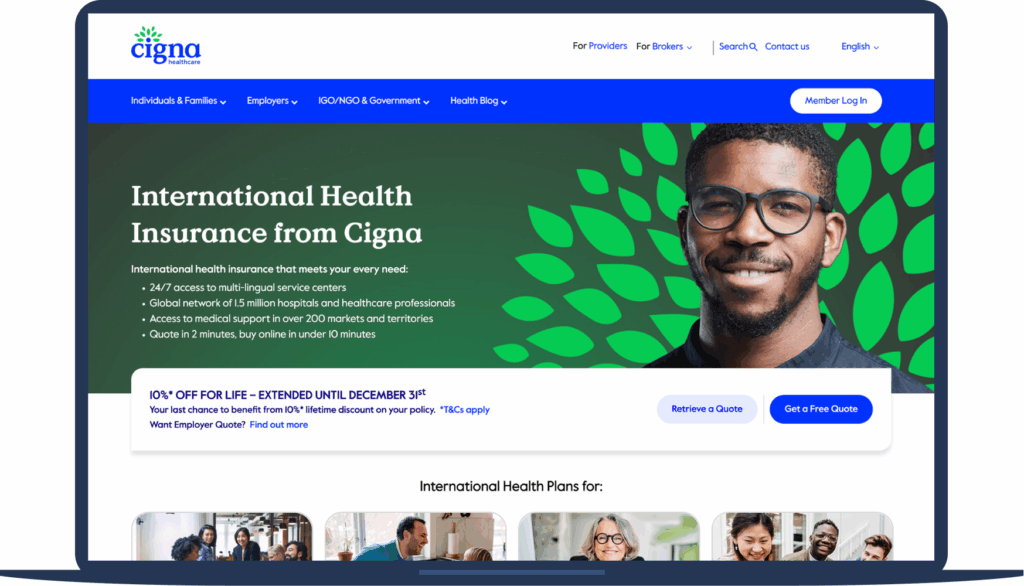
It offers policies for both individuals – including professionals, retirees and students – and families.
What do Cigna’s plans include?
Cigna plans include a range of features that are likely to appeal to jet-setters, including:
- Access to a global network of 1.5 million hospitals and healthcare specialists, across more than 200 markets and jurisdictions
- 24/7 access to multi-lingual service centres
- Priority access to support from Cigna doctors and nurses
- A range of tools, products and solutions to provide holistic healthcare support, including a telemedicine service – Global Telehealth
- A digital portal to securely store important documents.
Insurance plans: a detailed look
Cigna offers three tiers of insurance policy: Silver, Gold and Platinum. All three levels include cover for inpatient and day patient treatment, including a private room. But there are variations in the level of cover provided.
As you would expect, Platinum offers the highest levels of cover – and costs the most.
Our table provides a summary of the annual levels of cover provided under each tier for key features.
| Feature | Silver | Gold | Platinum |
|---|---|---|---|
| Inpatient and day patient treatment | ✔ Up to £1m | ✔ Up to £2m | ✔ No limit |
| Private room | ✔ | ✔ | ✔ |
| Full cancer care | ✔ Up to £1m | ✔ Up to £2m | ✔ No limit |
| Medical imaging and scans | ✔ Up to £10,000 | ✔ Up to £15,000 | ✔ No limit |
| Rehabilitation (inc physiotherapy) | ✔ Up to £5,000 | ✔ Up to £15,000 | ✔ No limit |
| A&E room treatment | ✔ Up to £500 | ✔ Up to £1,000 | ✔ Up to £2,000 |
| Routine maternity | × | ✔ Up to £7,000 | ✔ Up to £14,000 |
| Obesity surgery | × | ✔ Up to £20,000 | ✔ Up to £25,000 |
| Infertility treatment | × | × | ✔Up to £10,000 |
For each level of plan, you’ll need to choose between two geographic areas of cover:
- Worldwide excluding USA
- Worldwide including USA

What extras does Cigna offer?
On top of each of the healthcare plans in the table, you can also opt to bolt on one or more of these extras:
- International outpatient – including consultations with general practitioners and specialists; prescribed drugs and dressings; outpatient rehabilitation; diagnostic tests and vaccinations.
- International health and wellbeing – including access to counsellors and wellness coaches; routine annual physical examinations; preventative cancer screenings.
- International evacuation and crisis assistance – provides medical evacuation in the event of an emergency, and crisis response services.
- International vision and dental – including preventative, routine and major dental treatments; routine eye examination; costs for glasses and lenses.
Are there exclusions?
Cigna policies do not cover outpatient consultations; drugs or dressings that may be prescribed on an outpatient basis or outpatient rehabilitation treatments such as physiotherapy as standard. However, you can add these on as optional extras.

For some areas of cover, a waiting period of 12-24 months applies between when you first take out the policy and when you can claim under that section of the policy.

How do I make a claim?
To make a claim for medical treatment, you will need to:
- Download and print the appropriate claim form (depending on the type of claim)
- Follow the instructions included on the form to complete it
- Mail your completed claim to the address shown on the form
When Cigna receives a claim, it will check it against your policy to make sure that it’s covered.
Be mindful that for some claims, you will need to have the treatment pre-authorised by Cigna before you receive care. So, except for emergencies, it’s a good idea to let them know about a potential claim before you arrange treatment.
When a claim is approved, Cigna will usually pay the healthcare provider directly. If the terms of your policy require you to pay the healthcare provider yourself, then Cigna will pay you.
You may need to make a contribution towards the cost of medical treatment, depending on any deductible or cost share that you agreed to when you took out the policy.
You may need to make a contribution towards the cost of medical treatment, depending on any deductible or cost share that you agreed to when you took out the policy.
How can I contact Cigna Healthcare?
Cigna offers multiple ways for existing customers to get in touch. Worldwide clients can use:
- Phone: +44 (0)1475 788182
- Fax: +44 (0)1475 492113
- Email: [email protected]

There are different contact details if you’re within certain countries, including the US, Hong Kong, Singapore and Dubai.
You can also message Cigna Healthcare through your customer account dashboard.
Ask the expert – how can I reduce the cost of my premiums?
Cigna Healthcare offers fairly comprehensive cover, but the consequence of this is that the quote you receive may be more than you’re willing to pay.
There are a few ways to keep the cost of policies down, including:
- Opting for a lower tier of cover. If you’re willing to accept exclusions or lower cover limits on areas of cover, you’ll pay less.
- Avoiding optional extras. Consider whether you need the bolt-ons on offer, and only add them if you’re sure you need them.
- Choosing a higher deductible or cost share. The more you’re prepared to pay towards the cost of treatment, the lower your premiums will be.
As always, it’ll be a case of balancing quality of cover against up-front costs. Bear in mind that scrimping too much on cover, or setting deductibles too high, could come back to bite you when it’s time to claim.
FAQ
Readers' questions
Does Cigna cover emergency evacuation? 
As standard, emergency evacuation isn’t part of Cigna Healthcare’s policies. International evacuation and crisis assistance is available as a paid optional extra. It includes:
- Emergency transport to a medical centre
- Repatriation home after a serious medical incident
- Costs for compassionate visits
- Global crisis response services following a travel or security risk.
Does Cigna offer telemedicine services?
Yes, via its ‘Global Telehealth’ service. This provides online access to licensed doctors around the world for non-emergency health issues. A callback from a medical professional usually takes place within 24 hours of your request.
Will I need to pay anything towards my health insurance claims?
Potentially, yes. You can opt to reduce your premium by having a ‘deductible’ and/or a cost-share.
A deductible is an amount you must pay towards the cost of treatment during an insurance period. You can set them between US$0 and US$10,000. You pay for your treatment until you reach the deductible limit, after which the insurer will pay.
A cost-share is a percentage you must pay of the cost of treatment, up to an upper limit. Cigna Healthcare offers cost-share amounts between 0% and 30%.
What currencies can I use to pay for my policy?
Cigna lets you pay in three currencies – Euros, GB pounds, or US dollars.
Useful resources



Did you find this guide helpful?