
'%20id='ico-down'%20stroke='%23000000'%20stroke-width='1.5'%3e%3cg%20transform='translate(1092.250000,%20254.750000)'%3e%3cpolyline%20id='Path-2-Copy-4'%20transform='translate(5.500000,%202.750000)%20scale(1,%20-1)%20rotate(-180.000000)%20translate(-5.500000,%20-2.750000)%20'%20points='0%200%205.5%205.5%2011%200'%3e%3c/polyline%3e%3c/g%3e%3c/g%3e%3c/g%3e%3c/svg%3e)


Finance
Money Management
Best virtual credit cards in Thailand for foreigners 2026
Finding a virtual credit card in Thailand is usually not the hard part. The hard part is finding a payment tool you can actually get and use as a foreigner before your Thai banking setup is ready.


In Thailand, digital payments often sit on top of local bank apps, which mean you need an account, a Thai phone number, and in some cases credit checks. That may mean a Thai virtual credit card isn’t the best option for some new expats.
This guide separates true Thai-issued options from e-wallets and interim alternatives. We’ll look at the main bank options, where QR wallets fit, and what to use first if you have just arrived.
This article is for general information only, not legal, tax, or financial advice.
International money transfers with Wise
For convenient cross border transactions with transparent fees, check out Wise.
Expats can use Wise to hold and exchange Thai Baht (THB) and 40+ other currencies with transparent fees at the mid-market exchange rate. The Wise card allows you to spend in 150+ countries, while the account lets you send money to 160+ countries and receive payments in multiple currencies including THB and USD.

Key takeaways
- Bangkok Bank’s Be1st Digital Card is one of the clearest local options if you already bank in Thailand.
- AEON’s Virtual Instant Credit Card is closer to a true virtual credit card, but approval is still needed.
- New arrivals without Thai income, a local phone number, or settled paperwork may struggle with Thai-issued products.
- Once your local setup is ready, PromptPay and e-wallets can be more useful day to day than a virtual card.
- A travel card, prepaid card, or a Wise Card from a supported country can bridge the gap, but none of these are Thai credit products.
What is a virtual credit card and how does it work?
A virtual credit card exists in digital form. You get a card number, expiry date, and security code for online checkout, app payments, and sometimes wallet use, without waiting for a physical card.
The way the card works in practice depends on whether the issuer uses a credit line, a current account balance, or preloaded funds, which is why the difference between a virtual credit card, a virtual debit card, and a virtual prepaid card matters.
Here’s how a virtual card in Thailand usually works:
- You open the issuer’s app or website and view the digital card details.
- You enter the card number, expiry date, and CVV at checkout, or add the card to a wallet.
- The issuer checks funds or credit and may ask for app approval, an OTP, or another security step.
- The payment is completed, and you can usually freeze, replace, or limit the card from the app.
Thailand’s payment barrier for newcomers
Thailand’s payment barrier is not just about cards. Many of the most useful digital payment tools sit inside the local banking system, so you often need the right account, app access, and identity checks before day to day QR payments become easy.
If you’re still learning the Thai banking system for foreigners, that slower setup curve makes more sense. Major local banks such as Bangkok Bank, Kasikorn Bank, Siam Commercial Bank, and Krungsri may look digital first on the surface, but access for a new foreign resident still depends on paperwork and branch practice. If you are still trying to open a bank account in Thailand, that delay can affect everything from app top-ups to card activation.
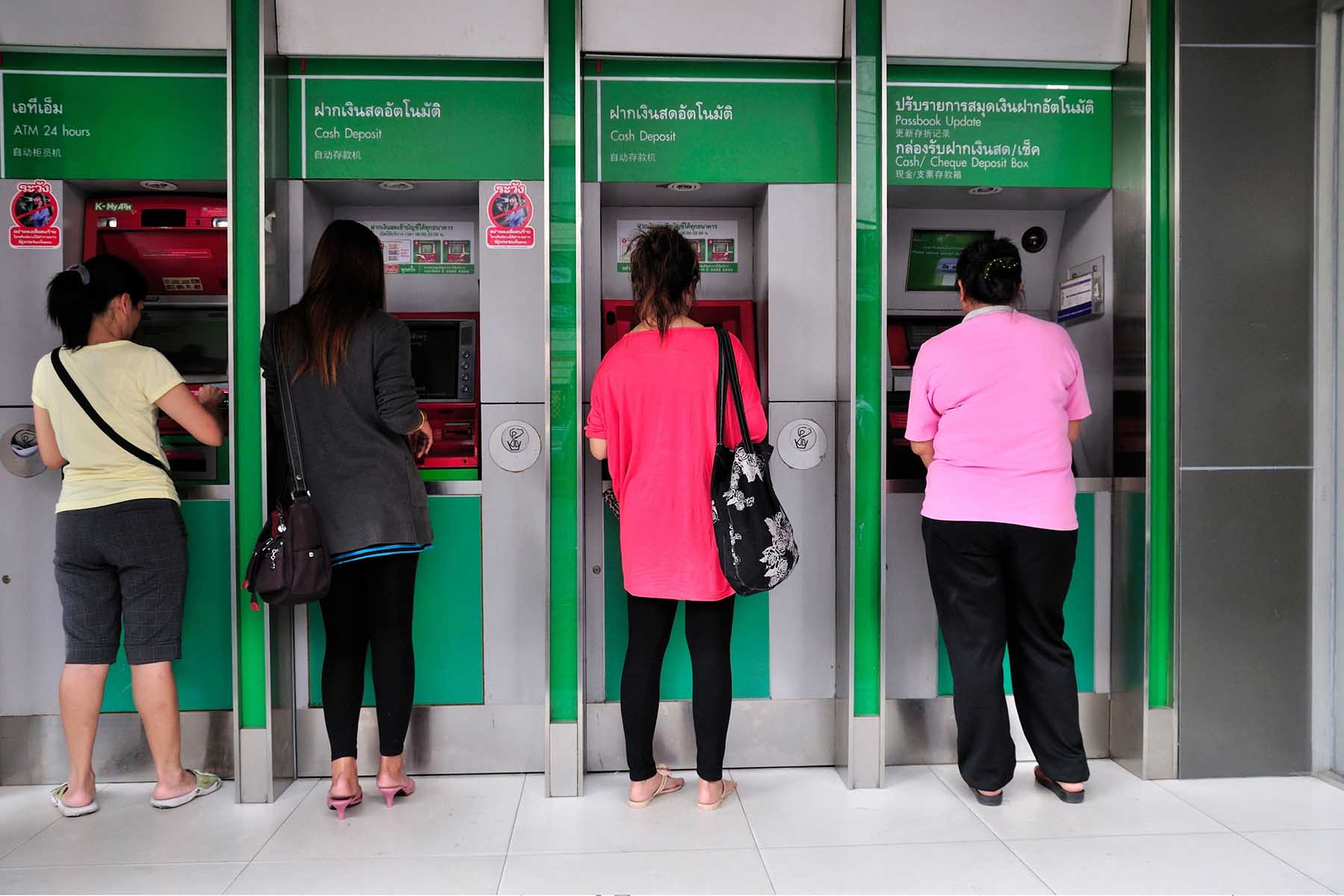
- No Thai bank account yet: many card and QR services assume an existing local banking relationship.
- No local income trail: credit products may ask for salary evidence or affordability checks.
- No Thai phone number or address proof: app access and OTP flows often work best with local registration.
- Branch level document checks: passport, visa, work permit, student proof, or other documents may be interpreted differently by branch.
That matters because popular tools such as PromptPay usually sit on top of domestic banking, not outside it. One practical reality is that a foreigner may be refused at one branch, then accepted at another that handles more expat applications.
What banks offer virtual cards in Thailand?
In 2026, the clearest Thailand-issued options were one digital debit product from Bangkok Bank and one instant-use credit feature from AEON.
| Product | Likely access route | Main limitation for foreigners |
|---|---|---|
| Bangkok Bank Be1st Digital Card | Virtual debit card in Bangkok Bank Mobile Banking | Usually needs a Bangkok Bank relationship |
| AEON Virtual Instant Credit Card | Virtual credit feature in the AEON Thai Mobile App after approval | Still depends on AEON credit approval |
Bangkok Bank’s Be1st Digital Card
Bangkok Bank’s Be1st Digital Card is one of the clearest official Thai virtual card products. It is a digital debit card, not a classic credit card, and Bangkok Bank says it can be applied for and activated through Bangkok Bank Mobile Banking for immediate use.
Bangkok Bank also says the virtual format can be used for online spending and linked to some e-wallet use cases. The local bank relationship is the real gatekeeper, so check current fees, account requirements, and app eligibility on Bangkok Bank’s official page before relying on it. If you already bank locally, ask whether digital card issuing is enabled on your app setup.
AEON’s Virtual Instant Credit Card
AEON’s Virtual Instant Credit Card is closer to what most readers mean by a virtual credit card. AEON says you apply at any AEON branch through its Express Application channel, wait for approval by SMS, then activate the virtual card in the AEON Thai Mobile App with a 6 digit PIN.
The key point is that instant use starts after approval, not before it. AEON also says the virtual card is valid for 30 days after approval and deactivates once the physical card is activated, so always check the latest supported card list and conditions.
Which users may struggle to qualify?
A product can exist on a Thai product page and still be out of reach for a new arrival. The biggest obstacles are usually local income evidence, residence status, and the fact that newcomers may still be building their Thai banking footprint.
You may struggle to get a virtual card in Thailand if you fall into one of these categories:
- Newly arrived workers without a local salary trail
- Tourists or short stay visitors who are not applying as residents
- Freelancers paid from abroad who may find local income checks harder to document
- Retirees or students whose visa or residence proof does not match current rules
If you already have a Thai account, local phone number, and stable local documents, it is worth asking about Thai-issued options. If you are still missing those basics, it usually makes more sense to switch early to an alternative.
What to use before you have a Thai bank account
For most newcomers, the practical answer starts here. If you cannot yet get a Thai-issued card, the aim is not to mimic local credit, it is to find a safe digital payment tool that lets you book, subscribe, and spend while your banking setup catches up.
Virtual prepaid credit cards and travel card alternatives
In practice, “virtual credit card” often just means any digital card you can use now. Virtual prepaid cards, travel cards, and app-based debit cards can solve the urgent payment problem even though they do not give you a Thai credit line.
If you arrive for work and, in your first week, need to pay a temporary accommodation deposit, a ride-hailing app, and a few online subscriptions, using an alternative payment method from abroad can be simpler than waiting for local approval. Setup is often faster, funding usually comes from an existing bank card or overseas account, and online use is usually straightforward, especially if you are still arranging international money transfers in Thailand. The trade-off is that these tools do not build Thai credit history or replace local credit approval.

Why the Wise Card is a practical bridge for newcomers
For newcomers who already live in a country where it is available, the Wise Card can be a practical bridge while you’re still setting up your core Thailand banking. It is not a Thai-issued virtual credit card, it is a debit card so it does not build Thai credit history or replace approval for Thai cards.
If you’ve got a Wise account from another country and need payment support when you travel to Thailand, it can help in a few specific ways while you are still setting up life:
- Online spending for bookings and subscriptions
- App payments before local banking is ready
- Multi-currency spending while moving money between countries
- In person card use where international cards are accepted
Check current Wise Card availability for your country of residence before sign-up. Keep in mind that for QR only merchants, you may still need another payment method.
Are e-wallets a better fit for daily payments?
In many cases, yes. Once your local setup is ready, e-wallets and QR payments can matter more day to day than owning a virtual card, because many shops, transport services, and small merchants are built around local QR flows rather than card numbers.
PromptPay, TrueMoney and LINE Pay for foreigners
PromptPay is not a branded wallet. It is Thailand’s national payment infrastructure, and the Bank of Thailand says users register it by linking an existing bank account to an ID or phone number through banking channels. That’s why mobile banking and banking apps in Thailand matter so much to everyday payments.
TrueMoney offers a clearer foreigner-facing route, with an official page that says foreigners can register using a Thai mobile number, passport scan, and face scan. LINE Pay is widespread in Thailand, but its consumer portal is less explicit about foreigner eligibility, so check current ID rules, phone number requirements, and top-up methods before applying.
| Option | What it is | Best for | Do I usually need a Thai bank account or Thai phone number? | Main foreigner limitation |
|---|---|---|---|---|
| PromptPay | National QR payment system | Residents with local banking, plus some tourists from linked overseas apps | Usually yes, but you can use Wise to scan and pay directly | Not a standalone foreigner wallet |
| TrueMoney | Branded e-wallet | Foreigners who want local app payments | Usually a Thai mobile number | Extra checks and top-up rules may still apply |
| LINE Pay | Wallet inside LINE | Existing LINE users | Often tied to local verification | Foreigner guidance is less clear |
For daily local payments, the most useful setup is often the one that lets you scan Thai QR codes reliably, even if it is not technically a virtual credit card. Cross-border QR links can help some tourists from participating overseas banking apps, but they are not a universal replacement for resident setup.
Business virtual credit cards in Thailand
Business virtual credit cards are usually about team spending, software subscriptions, ad spend, and tighter expense control, not about helping an individual expat pay for groceries or transport.
If you run a registered company in Thailand, the key question is whether your bank or spending platform offers business card controls after company KYC and account setup. For most readers, this matters only if you are hiring staff, paying suppliers, or separating company and personal spending.
FAQ
Frequently asked questions about virtual credit cards in Thailand
Can I get a virtual credit card instantly? 
Sometimes. Some products offer instant use after approval, but approval still comes first, and foreigners in Thailand may face identity or document checks as part of verification.
Do any credit cards offer virtual cards?
Some do. In Thailand, though, that can mean different things, from an app-issued digital debit card to a temporary virtual credit feature before the plastic card arrives.
Is there a Thai e-wallet available for foreigners?
Some foreigner-facing routes exist, yet many still ask for a Thai phone number, extra verification, or a local bank link. Check out TAGTHAi Easy Pay as a foreigner friendly option instead.
What is the most popular digital wallet in Thailand?
PromptPay is the dominant QR payment rail. TrueMoney is one of the biggest names and markets itself as Thailand’s most used e-wallet.
Does PayPal accept virtual credit cards?
Maybe, but acceptance depends on the issuer, the card network, and PayPal’s current rules. For Thailand, check PayPal’s latest official guidance before relying on it.
Which credit cards offer virtual card numbers?
It varies by issuer and market. In Thailand, look for app-based digital issuance or instant virtual access rather than assuming every major local bank offers the same feature.
Useful resources
- Bank of Thailand PromptPay for the official PromptPay overview.
- Bank of Thailand cross-border payment page for regional QR payment links.
- Bangkok Bank Be1st Digital Card for product details and fees.
- AEON Virtual Instant Credit Card for current conditions.
- TAGTHAi Easy Pay for a tourist QR payment route.
- TrueMoney for foreigners for foreigner registration steps.
- LINE Pay Thailand for current wallet features.
- PayPal Thailand for market specific account rules.
- Wise Card availability and product information for current country availability.


Did you find this guide helpful?