topics
tools
Expatica countries
Index Last Var.(%)
BEL 20 2117.66 -0.08
DAX 6323.19 -0.26
IBEX 30 6401.2 -2.17
CAC 40 3042.97 -0.16
FTSE 100 5356.34 0.09
AEX 292.76 0.00
DJIA 12454.83 -0.60
Nasdaq 2837.53 -0.07
FTSE MIB 13057.26 -0.74
TSX Composite 11566.15 -0.09
ASX 4120.2 0.96
Hang seng 18800.99 0.47
Straits Times 2787.22 0.52
ISEQ 20 501.76 0.16
You are here: Home News Dutch News Bilingual taboos easing in Belgium
Enlarge font Decrease font Text size


26/09/2007Bilingual taboos easing in Belgium

26 September 2007

SAINTES (AFP) - In "juf" Sonia's class in Wallonia, the French-speaking part of Belgium, French is banned today.

Cyril, Chloe, Jason and her other pupils are taking their lessons in Dutch, a language slowly gaining currency among Belgium's Francophones, who in the past snubbed its use as the tongue of Flemish peasants.

A year ago, the Arc-en-Ciel (Rainbow) school in the village of Saintes, some 20 kilometres from the capital Brussels, turned to "language immersion" in an effort to encourage real bilingualism.

It's a method that surfaced a decade ago in the French-language part of Belgium, Wallonia, and the bilingual region of Brussels and is now in use in around 113 primary schools and 61 high schools.

And with the country's current political crisis, bilingual education is again under scrutiny as one way that might help overcome some of the divisions sparked by the predominance of single-language regions.

Belgium, with 10.5 million residents, is divided into four linguistic zones.
French, Dutch and German speakers have monolingual regions, while Brussels -- home to some one million people, most of them Francophone -- is officially bilingual: French and Dutch.

More than three months after general elections, Belgium is still without a government in a crisis that is fuelling concern that the country could break apart along the linguistic fault lines.

Political parties in Flanders are seeking more autonomy while the Walloons see this aim as a threat to the federal state.

The coalition talks have thus been blocked over how much federal power, on subjects like employment, should be devolved to the regions -- the relatively rich Dutch-speaking Flanders, with 60 percent of the population, is seeking more than French-speaking Wallonia, which has 3.5 million people.

Arc-en-Ciel principal Michele Cabaret said "50 percent Dutch" is in use in the school. In other establishments, the use of a second language -- sometimes English -- can climb to 75 percent of class time.

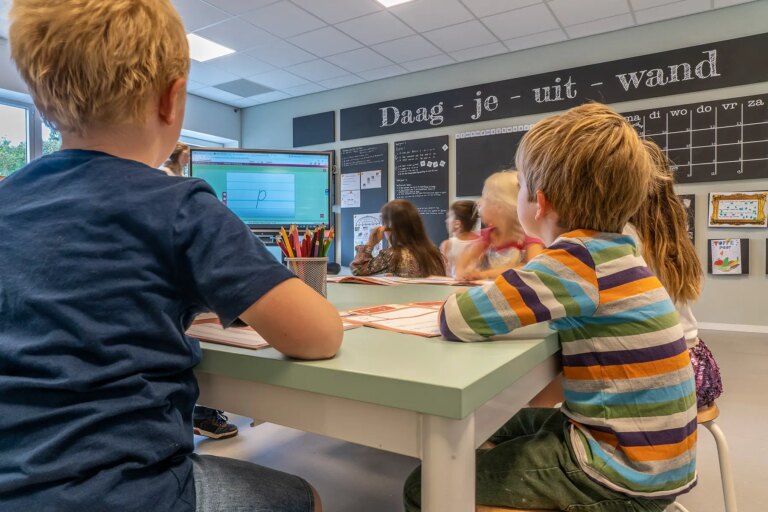
Every second day, 26 children from this village in the first year of primary school are given classes in Dutch by the "juf," a young teacher trained in Flanders, the Dutch-speaking region to the north.

On this September morning, three weeks after the new school year started, she is teaching them the basics, with the help of the same small text books used by Flemish children.

To keep their attention, something difficult to achieve with youngsters even in their native tongues, she is expressive and uses elaborate hand gestures.
But using French is out of the question.

"At the beginning, there were fears that the children's French would suffer but all the tests have shown the contrary," said Cabaret. "Playing with languages helps develop the mind, even if it is more tiring for the children, not to mention the teachers."

She said the number of people trying to enrol their children in the school had risen sharply this year.

"There was strong demand for immersion from parents who, in many cases, couldn't find work because they couldn't speak Dutch," said Cabaret, who admits that she too has not mastered the language, like many French-speakers.
Indeed Belgium's linguistic trends appear to be changing.

French -- once practised by the bourgeoisie whether they were Flemish or Walloons -- is being studied by fewer students in Flanders, who now turn to English as a second language, while Dutch is slowly taking root in Wallonia.

"The priority is total immersion in Dutch at school because in Flanders there are still many dialects and you have to know real Dutch to succeed with your studies," said Flemish regional education minister Frank Vandenbroucke.
"It's got nothing to do" with Belgium's political problems, he insisted.

[Copyright AFP 2007]

Subject: Belgian news


0 reactions to this article

0 reactions to this article

Discussion Forums

Relocating to the Netherlands

Taxation on Rental Apartments!

Housing in the Netherlands

Taxation on Rental Appartments?

Discuss Dutch Culture

High-quality fake passports, driver's licenses, ID

English in the Netherlands

Moved to Hengelo

Travel & Transport in the Netherlands

Buy fake passports, driver's licenses, identity cards

participate in the forums

Inside Expatica
Setting up home in the Netherlands

Setting up home in the Netherlands

A guide to telephone, internet and television along with utility services water, electricity and gas in the Netherlands.

Dutch immigration and residency regulations

Dutch immigration and residency regulations

Lost in the Dutch immigration system? Look no further than this guide compiled for our Survival Guide 2012.

A brief introduction to the Netherlands

A brief introduction to the Netherlands

Expatica offers a whistle-stop tour of life in the modern Netherlands.

Giving birth in the Netherlands

Giving birth in the Netherlands

The challenges and benefits of the maternity system in the Netherlands and how it differs to other countries.